

Sunday 06 April 2025
The world of mathematics is often shrouded in mystery, filled with complex equations and abstract concepts that can be daunting even for those with a solid understanding of the subject. But what happens when we apply mathematical techniques to real-world problems? The results can be fascinating, revealing hidden patterns and behaviors that underlie our everyday lives.
One such area of research is the study of harmonic maps, which describe how shapes and surfaces change over time. Harmonic maps are used to model everything from the flow of heat through a material to the behavior of magnetic fields. But what happens when we try to simulate these processes using numerical methods? Can we accurately capture the complex behaviors that arise?
A recent article published in the journal Mathematische Nachrichten sheds light on this very question. The authors, a team of mathematicians and computer scientists from Germany and Austria, have developed a new method for discretizing harmonic maps into finite elements. Discretization is a crucial step in numerical analysis, as it allows us to approximate complex functions using simpler, more manageable pieces.
The key innovation here lies in the way the authors handle the boundary conditions of their system. In traditional discretization methods, these boundaries are often treated separately from the rest of the calculation, which can lead to inaccuracies and instabilities. The new approach, however, incorporates the boundary conditions seamlessly into the overall simulation, resulting in a more robust and accurate representation of the harmonic map.
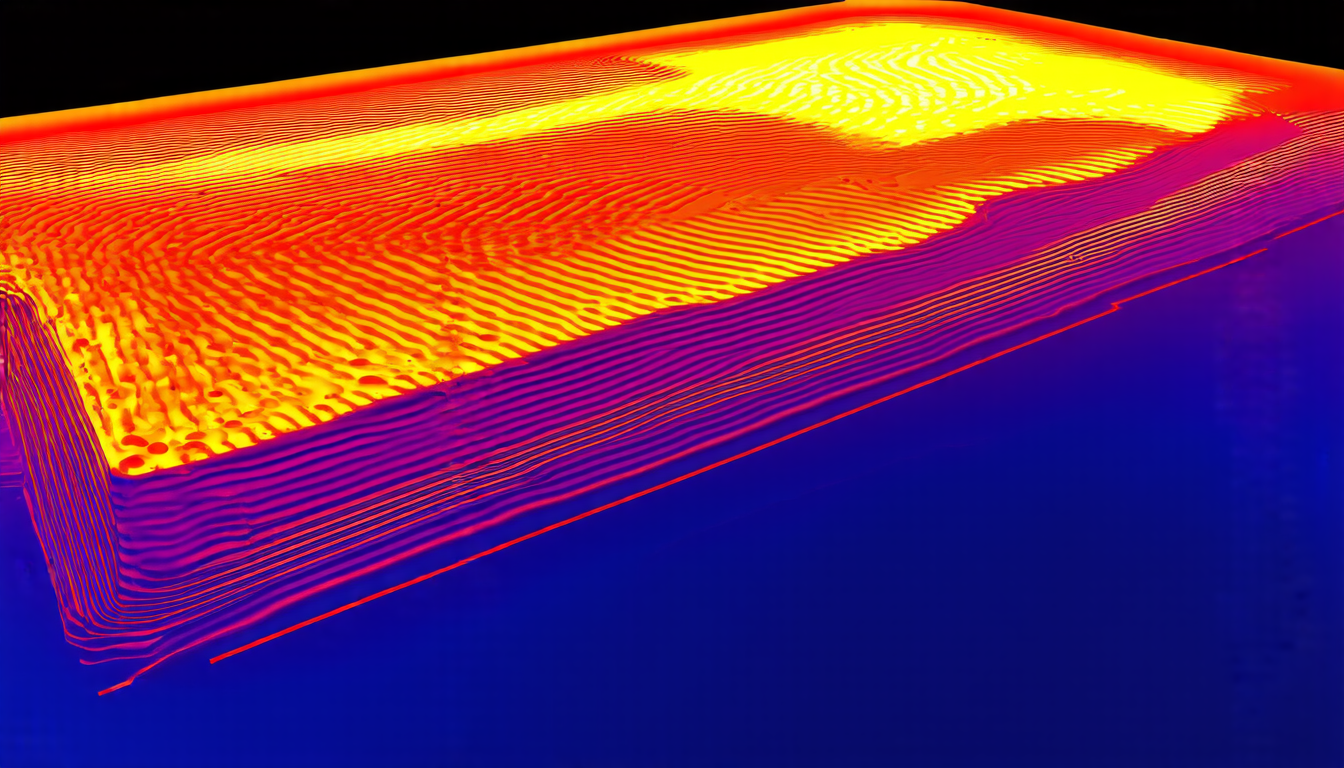
The authors test their method on several different scenarios, including the heat flow of harmonic maps on a disk and the Landau-Lifshitz-Gilbert equation, which describes the behavior of magnetic materials. In each case, they demonstrate that their approach yields accurate results with high precision, even in regions where traditional methods would struggle.
But what does this mean for our understanding of the world around us? The ability to accurately simulate harmonic maps has significant implications for a wide range of fields, from materials science and engineering to computer graphics and image processing. By better capturing the complex behaviors that arise in these systems, we can gain new insights into how they work and how we might manipulate them.
The authors’ work is a prime example of the power of interdisciplinary collaboration between mathematicians and computer scientists. By combining their expertise, they have developed a novel approach to discretization that has far-reaching implications for our understanding of harmonic maps and beyond.
Cite this article: “Unlocking the Secrets of Skyrmion Dynamics: A Novel Numerical Approach”, The Science Archive, 2025.
Mathematics, Harmonic Maps, Numerical Methods, Discretization, Finite Elements, Boundary Conditions, Heat Flow, Magnetic Materials, Materials Science, Computer Graphics





