

Sunday 06 April 2025
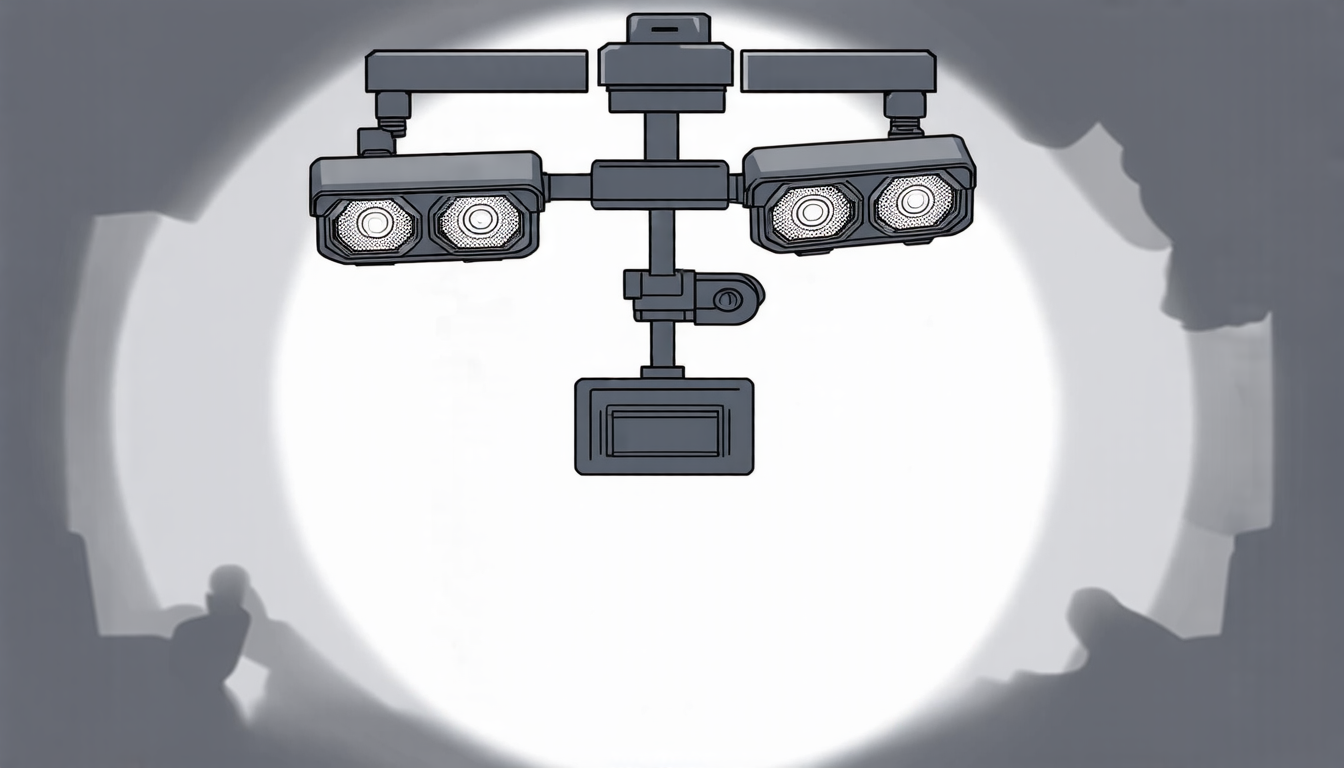
A team of researchers has made a significant breakthrough in creating high-quality, virtual single-viewpoint surgical videos captured by multiple cameras attached to a surgical light. The innovative technique involves automatic geometric calibration to eliminate occlusion and misalignment, making it easier for surgeons to monitor operations.
The challenge lies in the fact that traditional camera systems can be obstructed by the surgeon’s head and body, resulting in poor video quality and reduced visibility of the surgical field. To address this issue, the researchers installed multiple cameras on a surgical light, allowing them to capture the same scene from different angles. However, aligning these views requires complex calculations and manual intervention, which can be time-consuming and prone to errors.
The new method developed by the team uses computer vision techniques to automatically detect camera movement and realign the images in real-time. This is achieved by analyzing the degree of misalignment between frames and calculating homography matrices to correct any distortions. The algorithm also identifies the timing when cameras stop moving, allowing for seamless switching between views.
The results are impressive: the virtual single-viewpoint surgical videos generated using this method show significant improvements in image quality, with reduced motion blur and increased visibility of the surgical field. The technique has been tested on real-world surgical procedures, including orthopedic and neurosurgical operations, with promising results.
One of the key advantages of this approach is its ability to reduce occlusion and misalignment, making it easier for surgeons to monitor operations. This can lead to improved patient outcomes and reduced complications. Additionally, the automated process eliminates the need for manual alignment, freeing up medical staff to focus on more critical tasks.
The researchers are now exploring ways to further refine their technique, including using prior knowledge of geometric constraints and fine-tuning parameters to improve performance. The potential applications of this technology extend beyond surgery, with possibilities in fields such as virtual reality, film production, and surveillance.
As the demand for high-quality video content continues to grow, this innovative approach has significant implications for a wide range of industries. By automating the process of aligning multiple camera views, researchers have opened up new avenues for creating immersive and engaging visual experiences. The future of video technology is looking brighter than ever, with this breakthrough paving the way for even more sophisticated applications in years to come.
Cite this article: “Automated Occlusion-Free Surgical Video Generation: A Novel Approach to Enhancing Medical Visualization”, The Science Archive, 2025.
Virtual Reality, Surgical Videos, Camera Calibration, Computer Vision, Image Quality, Motion Blur, Real-Time Processing, Homography Matrices, Automated Alignment, Video Technology





