

Sunday 06 April 2025
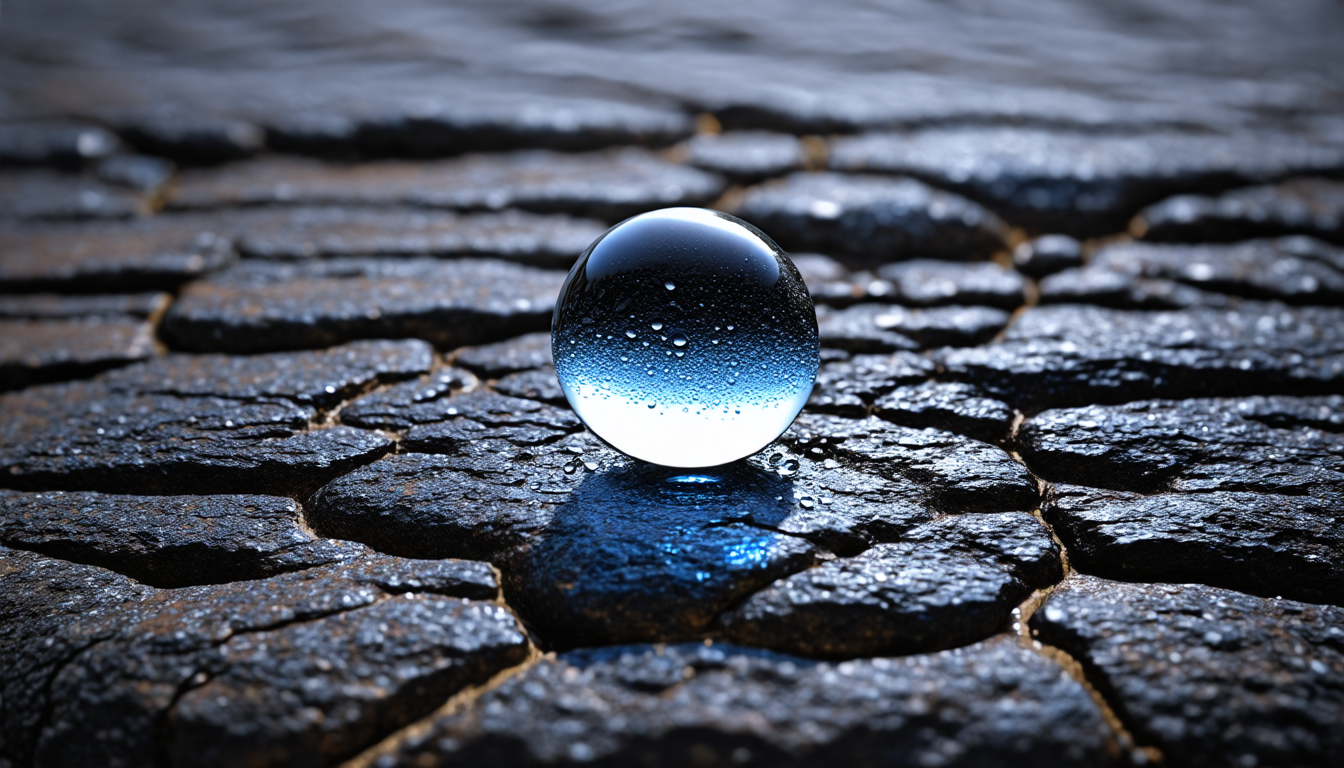
Thin films of liquid on a surface can behave in fascinating ways, especially when that surface is patterned or textured. For example, if you pour water onto a rough stone, it will spread out and form droplets, rather than flowing smoothly over the surface. This phenomenon is known as dewetting.
Scientists have long been interested in understanding how thin films of liquid behave on different surfaces, and what determines whether they will spread out or break up into droplets. In recent years, researchers have made significant progress in this area, using a combination of theoretical modeling and experimental techniques to study the behavior of thin films on patterned surfaces.
One area of particular interest has been the behavior of thin films on substrates with chemical patterns. These patterns can be created by chemically modifying the surface of the substrate, or by depositing layers of different materials onto it. The resulting pattern can influence the way that the liquid film behaves, causing it to spread out in certain areas and break up into droplets in others.
Researchers have used a variety of techniques to study this behavior, including experiments with liquids such as water and oil, as well as computer simulations. They have also developed new theoretical models to describe the behavior of thin films on patterned surfaces, and to predict how different patterns will affect their behavior.
One key finding has been that the behavior of the liquid film is influenced not just by the chemical properties of the surface, but also by its physical texture. For example, a surface with a rough texture can cause the liquid film to break up into droplets more easily than a smooth surface. This is because the roughness creates areas where the liquid can accumulate and form droplets.
Another important factor is the way that the liquid interacts with the surface. If the liquid is attracted to the surface, it will spread out and cover it more easily. But if it is repelled by the surface, it will break up into droplets more quickly.
Researchers have also found that the behavior of thin films on patterned surfaces can be influenced by the way that the pattern is created. For example, a pattern created by depositing layers of different materials onto the surface may behave differently than one created by chemically modifying the surface.
Overall, the study of dewetting on patterned surfaces has revealed many fascinating insights into the behavior of thin films of liquid on different surfaces.
Cite this article: “Unraveling the Secrets of Thin Film Dewetting: A Novel Approach to Measuring Surface Energy”, The Science Archive, 2025.
Thin Films, Patterned Surfaces, Dewetting, Liquids, Surface Chemistry, Texture, Roughness, Smoothness, Attraction, Repulsion





