

Sunday 06 April 2025
Researchers have been studying the behavior of random walkers, which are particles that move randomly in a given environment, for decades. These particles can be found in many natural systems, such as bacteria moving through a fluid or a person walking through a forest. In recent years, scientists have become interested in understanding how these particles behave when they are reset to their starting position after a certain amount of time.
One way to study this behavior is by using a mathematical technique called the Wiener-Hopf integral equation. This technique allows researchers to solve complex problems by breaking them down into simpler pieces and solving each piece separately. In the case of random walkers, the Wiener-Hopf integral equation can be used to calculate the probability that the particle will reach a certain point in space after being reset.
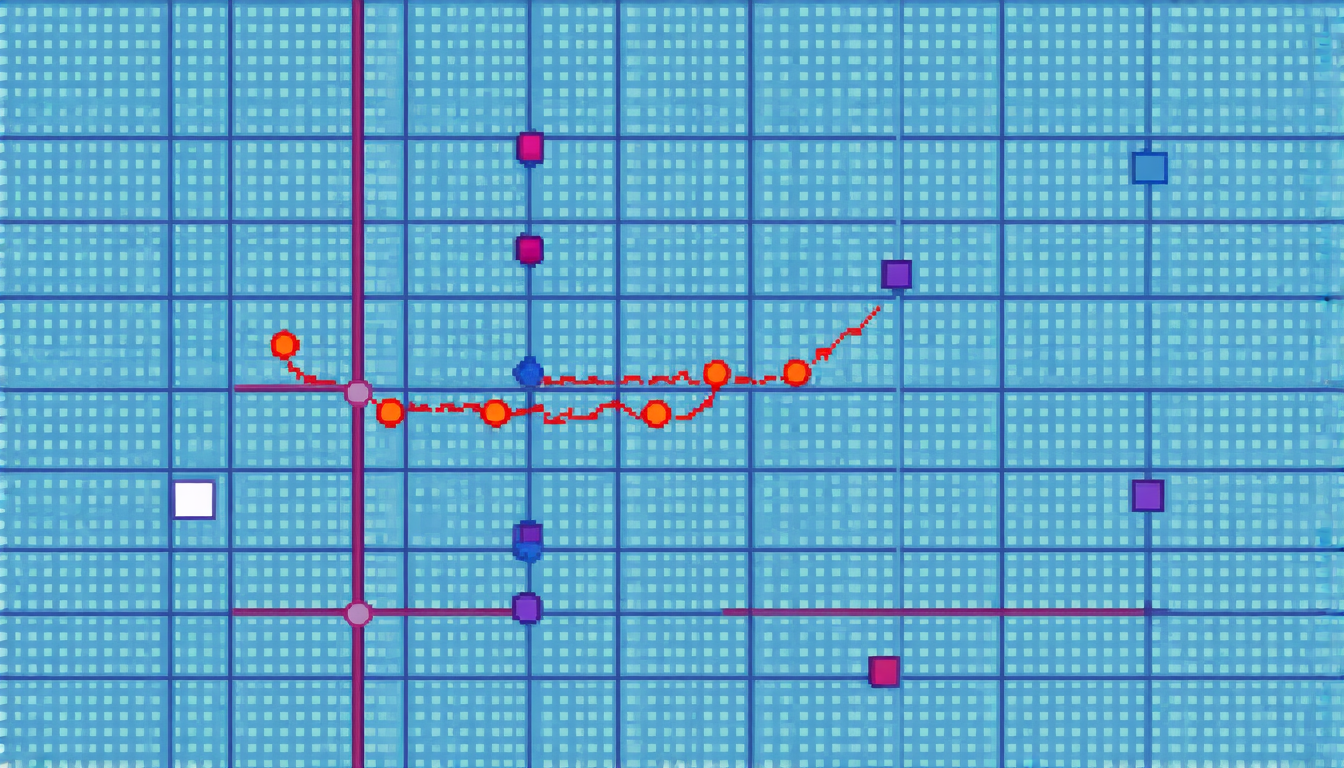
In a recent paper, researchers have used this technique to study the behavior of discrete-time random walkers under stochastic resetting. Discrete-time random walkers are particles that move at discrete intervals of time, such as every second or minute. Stochastic resetting means that the particle is reset to its starting position with a certain probability after each movement.
The researchers found that the Wiener-Hopf integral equation can be used to solve this problem by reducing it to a simpler equation called the Laplace transform. The Laplace transform is a mathematical technique that allows researchers to solve complex problems by converting them into simpler, more manageable equations.
Using this technique, the researchers were able to calculate the probability of the particle reaching a certain point in space after being reset. They found that this probability depends on several factors, including the distance between the starting and ending points, the time interval over which the particle moves, and the probability of resetting.
The results of this study have important implications for our understanding of random walkers and how they behave under stochastic resetting. For example, the study shows that the probability of reaching a certain point in space decreases as the distance between the starting and ending points increases. This means that if a particle is trying to move a long distance, it will be less likely to reach its destination after being reset.
The study also found that the probability of reaching a certain point in space depends on the time interval over which the particle moves. If the particle moves slowly over a long period of time, it will have a higher chance of reaching its destination than if it moves quickly over a short period of time.
Finally, the researchers found that the probability of reaching a certain point in space is affected by the probability of resetting.
Cite this article: “Unlocking the Secrets of Stochastic Resetting in Random Walks”, The Science Archive, 2025.
Random Walkers, Stochastic Resetting, Wiener-Hopf Integral Equation, Laplace Transform, Probability, Distance, Time Interval, Particle Movement, Resetting Probability, Discrete-Time Random Walkers





