

Monday 07 April 2025
The intricate dance of simplicial complexes has long fascinated mathematicians, but a recent discovery has shed new light on their properties and behaviour. Researchers have made significant strides in understanding the full subcomplexes of Bier spheres, shedding new insights into the world of topology.
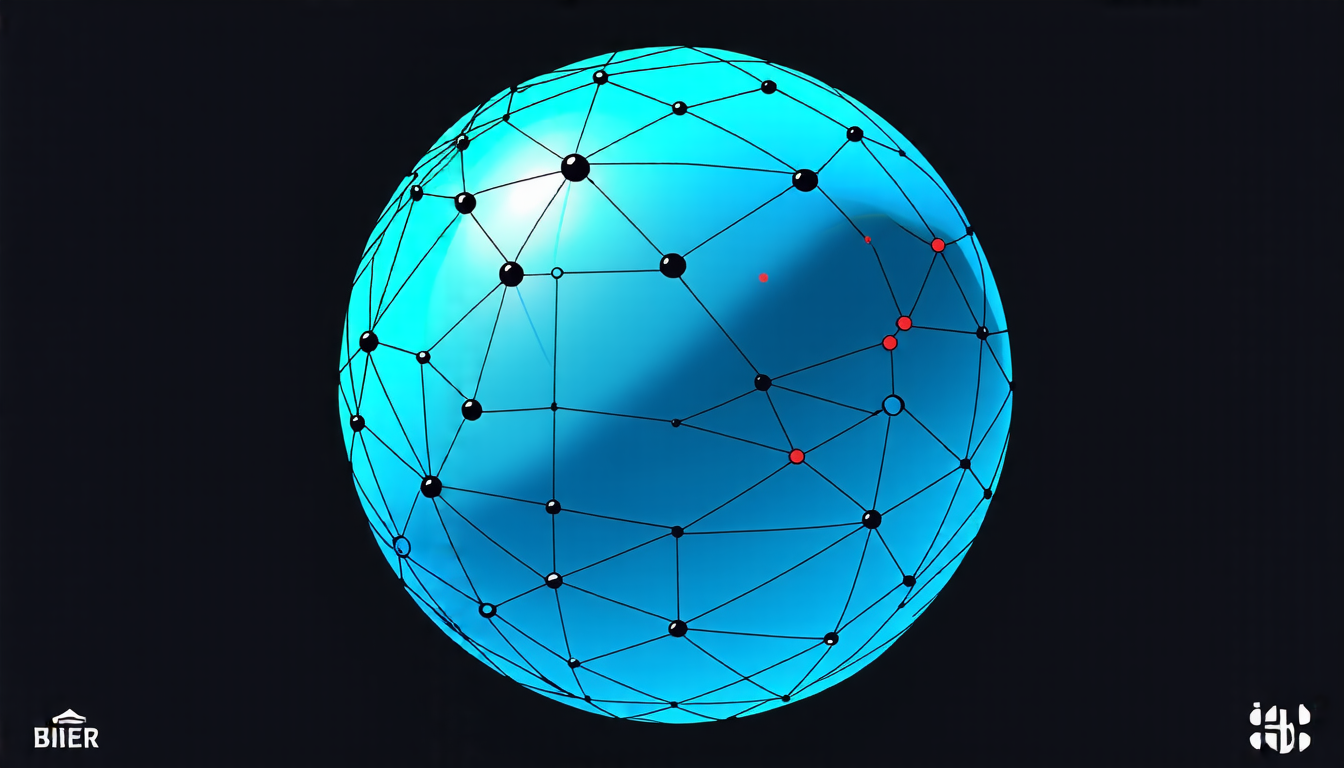
Bier spheres are a type of mathematical object that can be thought of as a complex web of interconnected points. They were first introduced by Thomas Bier in the 1990s and have since been studied extensively for their unique properties. The full subcomplexes of Bier spheres refer to the smaller, self-contained pieces within these larger structures.
One of the key findings is that certain collections of subsets within a Bier sphere can be used to generate its topological type. This has significant implications for our understanding of the relationship between the geometry and topology of these objects. By studying the properties of these subcomplexes, researchers have been able to develop new tools for classifying Bier spheres.
Another important discovery is the existence of a well-defined multiplicative structure on the rational cohomology ring of real toric spaces associated with Bier spheres. This has opened up new avenues for research into the algebraic properties of these spaces and their connections to other areas of mathematics.
The study of full subcomplexes also has significant implications for our understanding of the geometry and topology of real toric manifolds. These are complex geometric objects that arise from the intersection of algebraic and geometric ideas. By studying the properties of Bier spheres, researchers have been able to gain new insights into the structure of these manifolds and their relationship to other areas of mathematics.
The research has also shed light on the connections between Bier spheres and real permutohedral varieties, which are another type of mathematical object that arises from geometric and algebraic ideas. By studying the properties of full subcomplexes, researchers have been able to develop new tools for understanding the relationships between these objects and other areas of mathematics.
In addition to its theoretical implications, this research has also significant practical applications. For example, it could be used to develop new algorithms for solving problems in computer science and engineering. It could also be used to better understand complex systems in fields such as biology and economics.
Overall, the discovery of full subcomplexes of Bier spheres has opened up a new frontier in the study of topology and geometry. By exploring these intricate mathematical structures, researchers are gaining new insights into the fundamental nature of reality itself.
Cite this article: “Unlocking the Secrets of Bier Spheres and Real Toric Spaces”, The Science Archive, 2025.
Bier Spheres, Topology, Geometry, Simplicial Complexes, Full Subcomplexes, Real Toric Spaces, Rational Cohomology Ring, Algebraic Properties, Real Permutohedral Varieties, Computational Complexity.





