

Monday 07 April 2025
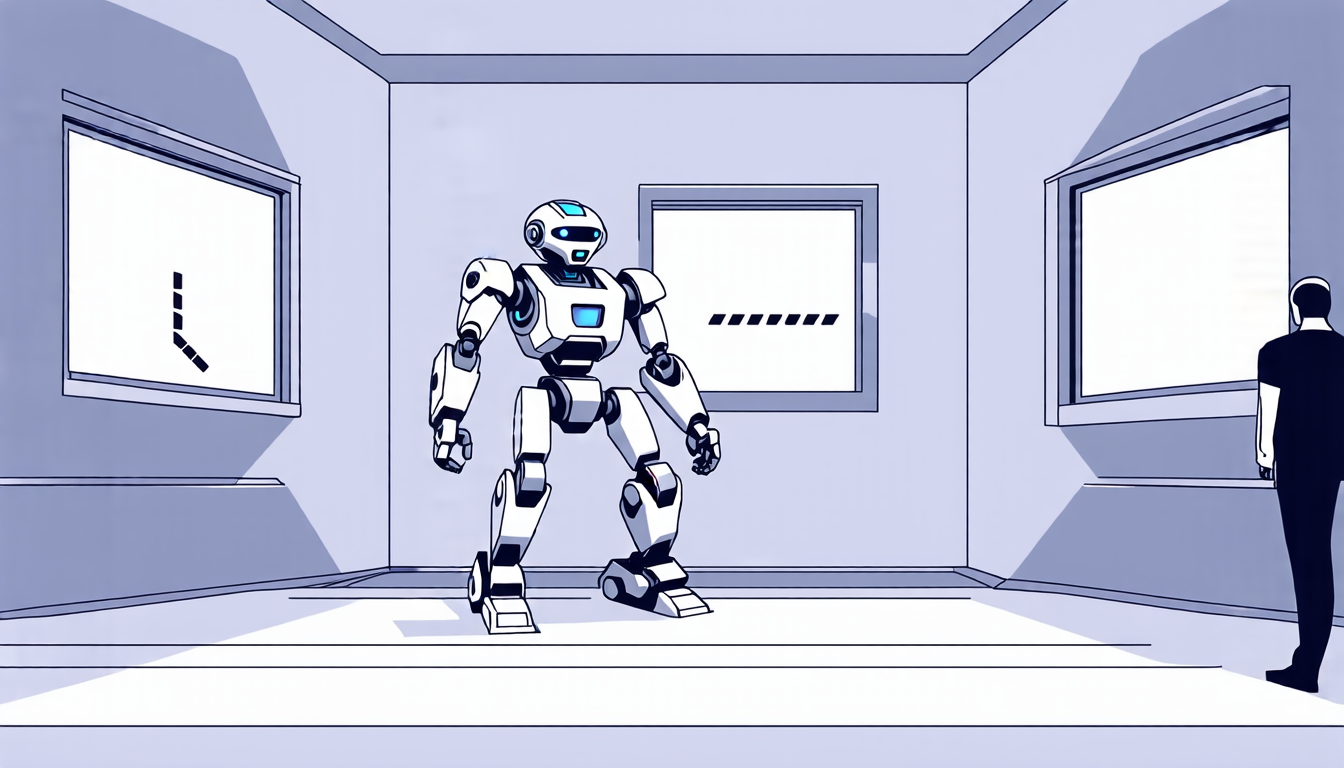
As robots become increasingly integrated into our daily lives, they need to be able to understand and follow complex instructions. This is where temporal logic comes in – a way of describing tasks that takes into account not just what needs to be done, but also when it needs to be done.
Temporal logic is a type of formal language that allows robots to understand and execute tasks with precision. It’s like writing a recipe for your robot friend, where you specify not only the ingredients and cooking time, but also the exact sequence of steps to follow. This way, your robot can perform complex tasks with ease, without getting confused or stuck.
Researchers have been working on developing temporal logic-based planning systems for robots, which allow them to plan and execute tasks in a more efficient and flexible way. For example, a robot might be tasked with cleaning a room, but the task requires it to avoid certain areas or objects at specific times. Temporal logic would enable the robot to understand these constraints and plan its actions accordingly.
One of the challenges in developing temporal logic-based planning systems is ensuring that they can handle exceptions and uncertainties. For instance, what if an object moves while the robot is executing a task? Or what if there’s an unexpected change in the environment? Temporal logic planners need to be able to adapt to these situations and adjust their plans accordingly.
To address this challenge, researchers have been exploring ways to incorporate machine learning algorithms into temporal logic planning systems. This would allow robots to learn from experience and adapt to new situations more quickly. For example, a robot might initially follow a pre-programmed plan for cleaning a room, but as it gains more experience and data, it can adjust its plan in real-time to optimize its performance.
Temporal logic planning systems also have the potential to be used in a wide range of applications beyond just robotics. For instance, they could be used in autonomous vehicles to plan routes that take into account traffic patterns and road closures. Or, they could be used in healthcare to plan treatment protocols for patients with complex medical conditions.
As robots become increasingly integrated into our daily lives, the need for sophisticated planning systems like temporal logic planners is only going to continue to grow. By enabling robots to understand and execute complex tasks with precision and flexibility, we can unlock new possibilities for how they interact with us and the world around them.
Cite this article: “Unlocking the Limits of Robot Task Specification: A Study on LTL Formulae and Poseability”, The Science Archive, 2025.
Robots, Temporal Logic, Planning Systems, Formal Language, Precision, Flexibility, Machine Learning, Algorithms, Adaptability, Uncertainty





