

Tuesday 08 April 2025
As robots and autonomous vehicles continue to transform industries like agriculture, a team of researchers has tackled a crucial challenge: how to accurately control the position of agricultural implements attached to these machines. The answer lies in developing more sophisticated control strategies that account for the unique dynamics of these systems.
Traditional approaches focus on controlling the movement of the vehicle itself, often neglecting the implement’s position and orientation. This can lead to significant errors, particularly when navigating curves or performing tasks like planting or harvesting. To address this issue, scientists have developed two novel methods: one that adapts existing control laws for the rear axle’s midpoint to manage lateral deviation, and another that employs backstepping techniques to create a control law targeting the implement itself.
The first approach builds upon classical control methods, shifting the desired lateral deviation of the implement to ensure accurate tracking. This method provides reliable results but may not be as effective in situations where the vehicle needs to make sharp turns or navigate complex terrain. The second approach uses backstepping techniques to compute an angular deviation that ensures exponential convergence of the lateral error.
One key advantage of this second method is its ability to handle more complex trajectories and dynamic environments. By directly targeting the implement’s position, the control law can adapt to changing conditions and correct for errors in real-time. This is particularly important in agriculture, where even slight inaccuracies can impact crop quality or yields.
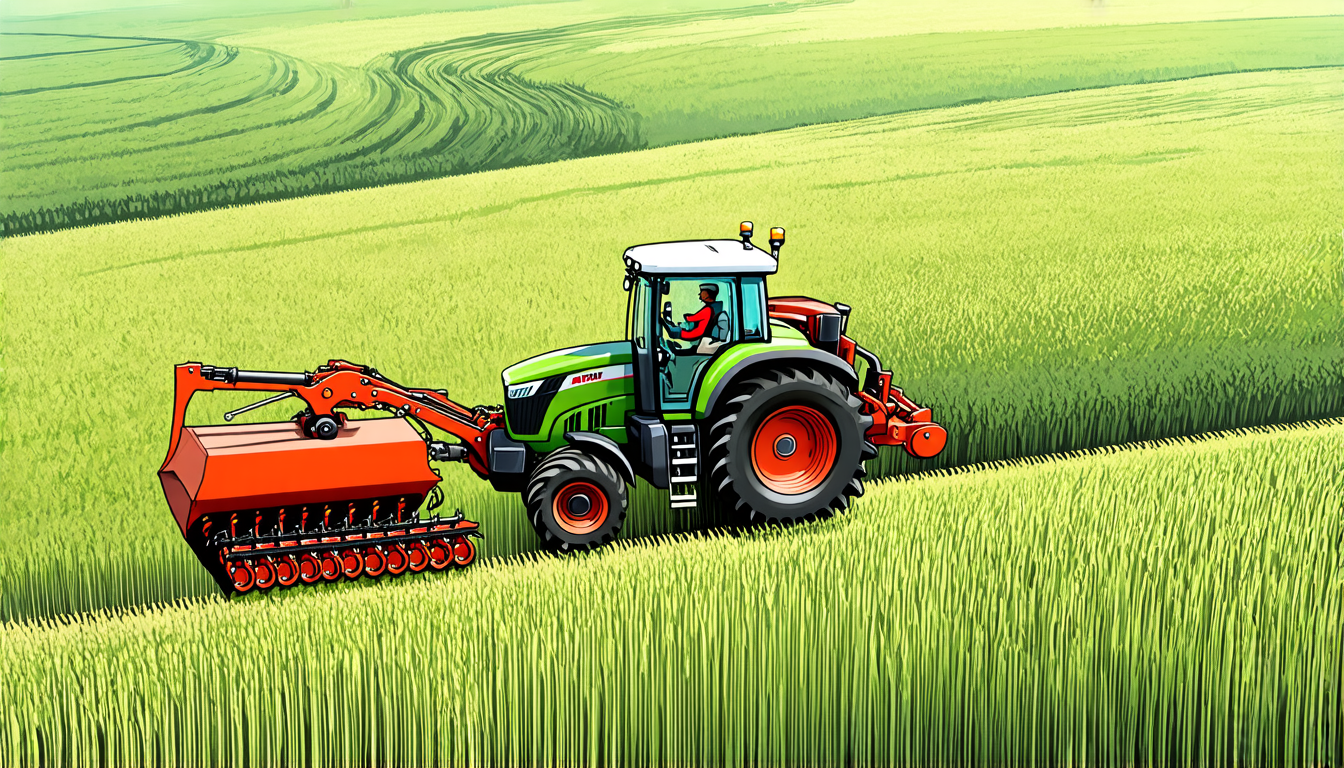
The researchers tested these methods on a robotic tractor equipped with an agricultural implement, demonstrating improved tracking accuracy and reduced errors compared to traditional approaches. The team also explored the impact of the implement’s position on control law precision, finding that the distance between the vehicle and the implement can significantly affect performance.
These findings have significant implications for the development of autonomous agricultural systems. As these machines become increasingly sophisticated, accurate control of implements will be crucial for optimizing crop yields, reducing waste, and improving overall efficiency. The research also highlights the importance of integrating multiple sensors and feedback mechanisms to ensure precise tracking and adaptability in dynamic environments.
In the coming years, we can expect to see more advanced agricultural robots that incorporate these innovative control strategies. As autonomous farming equipment becomes more widespread, it will be essential to develop systems that not only navigate complex terrain but also accurately position and orient implements for optimal performance. This research represents a critical step forward in achieving those goals.
Cite this article: “Precision Agriculture: A Novel Control Strategy for Offset Points Tracking in Agricultural Robotics”, The Science Archive, 2025.
Robotics, Autonomous Vehicles, Agricultural Implements, Control Strategies, Vehicle Dynamics, Lateral Deviation, Backstepping Techniques, Angular Deviation, Crop Yields, Precision Agriculture





