

Tuesday 08 April 2025
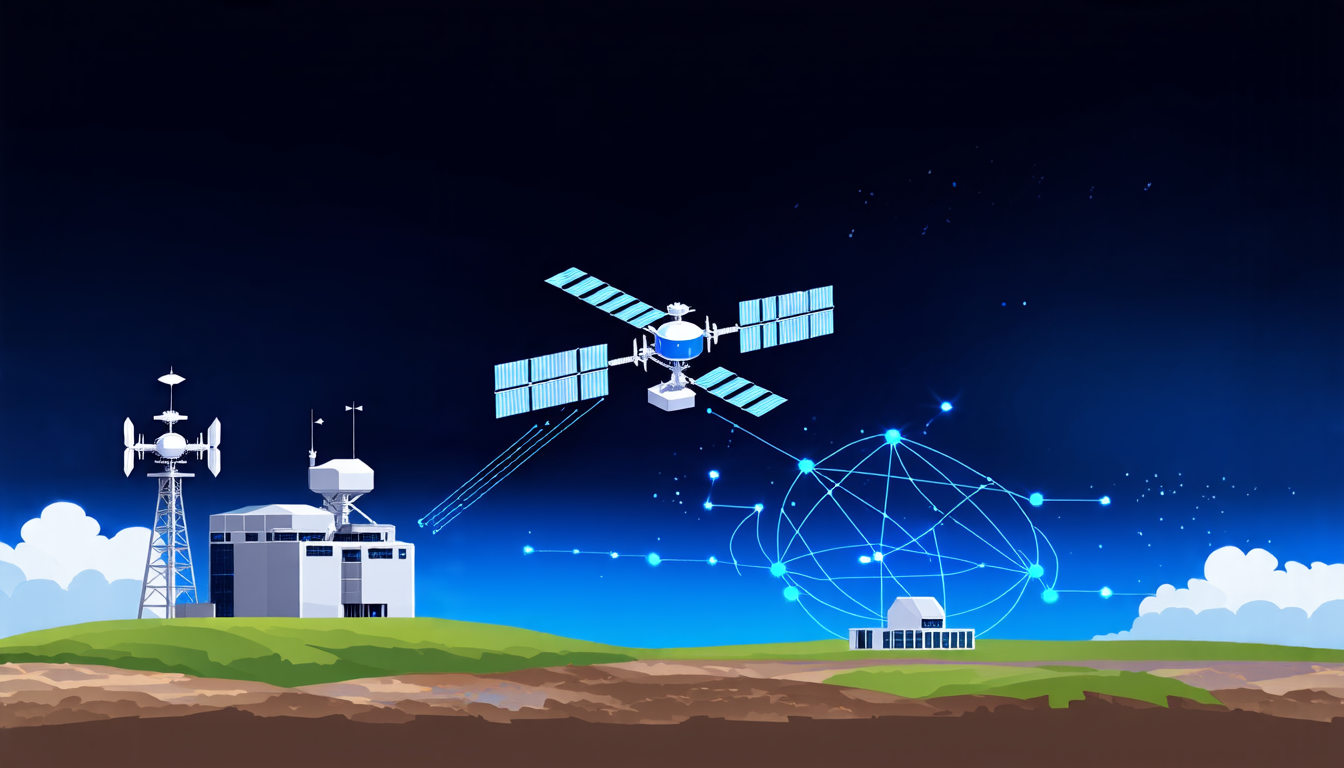
As we continue to push the boundaries of quantum technology, a new development has emerged that could revolutionize the way we secure our digital communications. Researchers have made significant strides in improving the efficiency and reliability of satellite-based quantum key distribution (QKD), a method that uses entangled photons to encode secret messages.
Traditional QKD systems rely on fiber-optic cables, which are prone to noise and interference. However, satellites offer a more reliable option, as they can transmit data over long distances without the need for physical infrastructure. But there’s a catch – the quantum signals transmitted by satellites are subject to dynamic channel conditions, making it challenging to maintain high-quality communications.
Enter blockwise post-processing, a novel approach that divides raw key bits into individual blocks and processes them independently. This strategy takes into account the varying noise levels and error rates of each block, allowing for more efficient error correction and privacy amplification.
A case study demonstrated the effectiveness of blockwise post-processing in satellite-based QKD systems. The researchers simulated a constellation of low-earth-orbit satellites, each equipped with an entanglement source, transmitting data to ground stations at various altitudes. They found that the blockwise strategy outperformed traditional non-blockwise methods, leading to significantly higher key rates and improved overall security.
One of the most promising aspects of this development is its potential to improve real-time dynamic channel conditions. By monitoring and adapting to changing environmental factors such as weather and cloud coverage, satellite-based QKD systems can optimize their performance in real-time. This could be particularly useful for applications that require high-speed data transmission over long distances, such as financial transactions or military communications.
The researchers also highlighted several open problems that need to be addressed to further improve the efficiency and security of satellite-based QKD systems. These include developing customized post-processing techniques for high-dimensional QKD systems, exploring alternative attack models, and connecting quantum and classical techniques to optimize key rates.
As the world becomes increasingly reliant on digital communications, it’s more important than ever that we develop secure methods for transmitting sensitive information. Satellite-based QKD has the potential to revolutionize the way we think about data security, offering a reliable and efficient solution for encrypting messages over long distances. With further advancements in blockwise post-processing and other related technologies, we can expect to see significant improvements in the near future.
Cite this article: “Satellite-Boosted Quantum Security: A New Era in Key Distribution”, The Science Archive, 2025.
Quantum Key Distribution, Satellite-Based, Qkd, Blockwise Post-Processing, Entangled Photons, Fiber-Optic Cables, Noise Interference, Error Correction, Privacy Amplification, High-Dimensional Qkd Systems.





