

Tuesday 08 April 2025
The quest for autonomous driving has long been plagued by the challenges of navigating complex parking scenarios. While many systems rely on a combination of sensors and pre-programmed routes, a new approach is emerging that uses AI to learn from expert drivers and generate precise trajectories.
This innovative technique, dubbed TransParking, employs a dual-decoder structure to predict future trajectory coordinates in real-time. By leveraging the strengths of transformers, a type of neural network originally designed for natural language processing, researchers have developed a system capable of accurately navigating even the most intricate parking scenarios.
The key innovation lies in the model’s ability to softly localize itself within the environment. This is achieved through the use of attention weights, which allow the system to focus on specific regions of the bird’s-eye view (BEV) representation and selectively incorporate environmental features into its decision-making process.
During training, the model learns from expert trajectories, carefully crafted to mimic human driving behavior. By iteratively refining these paths, the researchers were able to generate a dataset that effectively captures the nuances of parking maneuvers.
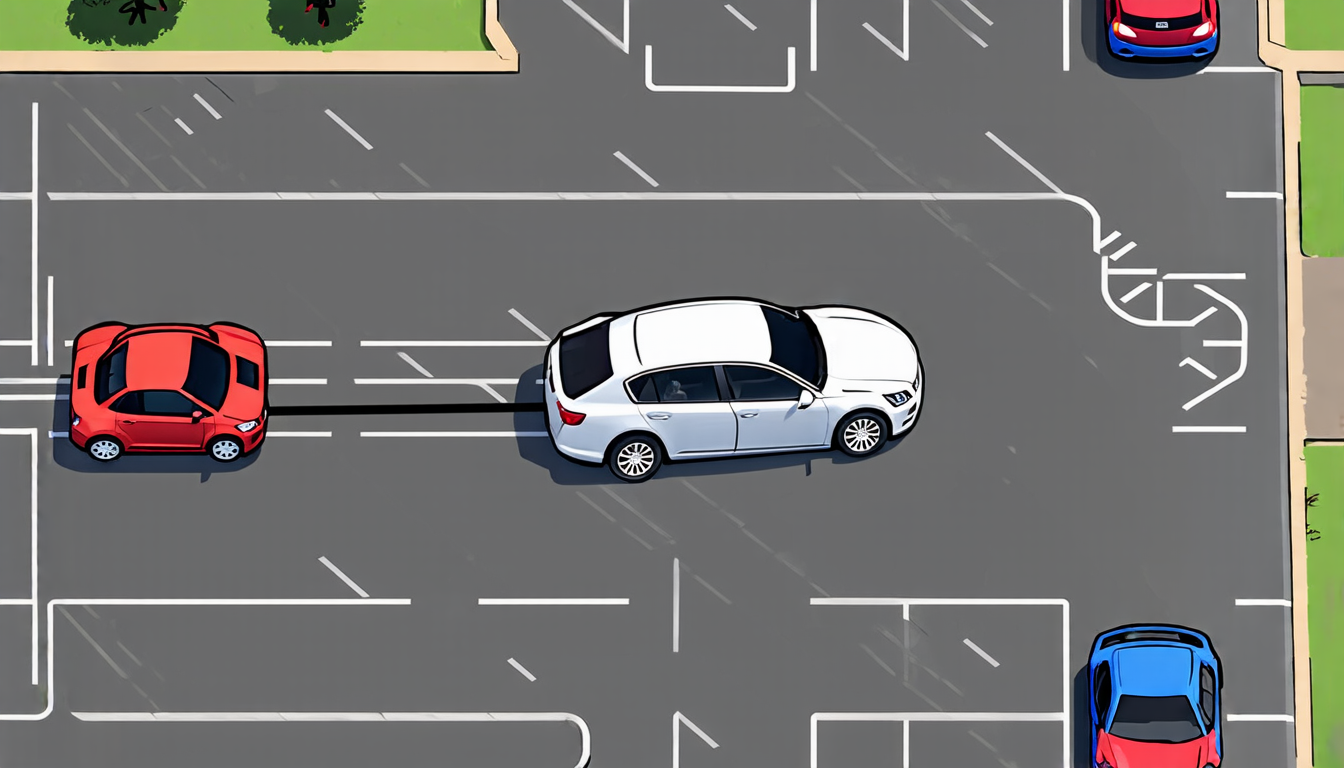
To put this technology to the test, the team simulated various parking scenarios using the CarLA simulator. Results showed that TransParking outperformed existing end-to-end autonomous driving systems by a significant margin, with average errors reduced by approximately 50%.
One of the most impressive aspects of this system is its ability to adapt to unexpected events. In scenarios where an obstacle suddenly appears, TransParking can re-route accordingly, ensuring a safe and efficient parking experience.
The potential implications of this technology are vast. As autonomous vehicles become increasingly prevalent on our roads, the need for advanced parking systems will only continue to grow. With TransParking, we may soon see self-driving cars effortlessly navigating even the most complex parking lots.
While there is still much work to be done before this system can be deployed in real-world scenarios, the early results are nothing short of impressive. As researchers continue to refine and expand their approach, it’s clear that we’re on the cusp of a major breakthrough in autonomous driving technology.
Cite this article: “Transforming Autonomous Parking: A Dual-Decoder Framework for End-to-End Parking Navigation”, The Science Archive, 2025.
Autonomous Driving, Parking Scenarios, Ai, Neural Networks, Transformers, Localization, Attention Weights, Expert Trajectories, Carla Simulator, End-To-End Autonomous Driving Systems





