

Tuesday 08 April 2025
For decades, mathematicians have been fascinated by the intricacies of complex shapes and their properties. Recently, researchers have made a breakthrough in understanding the structure of these shapes, specifically balanced triangulations of manifolds.
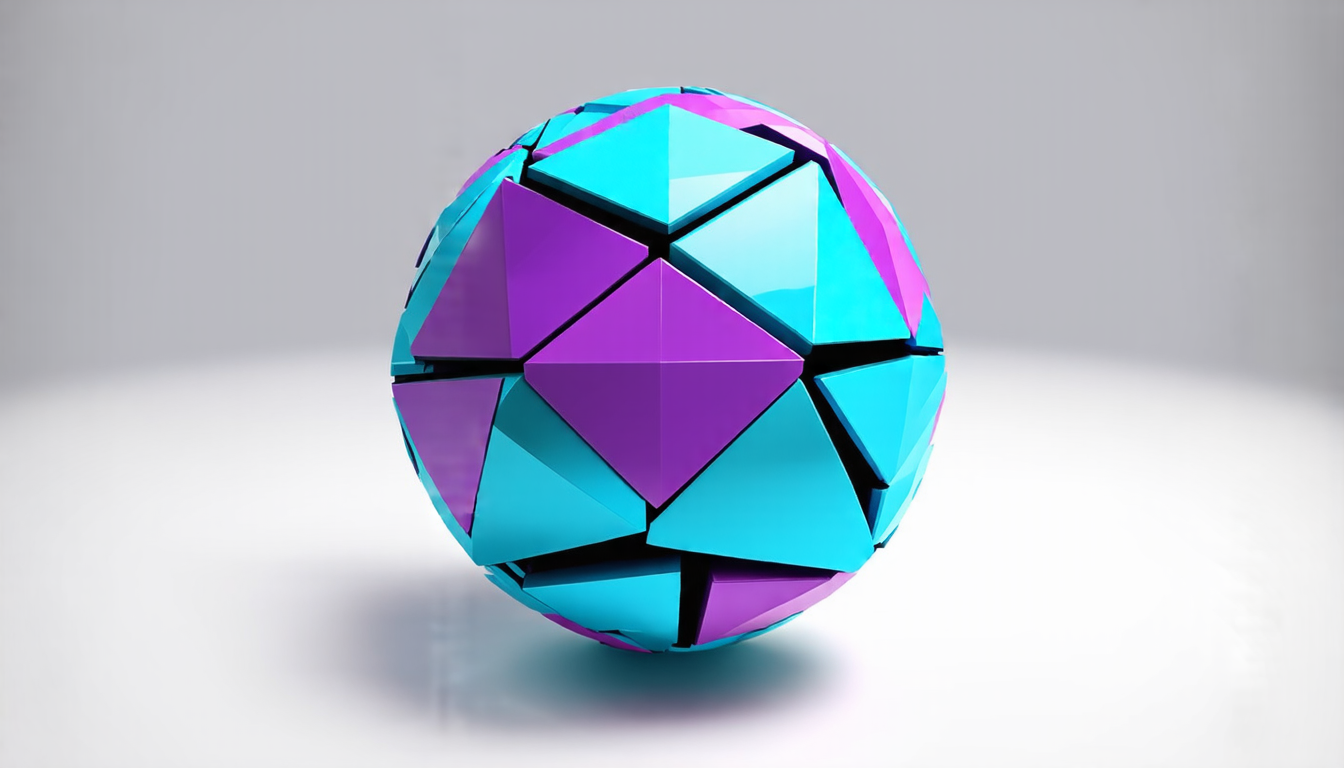
A manifold is essentially a shape that can be smoothly stretched out like rubber without tearing or gluing parts together. Think of a sphere or a torus (doughnut-shaped). A triangulation is a way to break down this shape into smaller pieces called triangles, which are connected in a specific way. In the case of balanced triangulations, each triangle has an equal number of edges connecting it to its neighbors.
The research team focused on PL manifolds, which are topological spaces that can be represented by piecewise-linear functions. These manifolds are crucial in understanding complex shapes and their properties. The team discovered a new invariant, called the balanced genus, which is a measure of the complexity of these triangulations.
This invariant has far-reaching implications for our understanding of PL manifolds. For instance, it allows researchers to determine whether a given manifold is homeomorphic (or topologically equivalent) to a sphere or not. This is crucial in fields such as physics and engineering, where complex shapes are used to model real-world phenomena.
The team’s findings also shed light on the relationship between balanced triangulations and other geometric structures. They demonstrated that certain types of manifolds can be decomposed into simpler pieces using balanced triangulations. This decomposition has important implications for computer science, as it can help streamline algorithms for processing complex data.
One of the most significant outcomes of this research is the establishment of a lower bound theorem for PL 4-manifolds. This theorem states that if a 4-dimensional manifold has a certain property called balanced genus, then its topological type (or homeomorphism class) is determined by this property alone.
The researchers’ work has opened up new avenues for exploration in geometry and topology. The discovery of the balanced genus invariant has sparked interest among mathematicians and physicists alike, as it has far-reaching implications for our understanding of complex shapes and their properties.
In the future, researchers hope to build upon these findings by exploring other types of manifolds and triangulations. They aim to develop new algorithms for processing complex data and to better understand the relationships between geometric structures. The study of balanced triangulations is a rich and exciting field, with many more secrets waiting to be uncovered.
Cite this article: “Unlocking the Secrets of Balanced Genus: A New Frontier in Combinatorial Topology”, The Science Archive, 2025.
Mathematics, Geometry, Topology, Manifolds, Triangulations, Balanced Genus, Pl Manifolds, Homeomorphism, Computer Science, Algorithms





