

Tuesday 08 April 2025
The search for a more accurate understanding of gravity has been ongoing for centuries, and researchers are making significant progress in this area. A recent study published in a scientific journal has shed new light on the behavior of gravity in extreme environments.
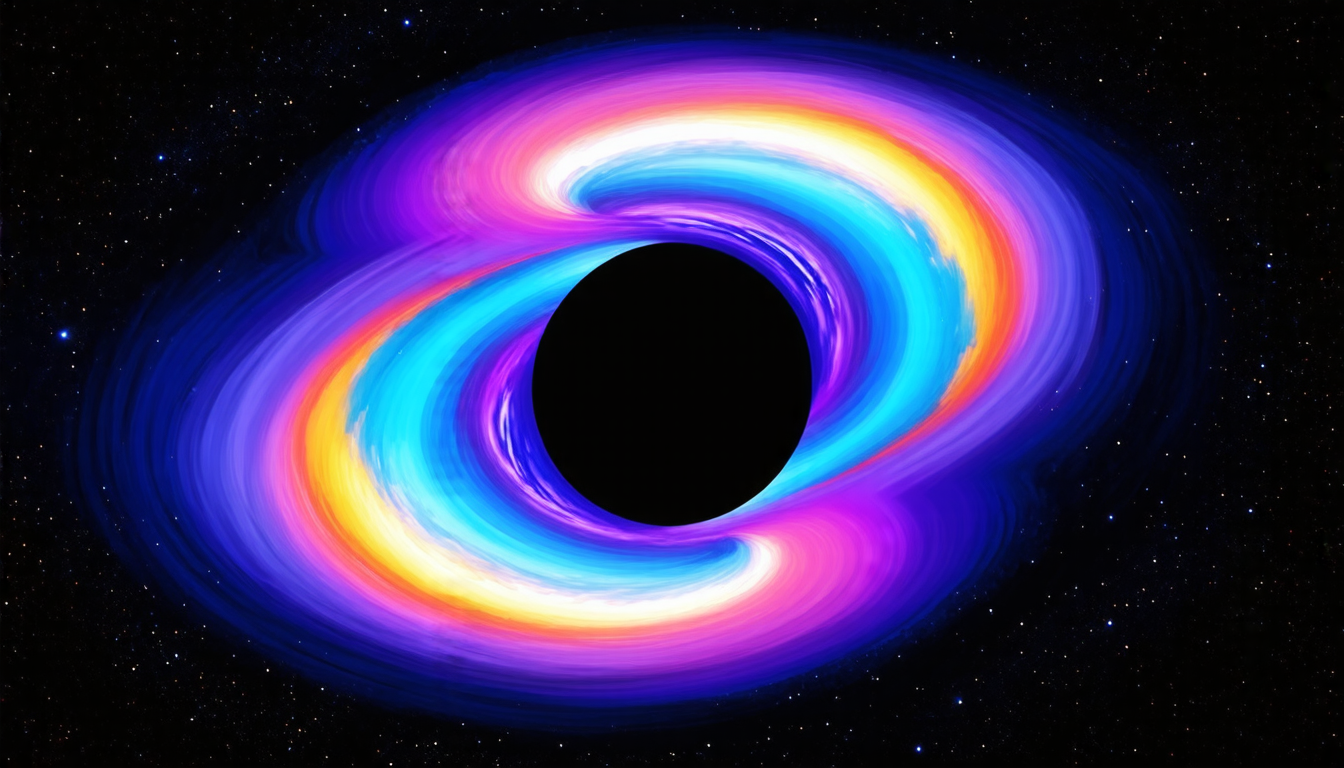
The study focused on the phenomenon of gravitational lensing, which occurs when the curvature of space-time around massive objects, such as black holes or galaxies, bends and distorts the path of light passing near them. This effect can be used to observe distant celestial objects that would otherwise be invisible due to their distance from us.
However, researchers have long known that the predictions of Einstein’s theory of general relativity for gravitational lensing do not always match what is observed in reality. In particular, there are certain cases where the bending of light appears to occur more quickly or slowly than expected.
To address this discrepancy, scientists turned their attention to a lesser-known area of physics: loop quantum gravity. This theoretical framework attempts to reconcile general relativity with the principles of quantum mechanics, which govern the behavior of particles at the atomic and subatomic level.
Using computer simulations and mathematical models, researchers applied the principles of loop quantum gravity to the phenomenon of gravitational lensing. Their results showed that the theory can accurately predict the bending of light around black holes and galaxies, even in extreme environments where general relativity breaks down.
The implications of this study are significant. For one, it provides further evidence for the validity of loop quantum gravity as a theoretical framework. It also opens up new possibilities for observing distant celestial objects that would be invisible to us using traditional methods.
Furthermore, the study highlights the importance of considering the effects of gravity on light in extreme environments. As scientists continue to explore the universe, they will increasingly encounter situations where the curvature of space-time is so extreme that general relativity becomes inadequate as a description of reality.
In this sense, the study serves as a reminder of the need for continued research and experimentation in the field of physics. By pushing the boundaries of our understanding of gravity and its effects on light, scientists can gain a deeper appreciation for the complexities of the universe and the fundamental laws that govern it.
Cite this article: “Unlocking the Secrets of Gravitational Lensing: A Quantum Perspective”, The Science Archive, 2025.
Gravity, Loop Quantum Gravity, General Relativity, Gravitational Lensing, Black Holes, Galaxies, Space-Time, Light, Quantum Mechanics, Physics





