

Tuesday 08 April 2025
As we delve into the mysteries of black holes, scientists continue to push the boundaries of our understanding of these cosmic behemoths. A recent study has shed new light on the properties of black holes in modified gravity theories, offering insights that could have significant implications for our comprehension of the universe.
Modified gravity theories attempt to reconcile the observed behavior of galaxies and galaxy clusters with our current understanding of gravity as described by Einstein’s theory of general relativity. One such theory, MOG (Modified Gravity), proposes that gravity behaves differently on large scales than it does on smaller scales. This difference in behavior could potentially resolve some of the long-standing issues with general relativity.
In this study, researchers explored the properties of black holes within the context of MOG. They found that these black holes exhibit unique characteristics that distinguish them from their general relativistic counterparts. For instance, the event horizon – the point of no return around a black hole – appears to be larger in MOG than it is in general relativity.
The researchers also discovered that MOG black holes have different quasinormal modes, which are the characteristic oscillations that occur when a black hole is perturbed. These oscillations can provide valuable information about the properties of the black hole and its environment. The differences in quasinormal modes between MOG and general relativistic black holes could potentially be used to distinguish between these two theories.
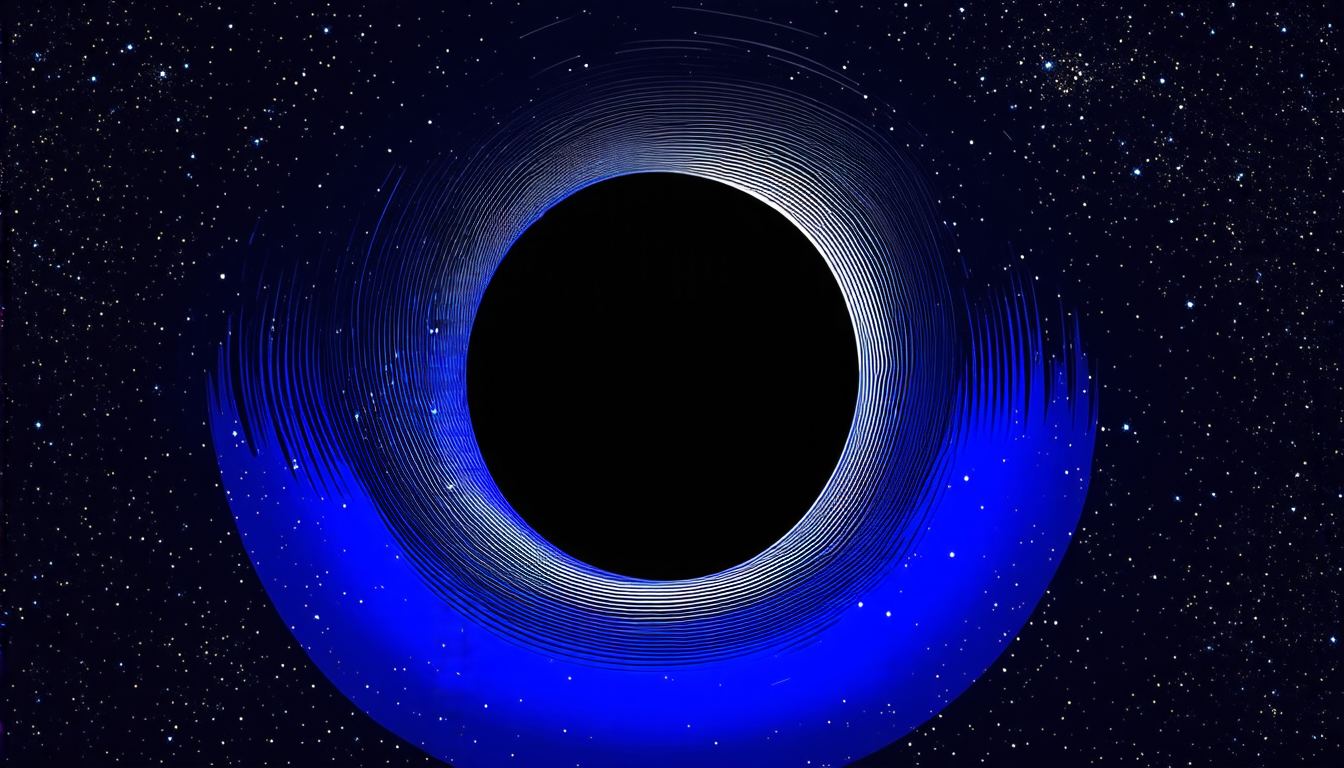
Furthermore, the study found that MOG black holes have distinct shadow profiles, which are the dark regions around a black hole that are visible from a distance. These shadows can provide insight into the properties of the black hole and its environment. The differences in shadow profiles between MOG and general relativistic black holes could potentially be used to test these theories.
The implications of this study extend beyond the realm of theoretical physics. If MOG is confirmed to be correct, it could have significant consequences for our understanding of the universe on large scales. For instance, it could provide an explanation for the observed behavior of galaxies and galaxy clusters without requiring dark matter or dark energy.
However, more research is needed to confirm these findings and to fully understand the properties of black holes in modified gravity theories. The study of black holes continues to be a rich and fertile area of research, with many open questions waiting to be answered.
In recent years, our understanding of black holes has undergone significant advances. From the detection of gravitational waves to the imaging of black hole shadows, we have gained new insights into these mysterious objects.
Cite this article: “Unlocking the Secrets of the Universe: A New Perspective on Black Holes and Gravity”, The Science Archive, 2025.
Black Holes, Modified Gravity Theories, Mog, General Relativity, Event Horizon, Quasinormal Modes, Shadow Profiles, Gravitational Waves, Galaxy Clusters, Dark Matter





