

Tuesday 08 April 2025
The quest for effective countermeasures against malicious micro aerial vehicles (MAVs) has led researchers to develop a novel cooperative MAV capture system. This innovative approach utilizes standard optical sensors and operates independently of predefined unique features, making it a significant advancement in the field.
The system relies on multiple pursuer MAVs equipped with onboard vision systems to detect, localize, and pursue a target MAV. To enhance robustness, a distributed state estimation and control framework enables the pursuers to autonomously coordinate their actions. The trajectories of these pursuiters are optimized using model predictive control (MPC) and executed via a low-level SO(3) controller, ensuring smooth and stable pursuit.
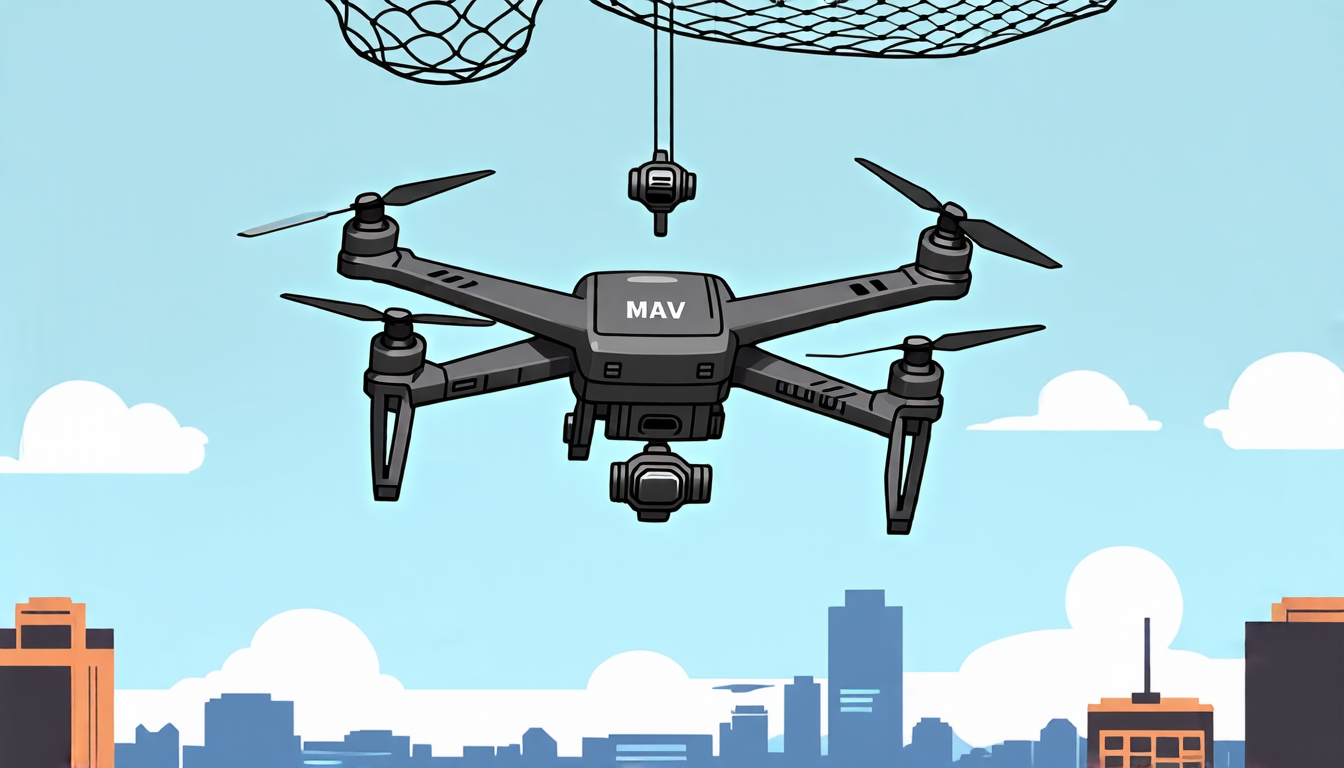
Once the capture conditions are satisfied, the pursuer MAVs automatically deploy a flying net to intercept the target. These capture conditions are determined based on the predicted motion of the net. To enable real-time decision-making, researchers have proposed a lightweight computational method to approximate the net’s motion, avoiding the prohibitive cost of solving the full net dynamics.
The effectiveness of the cooperative MCM system has been evaluated through both simulations and real-world experiments. In simulation tests, the system demonstrated its ability to accurately pursue and capture targets in various scenarios, including complex flight paths. Real-world experiments also showed promising results, with a success rate of 64.7% achieved in multiple trials.
The flying net deployed by the pursuer MAVs is designed to ensnare the target, allowing for safe and controlled capture. The system’s ability to adapt to changing environmental conditions and dynamic targets makes it an attractive solution for various applications, including security, surveillance, and search and rescue operations.
One of the key advantages of this cooperative MCM system is its ability to operate independently of predefined unique features, making it more effective against malicious MAVs that may not have distinct characteristics. This approach also enables the system to adapt to changing environmental conditions, such as wind or turbulence, which can impact the flight path and behavior of the target.
The development of this cooperative MCM system has significant implications for the field of robotics and artificial intelligence. It demonstrates the potential for autonomous systems to work together to achieve complex tasks, and highlights the importance of developing robust and adaptable control frameworks.
As researchers continue to refine and improve this technology, it is likely that we will see its application in a wide range of fields, from security and surveillance to search and rescue operations.
Cite this article: “Cooperative MAV Capture System: A Novel Approach to Efficiently Track and Catch Moving Targets in Real-Time”, The Science Archive, 2025.
Micro Aerial Vehicles, Malicious Mavs, Cooperative Capture System, Optical Sensors, Model Predictive Control, So(3) Controller, Flying Net, Real-Time Decision-Making, Robotics, Artificial Intelligence





