

Tuesday 08 April 2025
As our cities become increasingly congested and our roads more crowded, finding new ways to manage traffic flow has become a pressing concern. One promising solution lies in the field of artificial intelligence (AI), specifically in the application of federated learning.
Federated learning is a type of AI that allows multiple devices or systems to collaborate on complex tasks without sharing their individual data. This approach has been shown to be particularly effective in areas such as healthcare, finance, and transportation. In the context of traffic flow prediction, federated learning enables vehicles to share information about their surroundings, such as speed and acceleration, to improve the accuracy of predictions.
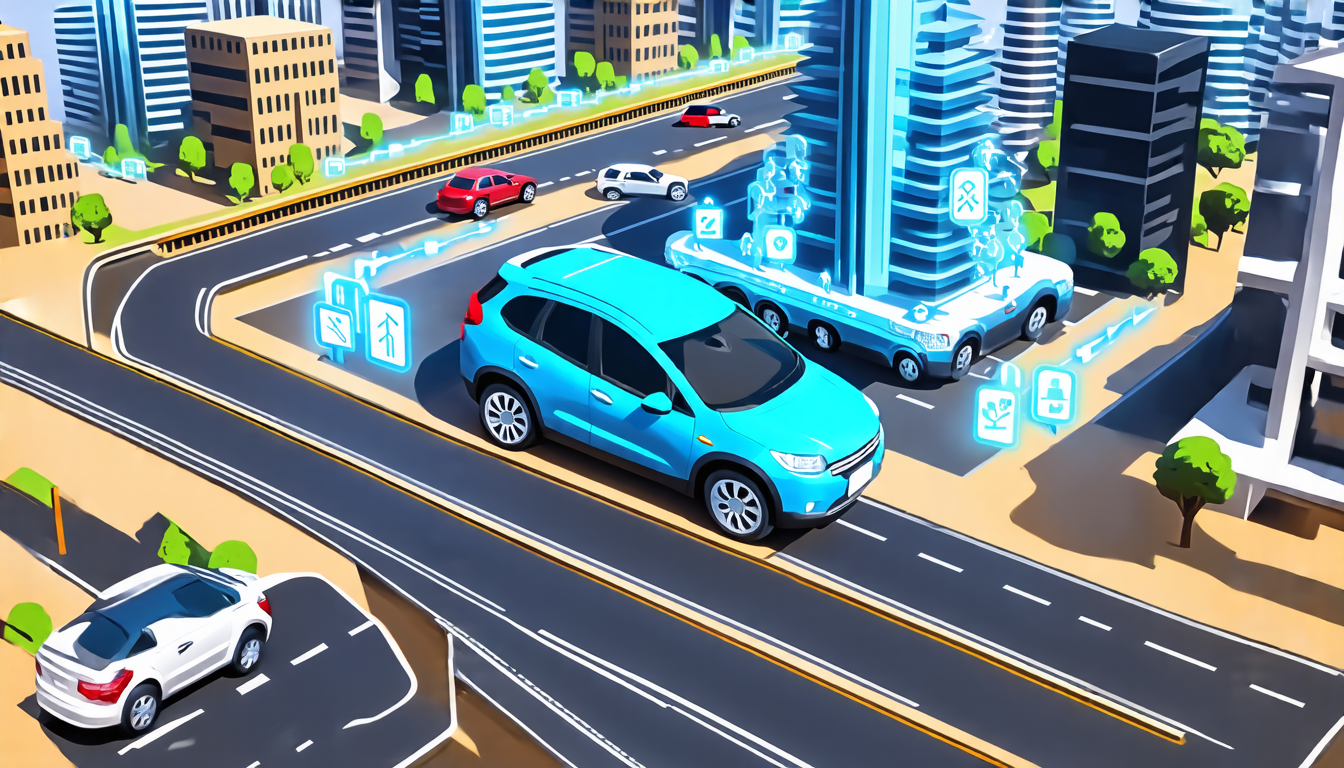
In a recent paper, researchers explored the application of federated learning to traffic flow prediction in vehicular networks. The team developed a novel framework that allows vehicles to learn from one another while minimizing data sharing. This approach, known as mobility-aware decentralized federated learning (MDFL), takes into account the dynamic nature of vehicle movements and energy constraints.
The researchers designed MDFL to optimize two key factors: energy consumption and participation ratio. They achieved this by incorporating a local iteration selection mechanism that adapts to changing network conditions and a leader selection algorithm that balances energy efficiency with accuracy.
To test their framework, the team conducted a series of simulations using real-world traffic data from California’s freeway system. The results showed that MDFL outperformed traditional centralized learning methods in terms of both energy consumption and participation ratio.
The implications of this research are significant. By enabling vehicles to learn from one another without sharing sensitive information, MDFL has the potential to revolutionize the way we approach traffic flow management. This technology could be integrated into existing intelligent transportation systems (ITS) to improve traffic prediction accuracy and reduce congestion.
Furthermore, the scalability of MDFL makes it an attractive solution for deployment in large-scale urban environments. As cities continue to grow and evolve, the need for efficient and effective traffic management strategies will only become more pressing. With its ability to adapt to changing network conditions and minimize energy consumption, MDFL is poised to play a key role in shaping the future of transportation.
In addition to its practical applications, this research also highlights the potential of federated learning to address privacy concerns in AI-powered systems. By enabling devices to learn from one another without sharing individual data, MDFL offers a promising solution for balancing the need for accurate predictions with the need for data protection.
Cite this article: “Decentralized Federated Learning in Vehicular Networks: A Novel Approach to Enhance Mobility-Awareness and Energy Efficiency”, The Science Archive, 2025.
Artificial Intelligence, Federated Learning, Traffic Flow Prediction, Vehicular Networks, Mobility-Aware Decentralized Federated Learning, Energy Consumption, Participation Ratio, Intelligent Transportation Systems, Urban Environments, Data Protection.





