

Tuesday 08 April 2025
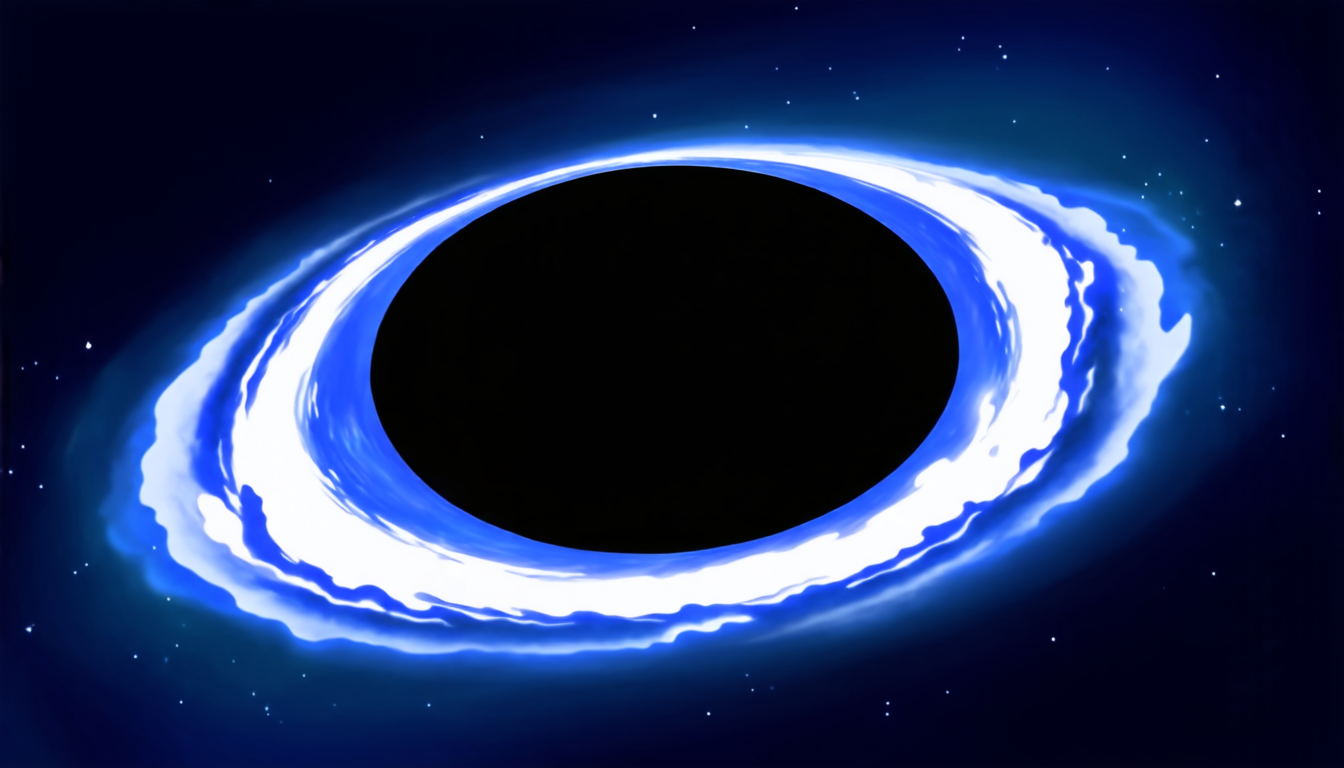
Scientists have made a significant breakthrough in understanding the behavior of black holes, those mysterious regions of space where gravity is so strong that nothing, not even light, can escape once it gets too close. A team of researchers has developed a new model for studying how matter behaves as it spirals towards a black hole, and their findings could have major implications for our understanding of these cosmic behemoths.
The new model takes into account the complex interplay between gravity, magnetism, and radiation in the hot, swirling disk of gas that surrounds a black hole. This disk is thought to be responsible for many of the intense X-ray and gamma-ray emissions that are observed coming from black holes, but it’s been difficult for scientists to understand exactly how these emissions arise.
The researchers used advanced computer simulations to model the behavior of this disk, taking into account factors such as the strength of the magnetic field, the rate at which matter is accreting onto the black hole, and the temperature and density of the gas in the disk. By analyzing the results of these simulations, they were able to identify a new type of shock wave that forms in the disk, which plays a crucial role in generating the intense radiation emissions.
This new understanding of the behavior of matter near a black hole could have significant implications for our ability to study these objects. For example, scientists may be able to use the patterns of X-ray and gamma-ray emission to better understand the properties of the black hole, such as its mass and spin rate. Additionally, the new model could help scientists to better understand how black holes interact with their surroundings, including nearby stars and other matter in the galaxy.
The study also highlights the importance of magnetism in shaping the behavior of matter near a black hole. Magnetic fields play a crucial role in many astrophysical phenomena, from the formation of stars and planets to the behavior of black holes and neutron stars. The new model provides further evidence of the key role that magnetism plays in these processes.
The researchers’ findings have been published in a recent issue of the journal Physical Review Letters. While more work is needed to fully understand the implications of their results, this breakthrough has the potential to revolutionize our understanding of black holes and the extreme environments in which they reside.
Cite this article: “Unveiling the Secrets of Black Hole Accretion: A Study on Magnetic Field Structure and Shock Formation”, The Science Archive, 2025.
Black Holes, Gravity, Magnetism, Radiation, X-Rays, Gamma Rays, Computer Simulations, Shock Waves, Astrophysics, Magnetism





