

Tuesday 08 April 2025
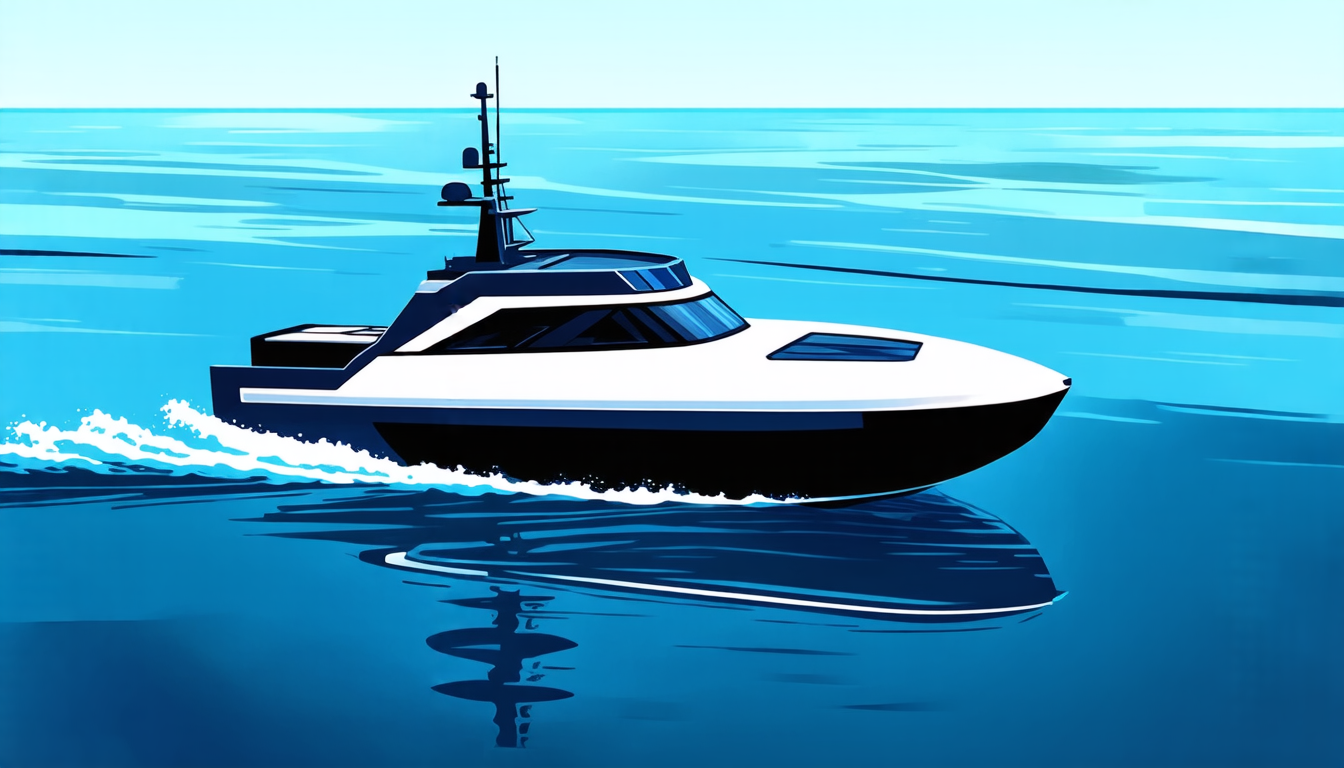
The autonomous surface vessels (ASVs) that are revolutionizing marine transportation are often touted as eco-friendly and efficient, but a new development could take them to the next level. By combining advanced control systems with economic model predictive control, researchers have created a method that not only optimizes energy consumption but also improves navigation accuracy.
The ASVs in question are designed for tasks such as tracking ocean currents or monitoring marine life, and their ability to follow predetermined paths is crucial. However, these vessels often face unpredictable disturbances, like wind and waves, which can throw off their trajectory. Traditional control systems struggle to balance energy efficiency with navigation accuracy, leading to suboptimal performance.
The new approach, developed by researchers at Hunan University in China, uses a cost function that incorporates both energy consumption and tracking error. This allows the ASV’s control system to make trade-offs between the two, optimizing its behavior for specific scenarios. In simulations, the method was shown to reduce cross-track errors by up to 18.61% while increasing energy consumption by just 0.06%.
The key innovation is the incorporation of a terminal cost function, which estimates the energy required to reach the next waypoint and correct any tracking errors that may have occurred along the way. This allows the control system to anticipate and prepare for potential disturbances, rather than simply reacting to them.
The method was tested in simulations using real-world ocean disturbance data and found to be effective even under challenging conditions. The ASVs were able to maintain accurate trajectories while minimizing energy consumption, making them well-suited for extended missions.
In addition to its potential benefits, the new approach also highlights the importance of integrating control systems with economic considerations. By optimizing energy efficiency and navigation accuracy simultaneously, researchers can create more efficient and effective autonomous vessels that are better equipped to tackle complex tasks.
The implications of this technology extend beyond ASVs, however. The same principles could be applied to other areas where optimization is key, such as robotics or aerospace engineering. As researchers continue to develop and refine the method, it’s likely that we’ll see even more innovative applications in the future.
One of the most promising aspects of this research is its potential to improve our understanding of autonomous systems and their ability to adapt to changing environments. By pushing the boundaries of what’s possible with ASVs, scientists can gain valuable insights into the complex interactions between control systems, energy efficiency, and environmental factors.
Cite this article: “Autonomous Surface Vessels Navigate Turbulent Waters with Optimized Energy Efficiency”, The Science Archive, 2025.
Autonomous Surface Vessels, Marine Transportation, Eco-Friendly, Efficient, Energy Consumption, Navigation Accuracy, Control Systems, Economic Model Predictive Control, Ocean Currents, Monitoring Marine Life.





