
Tuesday 08 April 2025
A new mathematical framework has emerged, one that could revolutionize our understanding of uncertainty and probability. At its core is a concept called extropy, a dual companion to entropy that can help us better grasp the intricacies of chance events.
Entropy, as you may know, measures the amount of disorder or randomness in a system. It’s a fundamental concept in physics and information theory, used to describe everything from the behavior of gases to the efficiency of data compression algorithms. But entropy has its limitations. It can’t capture certain aspects of uncertainty that are crucial in fields like medicine, finance, and engineering.
Enter extropy, which flips entropy on its head by focusing on the structure and patterns within a system rather than its disorder. In other words, extropy measures how much information is preserved or lost as we move from one probability distribution to another.
The research team behind this breakthrough has developed a range of mathematical tools and techniques to work with extropy. They’ve created new measures of divergence, which can help us quantify the differences between two probability distributions. These measures have far-reaching implications for fields like machine learning, data analysis, and decision-making under uncertainty.
One of the most exciting applications of extropy is in survival analysis. This branch of statistics deals with studying the time until an event occurs, such as a patient’s death or a machine’s failure. By using extropy-based measures, researchers can gain deeper insights into the relationships between different factors that affect these events. For example, they might use extropy to analyze how different treatment options impact patient outcomes.
The team has also explored the connection between extropy and image analysis. In this context, extropy can be used to develop new algorithms for tasks like object recognition and segmentation. These algorithms could potentially outperform existing methods, especially in situations where data is noisy or incomplete.
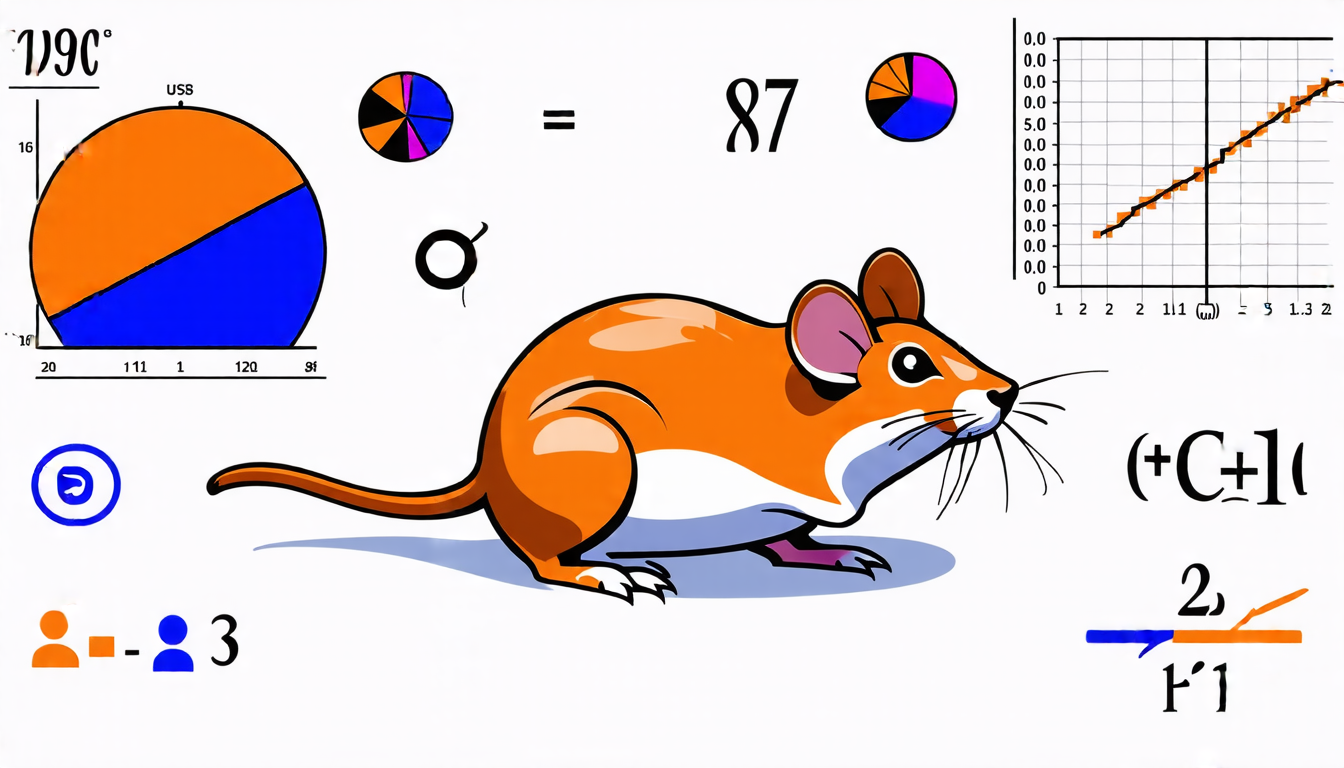
To demonstrate the power of extropy, the researchers applied their techniques to real-world datasets. They analyzed a collection of mouse experiments to study the relationship between age, gender, and tumor presence on survival rates. By using an extropy-based measure, they were able to identify patterns that wouldn’t have been apparent with traditional entropy-based methods.
As we continue to grapple with complex problems in fields like medicine and finance, the insights provided by extropy could be game-changing.
Cite this article: “Unraveling the Secrets of Survival: A Novel Approach to Measuring Inaccuracy and Divergence in Lifespan Data”, The Science Archive, 2025.
Uncertainty, Probability, Entropy, Extropy, Information Theory, Machine Learning, Data Analysis, Survival Analysis, Image Analysis, Statistics