

Tuesday 08 April 2025
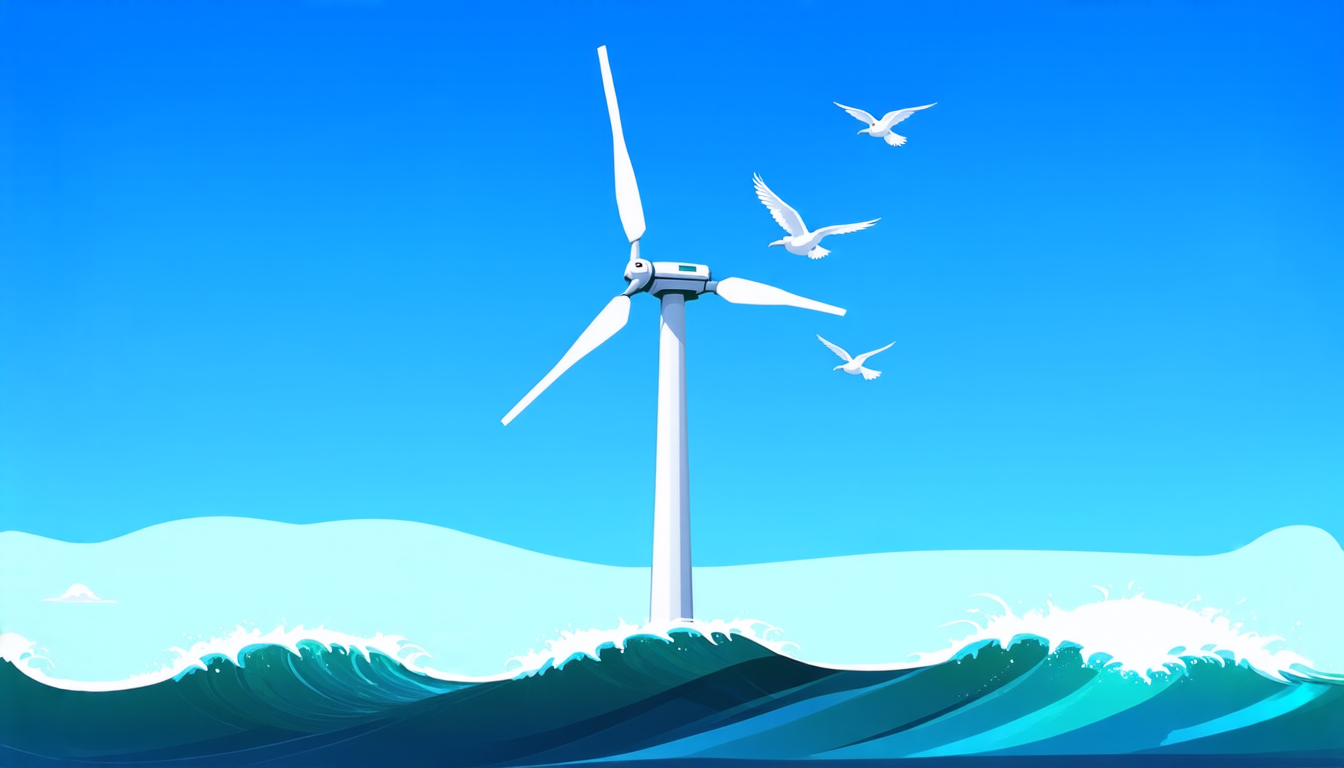
Offshore wind turbines have long been hailed as a promising solution for reducing our reliance on fossil fuels and mitigating climate change. But one major challenge has held them back: the harsh conditions of the open ocean can be tough on these massive structures, making it difficult to keep them running smoothly.
Researchers have been working to overcome this hurdle by developing more sophisticated control systems that can adapt to changing weather conditions and optimize energy production. One promising approach is the use of artificial intelligence (AI) techniques, such as reinforcement learning, to develop intelligent control strategies for offshore wind turbines.
Reinforcement learning is a type of machine learning that involves training an algorithm to make decisions based on rewards or penalties. In this case, the algorithm learns to optimize energy production by adjusting the turbine’s pitch and yaw angles in response to changing wind conditions.
The researchers used a combination of simulation and real-world testing to develop their AI-powered control system. They first developed a detailed model of the offshore wind turbine and its environment using computer simulations, which allowed them to test different control strategies and optimize performance.
Next, they tested their AI-powered control system on a 10-megawatt floating wind turbine installed off the coast of France. The results were impressive: the AI-controlled turbine produced more energy than a traditional control system under similar conditions.
But what really sets this approach apart is its ability to adapt to changing weather conditions in real-time. Traditional control systems rely on pre-programmed rules and formulas, which can become outdated or ineffective if the weather patterns change. The AI-powered control system, on the other hand, can learn from experience and adjust its strategy accordingly.
For example, if a sudden gust of wind hits the turbine, the AI algorithm can quickly adapt by adjusting the pitch and yaw angles to maximize energy production while minimizing stress on the structure. This flexibility is critical for offshore wind turbines, which must withstand harsh weather conditions and operate reliably over long periods of time.
The potential benefits of this technology are significant. With more efficient control systems, offshore wind farms could produce even more clean energy, helping to reduce our reliance on fossil fuels and mitigate climate change. And by adapting to changing weather conditions in real-time, these turbines could also help stabilize the grid and provide reliable power during periods of high demand.
Of course, there are still many challenges to overcome before this technology can be widely deployed. But the results so far are promising, and researchers continue to refine their approach and test its limits.
Cite this article: “Unlocking the Potential of Floating Wind Farms: A Novel Data-Driven Control Approach”, The Science Archive, 2025.
Offshore Wind Turbines, Artificial Intelligence, Reinforcement Learning, Machine Learning, Energy Production, Control Systems, Weather Conditions, Simulation, Floating Wind Turbine, Climate Change





