

Tuesday 08 April 2025
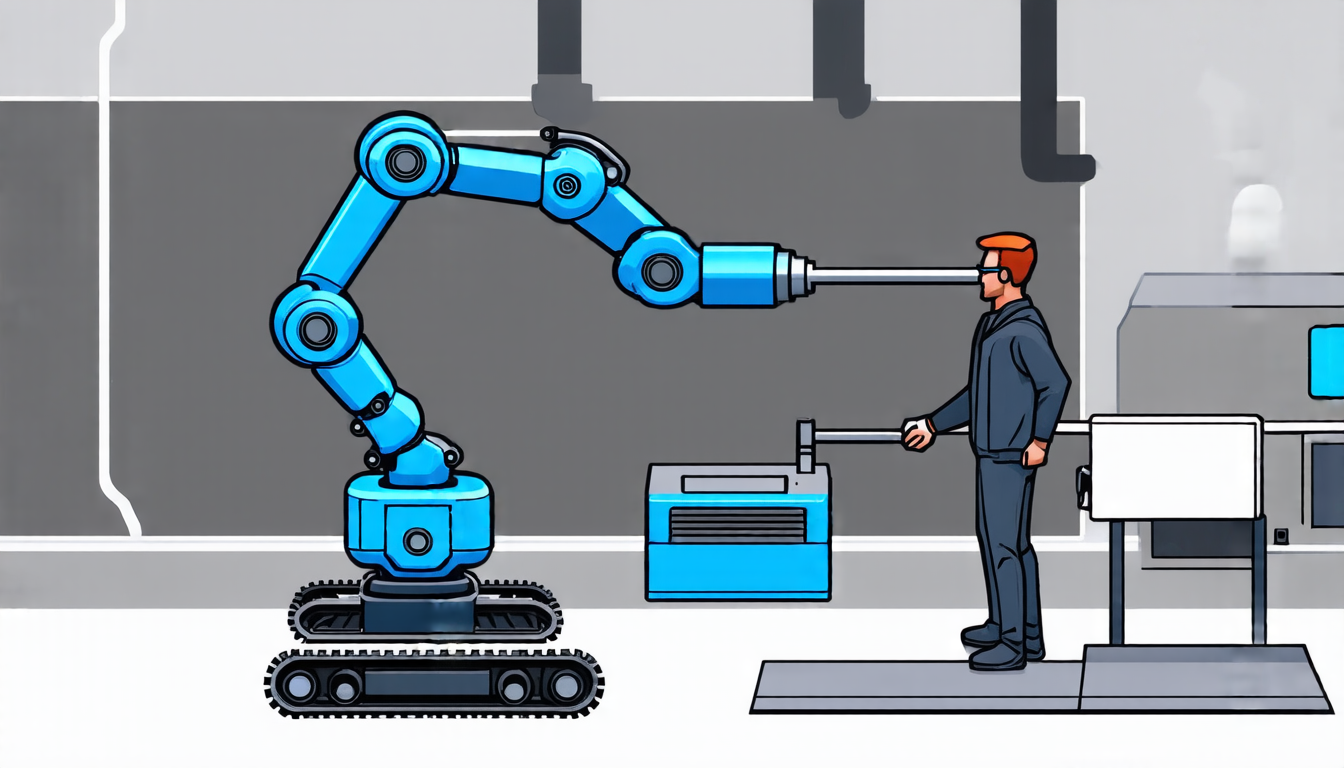
As we navigate through our daily lives, it’s easy to take for granted the intricate dance of humans and machines working together in harmony. From assembly lines to healthcare, collaborative robots (cobots) are becoming increasingly common, promising improved productivity, efficiency, and even safety.
However, ensuring a seamless coexistence between humans and machines is no trivial task. Cobots must be programmed to anticipate and respond to the unpredictable nature of human behavior, all while avoiding collisions and minimizing downtime. It’s a complex problem that has puzzled researchers for years.
Enter MARSHA, a revolutionary new algorithm designed to optimize the path planning process in cobot systems. Developed by a team of researchers from Italy and Germany, MARSHA (Motion Replanning with Safety-Aware Human State Estimation) combines reactive and proactive elements to dynamically adjust the robot’s path in real-time, minimizing execution time while ensuring safety.
The key innovation lies in MARSHA’s ability to estimate the human state – including their proximity, speed, and direction of movement – and incorporate this information into the motion planning process. This allows the cobot to anticipate potential hazards and adjust its course accordingly, reducing the need for costly and time-consuming safety interventions.
But how does it work? In short, MARSHA uses a sampling-based costmap planner to generate a set of possible paths based on the human state estimate. The algorithm then evaluates these paths using a safety-aware cost function, selecting the most efficient and safe route. This process is repeated in real-time as the human and robot interact, allowing the cobot to adapt to changing circumstances.
The results are nothing short of impressive. Simulations and real-world experiments have shown that MARSHA reduces execution time by up to 60% compared to traditional motion planning approaches, while also minimizing safety interventions. This has significant implications for industries where downtime can be costly, such as manufacturing and healthcare.
MARSHA’s potential extends beyond the realm of cobots, too. The algorithm could be applied to a wide range of applications where human-robot collaboration is essential, from search and rescue operations to space exploration.
As we continue to push the boundaries of what’s possible with human-machine collaboration, MARSHA represents an important step forward in ensuring the safe and efficient integration of robots into our daily lives. By empowering cobots to adapt and respond to changing circumstances in real-time, MARSHA is poised to revolutionize the way humans and machines work together – a prospect that’s both exciting and unsettling.
Cite this article: “Hybrid Path Planning for Human-Robot Collaboration: A Proactive and Reactive Approach to Enhance Safety and Efficiency”, The Science Archive, 2025.
Cobots, Motion Planning, Path Planning, Algorithm, Safety-Aware, Human State Estimation, Real-Time Adaptation, Execution Time, Collaboration, Robots





