

Tuesday 08 April 2025
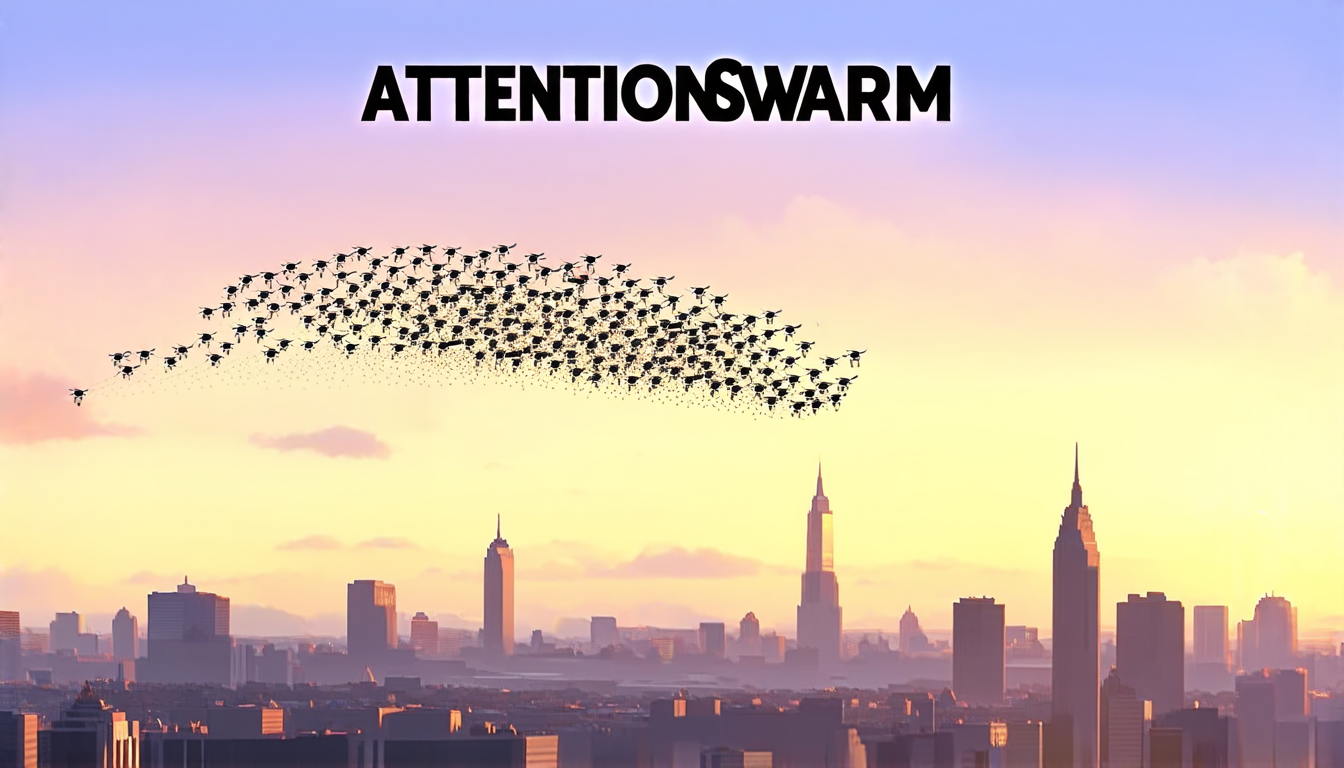
A swarm of tiny drones, each about the size of a human hand, recently navigated through treacherous airspace with ease, dodging obstacles and landing safely in their designated spot. But this isn’t just any ordinary drone operation – these autonomous flyers are powered by a sophisticated artificial intelligence that ensures their safety and efficiency.
The technology behind this feat is called AttentionSwarm, a novel approach to multi-agent reinforcement learning (MARL) that allows drones to adapt to complex environments in real-time. By incorporating an attention mechanism into its control barrier function, the system can dynamically prioritize critical obstacles and agents in the swarm’s vicinity, making it far more effective at navigating dynamic scenarios.
In traditional MARL systems, each drone is programmed with a set of predefined rules or behaviors that govern its actions. But this approach has limitations – what happens when unexpected obstacles appear, or when multiple drones need to coordinate their movements simultaneously? AttentionSwarm addresses these challenges by introducing an attention mechanism that allows the system to focus on the most relevant information in real-time.
The result is a swarm of drones that can navigate through dense crowds and dynamic environments with ease. In one experiment, researchers tested the system’s capabilities by simulating a drone racing scenario with multiple obstacles and moving gates. The results were impressive – the AttentionSwarm system achieved 100% accuracy in navigation, far outperforming traditional MARL systems.
But what makes AttentionSwarm truly remarkable is its potential to be applied to a wide range of real-world scenarios. Imagine autonomous delivery drones navigating through busy city skies, or search and rescue teams coordinating their efforts in response to natural disasters. The possibilities are endless, and researchers are already exploring the potential applications of this technology.
One of the key advantages of AttentionSwarm is its ability to learn from experience. As the system encounters new scenarios, it can adapt its behavior to optimize performance and safety. This means that drones can become increasingly efficient and effective over time, making them ideal for a wide range of applications.
The development of AttentionSwarm is a testament to the power of human ingenuity and innovation. By combining cutting-edge AI research with real-world problem-solving, researchers have created a technology that has the potential to transform industries and improve lives. As we continue to push the boundaries of what is possible, it’s exciting to think about the possibilities that AttentionSwarm could bring.
Cite this article: “Safe Swarm Navigation: A Novel Attention-Based Control Barrier Function Framework for Multi-Agent Drone Racing and Landing in Dynamic Environments”, The Science Archive, 2025.
Artificial Intelligence, Autonomous Drones, Multi-Agent Reinforcement Learning, Marl, Attention Mechanism, Swarm Robotics, Obstacle Avoidance, Real-Time Navigation, Drone Racing, Search And Rescue





