

Wednesday 09 April 2025
Scientists have made a significant breakthrough in developing superconducting microwave resonators, a crucial component for quantum computers and other cutting-edge technologies. By creating a vacuum gap between the conductor and the ground plane, researchers have been able to significantly reduce losses and improve the performance of these devices.
Superconducting microwave resonators are used to amplify and manipulate microwave signals in quantum computers. They work by storing energy in a magnetic field and then releasing it as a coherent signal. However, traditional designs often suffer from high losses due to the dielectric material used between the conductor and the ground plane.
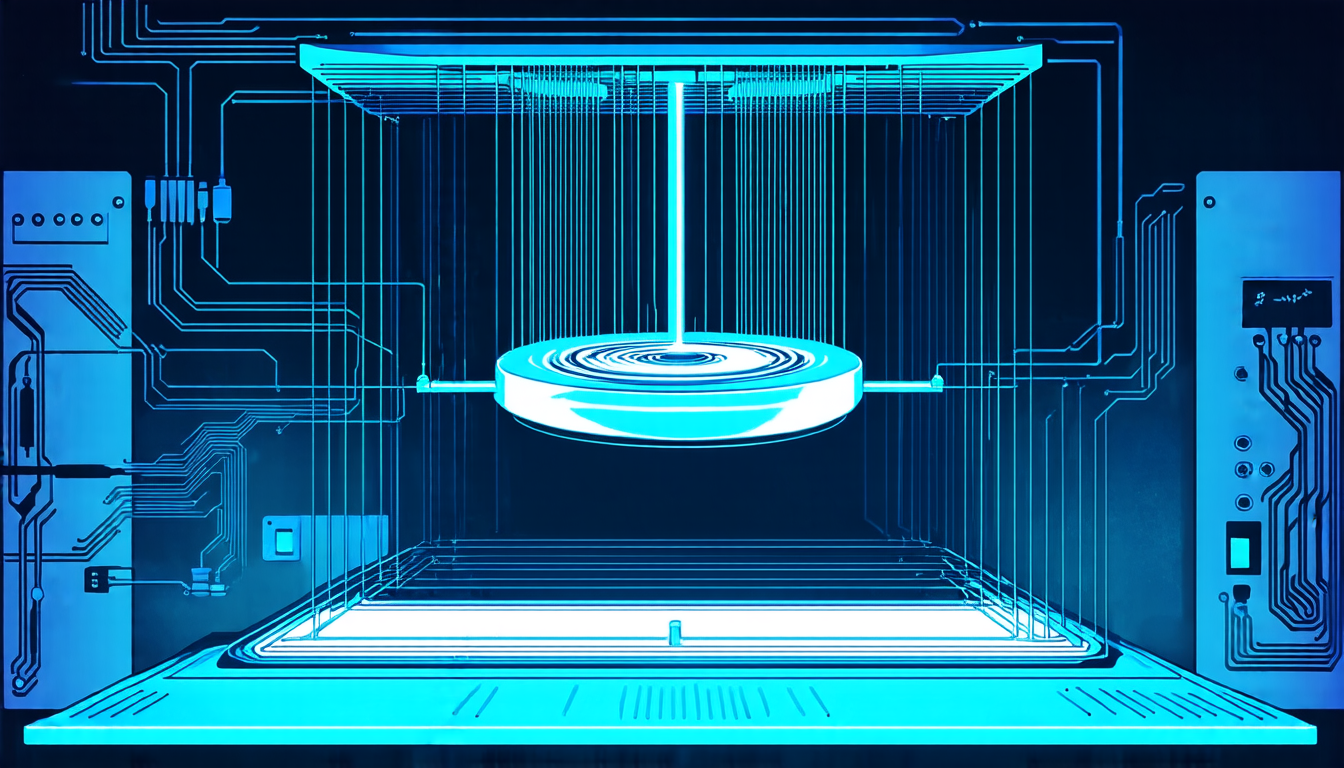
The new design uses a vacuum gap instead of a dielectric material, which greatly reduces the loss of energy. This is achieved by suspending the conductor above the ground plane using a thin membrane or a series of small pillars. The result is a device that can store more energy and release it with greater precision.
One of the key benefits of this design is its ability to reduce the noise level in the system. Quantum computers are extremely sensitive to noise, as it can cause errors in the calculations. By reducing the noise level, researchers can improve the overall accuracy of the quantum computer.
Another advantage of this design is its potential for scaling up. As more and more quantum computers are built, there is a growing need for devices that can handle higher frequencies and greater power levels. The new design could be used to create larger, more powerful resonators that can handle these demands.
The researchers achieved this breakthrough by using advanced materials and techniques. They created the vacuum gap using a combination of microfabrication and chemical vapor deposition. This allowed them to precisely control the distance between the conductor and the ground plane, as well as the thickness of the membrane or pillars used to suspend it.
The team also developed new algorithms and software tools to simulate and optimize the performance of the resonators. These simulations helped them to identify the optimal design parameters for maximum energy storage and release.
In addition to its potential applications in quantum computing, this technology could also have implications for other fields such as medicine and materials science. For example, superconducting microwave resonators could be used to create more precise medical imaging devices or to study the properties of exotic materials.
Overall, this breakthrough has the potential to revolutionize the field of quantum computing and beyond. By reducing losses and improving performance, these new resonators could enable faster, more accurate calculations and open up new possibilities for scientific research and technological innovation.
Cite this article: “Breakthrough in Quantum Computing: Scientists Develop Revolutionary Fabrication Process for Superconducting Resonators”, The Science Archive, 2025.
Superconducting, Microwave, Resonators, Quantum Computers, Vacuum Gap, Losses, Performance, Noise, Scaling, Materials Science





