

Wednesday 09 April 2025
The intricate dance of fluids and heat is a complex phenomenon that has fascinated scientists for centuries. At the heart of this puzzle lies the behavior of supercritical fluids, which exhibit unique properties when heated above their critical point. Recent research has shed new light on this enigmatic realm, revealing a subtle interplay between thermodynamics, fluid dynamics, and numerical methods.
Supercritical fluids are those that exist above their critical temperature and pressure, where the distinction between liquid and gas phases becomes meaningless. This regime is characterized by rapid changes in density, viscosity, and thermal conductivity, making it challenging to model and predict their behavior. The discovery of novel materials and technologies relies heavily on our understanding of these properties.
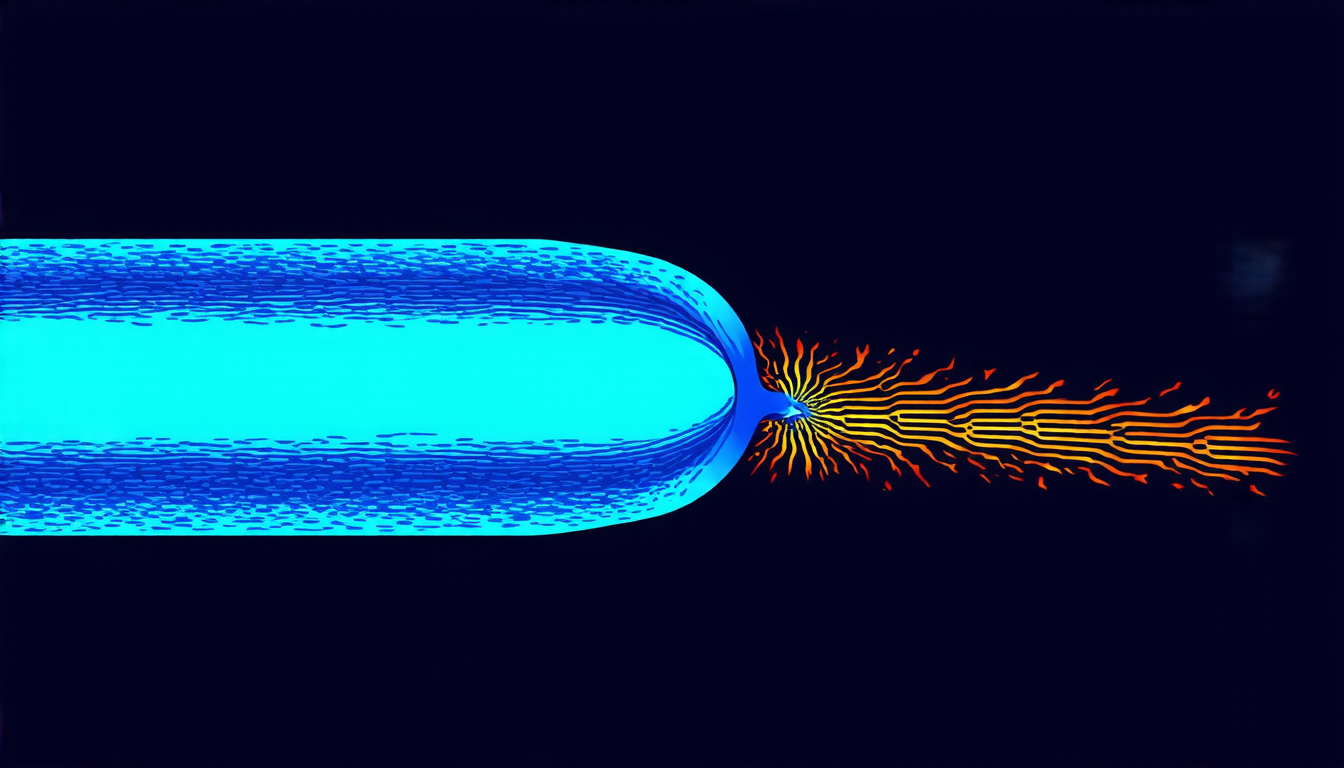
Researchers have long struggled to develop accurate numerical models that capture the intricacies of supercritical fluid dynamics. A recent study presents a new approach, dubbed the ‘reversible-irreversible vector field splitting’ method, which promises to revolutionize the field. This innovative technique decouples the reversible and irreversible components of the fluid’s motion, allowing for more precise simulations.
The authors employ a clever combination of numerical methods and thermodynamic principles to tackle this problem. By splitting the vector field into its reversible and irreversible parts, they can accurately model the fluid’s behavior while avoiding the pitfalls of traditional approaches. This breakthrough has far-reaching implications for fields such as chemical engineering, materials science, and even geothermal energy.
One of the most striking aspects of this research is its ability to reconcile seemingly contradictory theories. For decades, scientists have debated the role of thermodynamics in supercritical fluid dynamics. The new method reconciles these conflicting views by recognizing that both reversible and irreversible processes play crucial roles in shaping the fluid’s behavior.
This study also highlights the importance of numerical methods in understanding complex phenomena. By leveraging advanced computational techniques, researchers can now simulate the intricate interactions between fluids and heat with unprecedented accuracy. This has significant implications for the development of novel materials and technologies.
The future of supercritical fluid research looks bright indeed, thanks to this innovative approach. As scientists continue to push the boundaries of our understanding, we may uncover new applications in fields such as medicine, energy storage, and advanced manufacturing. The dance between fluids and heat is about to become even more intricate, with profound consequences for our world.
Cite this article: “Unlocking Supercritical Fluid Dynamics: A Novel Time-Integration Scheme”, The Science Archive, 2025.
Supercritical Fluids, Thermodynamics, Fluid Dynamics, Numerical Methods, Critical Point, Heat Transfer, Density, Viscosity, Thermal Conductivity, Chemical Engineering.





