

Wednesday 09 April 2025
Robotics has been revolutionizing industries and daily life for decades, but a crucial aspect of robotic development remains largely untapped: quality-aware benchmarking. Researchers have traditionally focused on measuring success rates, ignoring factors that affect real-world performance. A new study introduces QBIT, a cloud-based framework designed to address this issue.
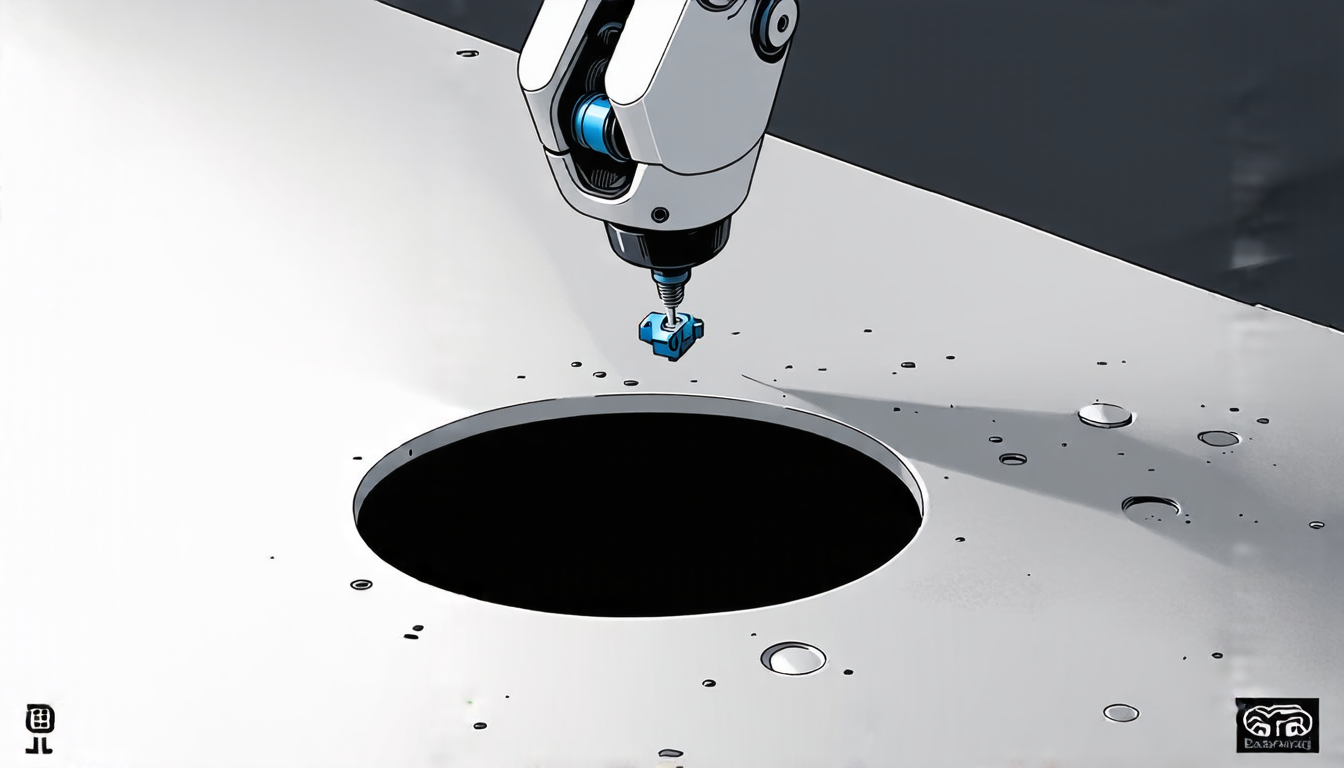
The team behind QBIT recognized the limitations of previous approaches, which often relied solely on success rates to evaluate robotic insertion tasks. These tasks, such as peg-in-hole operations, require precise control and delicate handling. However, real-world applications are often plagued by environmental uncertainties, surface roughness, and varying friction levels. To accurately assess performance, QBIT incorporates quality-aware metrics that consider these factors.
One key innovation is the use of randomized contact model parameters in simulations. This approach ensures that the simulation environment better replicates the unpredictability of real-world scenarios, providing a more comprehensive understanding of robotic performance. By leveraging cloud computing and Kubernetes-based parallelization, QBIT can efficiently process vast amounts of data and simulate complex insertion tasks.
The framework also incorporates advanced mesh decomposition techniques to accurately model contact behavior. Traditional methods often rely on convex decomposition, which can be sensitive to mesh scale. In contrast, QBIT employs a sphere-based approach that allows for more realistic simulations and is less susceptible to parameter variation.
To validate the effectiveness of QBIT, researchers conducted extensive experiments using three different insertion approaches: geometric-based, force-based, and learning-based. The results demonstrate that QBIT’s quality-aware metrics effectively distinguish between these methods, even when all executions were technically successful.
The implications of this research are far-reaching. By providing a comprehensive evaluation framework, QBIT enables roboticists to develop more reliable and efficient insertion tasks. This can have significant benefits in industries such as manufacturing, where precise assembly is crucial for product quality and reliability.
Furthermore, the study’s emphasis on sim-to-real gap reduction has the potential to accelerate the development of real-world robotic applications. By better understanding the differences between simulated and actual environments, researchers can design more effective algorithms that adapt to real-world uncertainties.
As robotics continues to evolve, QBIT offers a vital tool for advancing our understanding of complex insertion tasks. By bridging the sim-to-real gap and incorporating quality-aware metrics, this framework has the potential to revolutionize the development of robotic systems and unlock new possibilities in various industries.
Cite this article: “Unlocking the Secrets of Robotic Assembly: A Cloud-Based Framework for Quality-Aware Evaluation”, The Science Archive, 2025.
Robotics, Benchmarking, Quality-Aware Metrics, Sim-To-Real Gap, Cloud-Based Framework, Kubernetes, Parallelization, Mesh Decomposition, Contact Behavior, Insertion Tasks





