

Wednesday 09 April 2025
The persistence of resonant caustics in perturbed circular billiards has long been a topic of interest among mathematicians and physicists. In a recent study, researchers have made significant progress in understanding the behavior of these caustics under small perturbations.
For those unfamiliar with the concept, caustics are curves that tangent trajectories in a billiard table stay tangent to after every reflection. Resonant caustics, specifically, are those where the rotation number of the caustic is rational. These caustics play a crucial role in determining the dynamics of the billiard system.
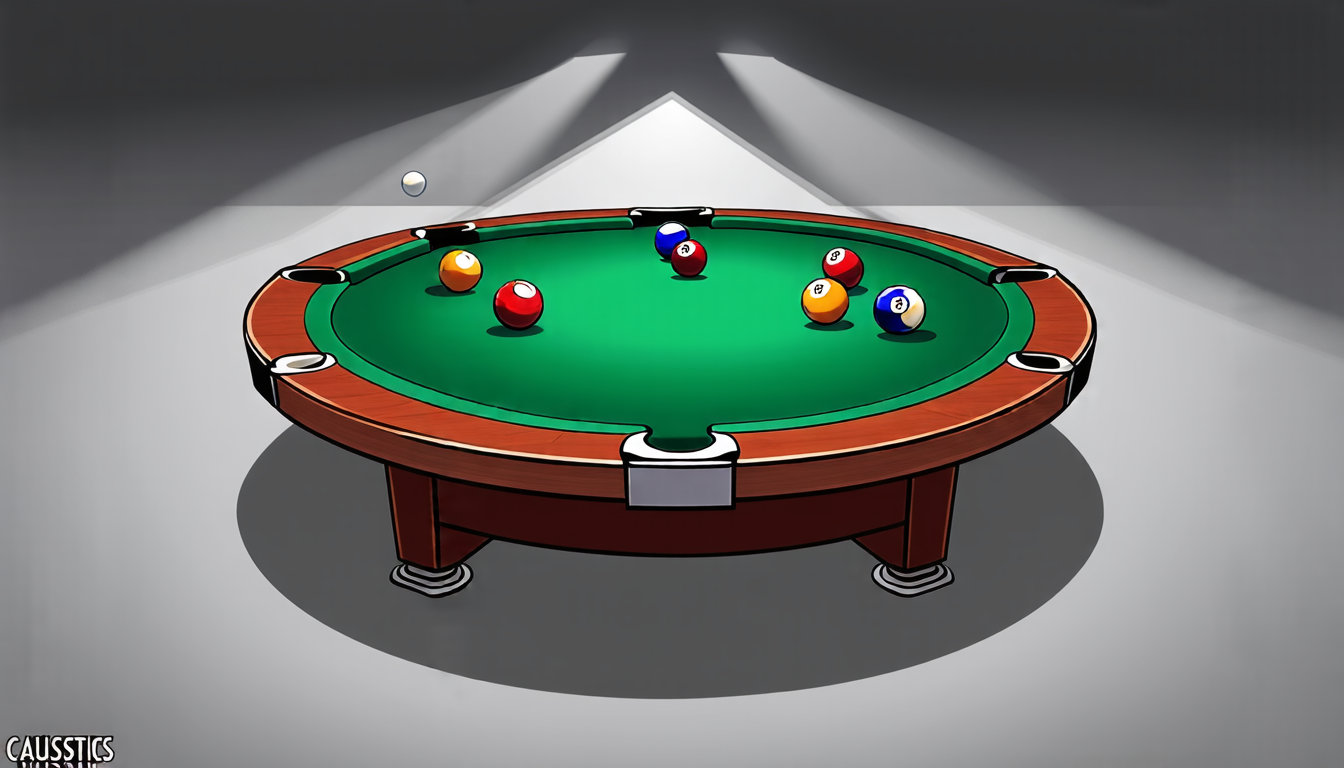
The study focuses on perturbed circular billiards, which are billiards with a circular boundary that has been deformed by a small amount. The researchers used a novel approach to analyze the behavior of resonant caustics under these deformations. They developed a high-order perturbation theory that allows them to compute the O(εm)-corrections for the support function and the rotation number of the caustic.
The key finding is that, surprisingly, all resonant caustics with period q persist up to order ⌈q/n⌉−1 under any polynomial deformation of degree n. This means that even under small perturbations, these caustics remain stable and continue to exhibit their characteristic behavior.
The researchers also explored the cases where the perturbation is not polynomial but rather anti-centrally symmetric or centrally symmetric. In these scenarios, they found that the persistence conditions are more stringent, requiring the period of the caustic to be odd or even, respectively.
This study has significant implications for our understanding of billiard dynamics and the behavior of resonant caustics. The findings could also have applications in fields such as optics, where caustics play a crucial role in determining the behavior of light.
The researchers used a combination of mathematical techniques and computational methods to analyze the problem. They developed novel algorithms to compute the high-order corrections and validated their results using numerical simulations.
In the future, this research could lead to a deeper understanding of the dynamics of billiard systems and potentially inspire new applications in other fields. The study’s findings also highlight the importance of mathematical rigor in understanding complex phenomena.
The persistence of resonant caustics is a fascinating area of research that continues to attract attention from mathematicians and physicists alike.
Cite this article: “Unlocking the Secrets of Billiard Tables: A New Approach to Understanding Chaos and Integrability”, The Science Archive, 2025.
Billiards, Caustics, Perturbations, Circular Billiards, Resonant Caustics, Rotation Number, Support Function, High-Order Perturbation Theory, Polynomial Deformation, Anti-Centrally Symmetric Deformation, Centrally Symmetric Deformation





