

Wednesday 09 April 2025
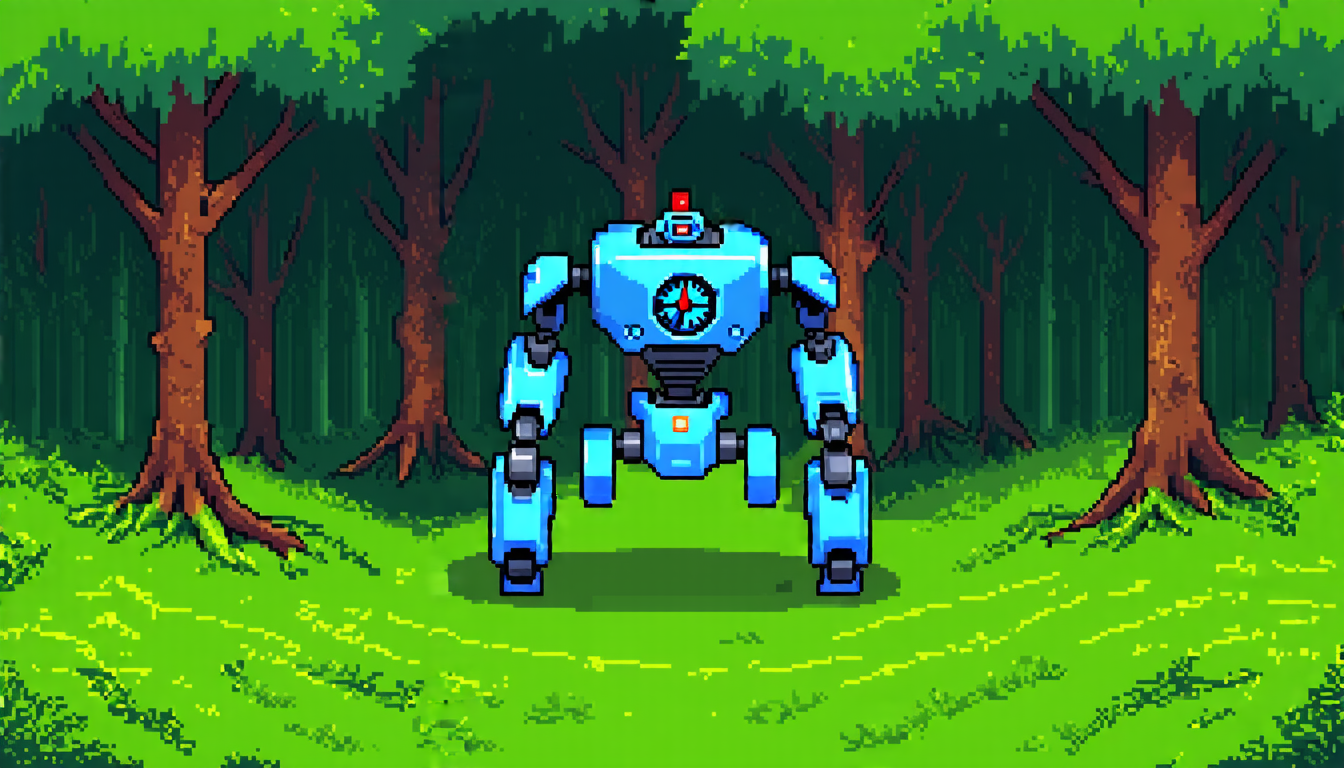
Scientists have made a significant breakthrough in developing a navigation system that can help robots and autonomous vehicles navigate through complex environments without relying on advanced sensors or cameras. This innovative approach, called Blind- Wayfarer, uses a minimalist sensor suite to enable robots to traverse challenging terrain, including dense forests and uneven landscapes.
The key to this technology lies in its ability to adapt to changing environments by using a combination of a compass and inertial measurement unit (IMU) sensors. These sensors provide the robot with crucial information about its heading and orientation, allowing it to make informed decisions about its movement.
In traditional navigation systems, robots rely heavily on visual data from cameras or LiDAR sensors to build a mental map of their surroundings. However, in environments where these sensors are unreliable or unavailable, such as dense forests or areas with heavy occlusion, the robot can become lost or stuck.
Blind-Wayfarer addresses this problem by using a probing-driven approach, where the robot uses its sensors to detect and respond to obstacles in its path. This allows the robot to adapt to changing environments and avoid getting stuck or lost.
The system was tested in a series of simulated forest environments, where it achieved a remarkable 99.7% success rate in navigating through complex terrain without getting stuck. The researchers also demonstrated the effectiveness of Blind-Wayfarer by testing it on two real-world robot platforms, one larger and more robust, and another smaller and lighter.
In these experiments, the robots were able to successfully navigate through dense forests and uneven landscapes using only their compass and IMU sensors. This breakthrough has significant implications for the development of autonomous vehicles and robots that can operate in a wide range of environments without relying on advanced sensors or cameras.
One potential application of Blind-Wayfarer is in search and rescue operations, where robots could be deployed to navigate through rubble or debris-filled areas to locate survivors or detect hazards. Another potential use case is in agricultural settings, where autonomous tractors or other vehicles could use Blind-Wayfarer to navigate through fields and orchards without getting stuck or lost.
The researchers behind Blind-Wayfarer are now exploring ways to further improve the system’s performance and adaptability. They are also investigating its potential applications in a range of industries, from agriculture and construction to search and rescue and environmental monitoring.
Cite this article: “Breaking Free: A Probing-Driven Navigation Framework for Reliable Robot Escapes in Perception-Degraded Environments”, The Science Archive, 2025.
Robotics, Navigation, Autonomous Vehicles, Sensors, Compass, Imu, Blind-Wayfarer, Navigation System, Robotics Technology, Environmental Monitoring.





