

Wednesday 09 April 2025
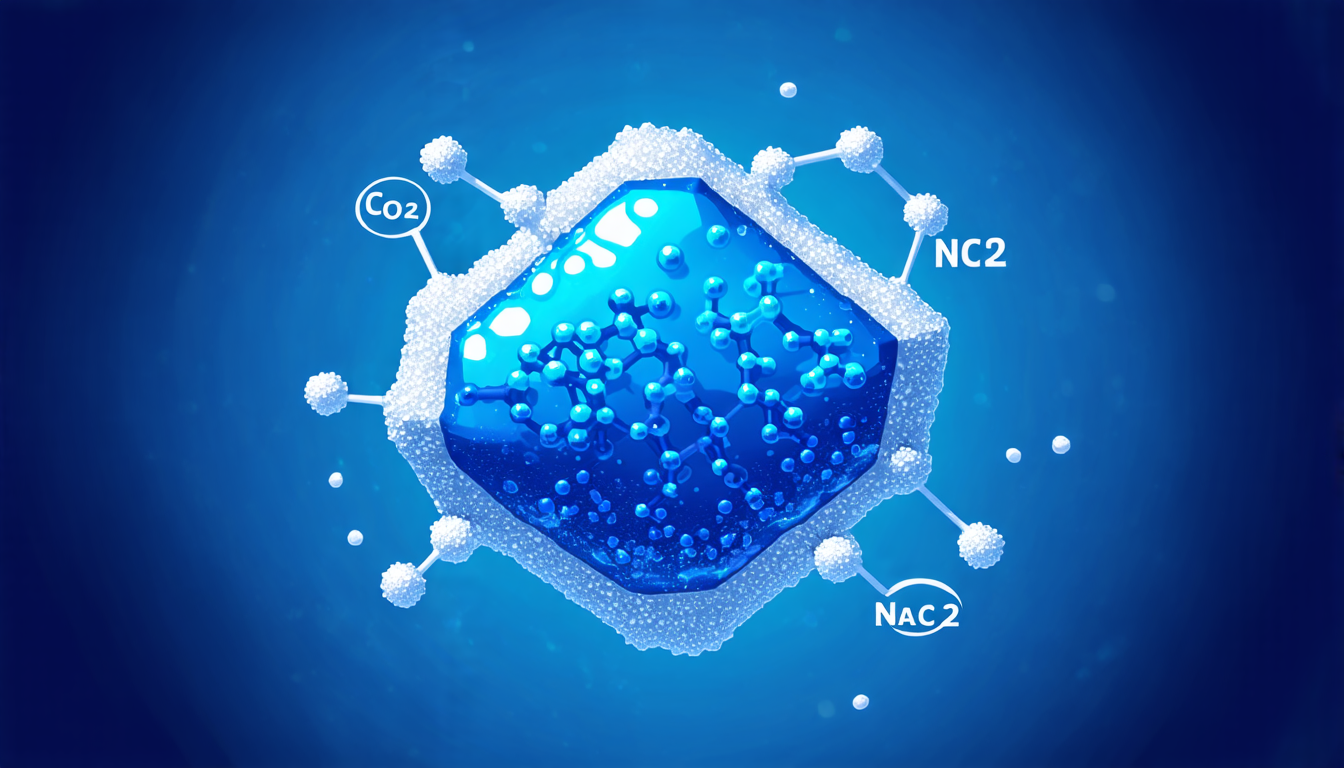
A recent study has shed new light on the behavior of carbon dioxide hydrates, a type of clathrate that forms when CO2 is dissolved in water under specific conditions. These hydrates have potential applications in energy storage and carbon capture, but understanding their properties is crucial for harnessing their benefits.
The research focused on the cryoscopic decrease effect, a phenomenon where the temperature at which hydrates dissociate decreases as the concentration of salt (in this case, sodium chloride) increases. This effect has been observed before, but the study aimed to investigate its extent and implications for practical applications.
To achieve this, scientists used molecular dynamics simulations to model the behavior of CO2 hydrates in aqueous solutions with varying concentrations of NaCl. These simulations allowed them to analyze the interactions between water molecules, ions, and CO2, as well as the structure and stability of the hydrate crystals.
The results showed that the cryoscopic decrease effect is indeed real and significant, with dissociation temperatures decreasing by up to 20% in the presence of high salt concentrations. This has important implications for the design and operation of systems that rely on CO2 hydrates, such as those used for carbon capture and storage.
One key finding was that the effect is more pronounced at higher pressures, which suggests that it could be exploited to create more efficient and effective CO2 storage systems. Additionally, the simulations revealed that the cryoscopic decrease effect is not limited to CO2 hydrates, but can also occur with other types of clathrates.
The study’s findings have significant implications for the development of sustainable energy solutions. By better understanding the behavior of CO2 hydrates, scientists can design more effective systems for capturing and storing carbon dioxide, which is essential for mitigating climate change.
Furthermore, the research highlights the importance of considering the interactions between water molecules, ions, and guest molecules (such as CO2) when designing and optimizing energy storage and capture technologies. By taking into account these complex interactions, scientists can create more efficient and effective systems that are better equipped to handle the challenges of a low-carbon future.
The study’s results also underscore the importance of computational modeling in understanding complex phenomena like clathrate formation and dissociation. Molecular dynamics simulations offer a powerful tool for exploring the behavior of materials at the molecular level, allowing scientists to test hypotheses and make predictions about real-world systems.
Cite this article: “Unlocking the Secrets of Carbon Dioxide Hydrates: A Computational Study Reveals New Insights into Phase Equilibria”, The Science Archive, 2025.
Carbon Dioxide Hydrates, Clathrate, Cryoscopic Decrease Effect, Molecular Dynamics Simulations, Sodium Chloride, Energy Storage, Carbon Capture, Sustainable Energy Solutions, Climate Change, Computational Modeling.





