

Wednesday 09 April 2025
The quest for seamless teleoperation has long been a holy grail for robotics researchers. For decades, scientists have strived to develop systems that allow humans to control robots with ease and precision, mimicking the natural way we interact with our own bodies. Now, a team of experts has made significant strides towards achieving this goal.
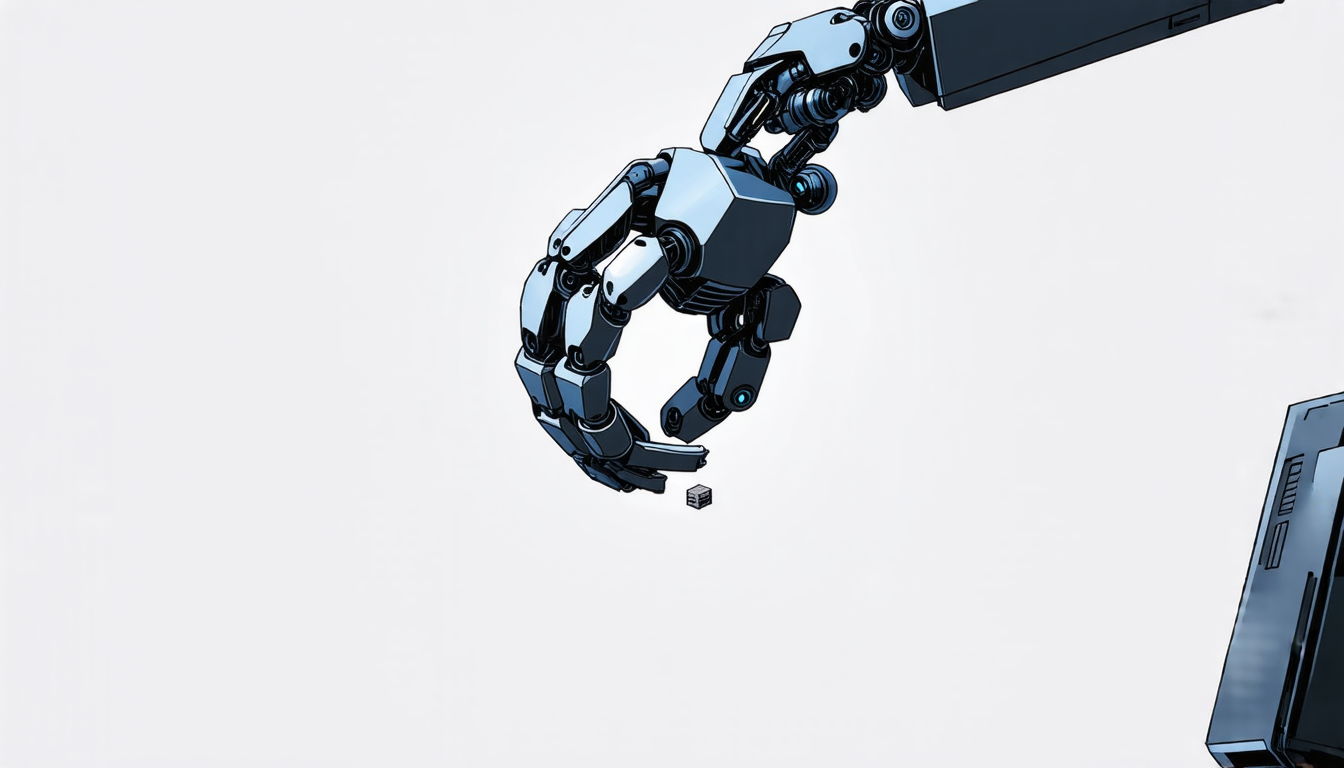
The breakthrough comes in the form of Geometric Retargeting (GeoRT), a novel approach to neural hand retargeting that enables robots to mirror human movements with uncanny accuracy. Developed by researchers at Meta FAIR Labs and UC Berkeley, GeoRT is an unsupervised learning system that doesn’t require manual annotations or tedious calibration processes.
At its core, GeoRT relies on a set of geometric objective functions that define the ideal retargeting process. These objectives ensure that the robot’s hand movements are not only smooth but also preserve the natural motion fidelity and C-space coverage of human hands. In other words, GeoRT encourages the robot to mimic human movements in a way that is both intuitive and efficient.
The system’s effectiveness has been demonstrated through simulations and real-world experiments using the Allegro robot hand and Franka Panda robot arm. Results show that GeoRT enables robots to grasp objects with unprecedented speed and precision, rivaling even the most advanced teleoperation systems.
One of the key advantages of GeoRT is its ability to learn from human movements without explicit supervision. This means that the system can adapt to new situations and environments with minimal training data, making it an attractive solution for a wide range of applications, from industrial manufacturing to search and rescue operations.
In addition to its technical prowess, GeoRT also has significant implications for the field of robotics as a whole. By enabling robots to mirror human movements in a more natural and intuitive way, GeoRT paves the way for the development of more sophisticated robotic systems that can interact with humans in a more seamless and efficient manner.
The potential applications of GeoRT are vast and varied, from enhancing the capabilities of service robots to improving the performance of surgical assistants. As researchers continue to refine and expand this technology, we may soon see robots becoming an integral part of our daily lives, working alongside us to make our world a better place.
GeoRT’s success is a testament to the power of collaborative research and the potential for innovation that arises from interdisciplinary approaches.
Cite this article: “Unlocking Dexterous Teleoperation: A Principled Approach to Neural Hand Retargeting”, The Science Archive, 2025.
Robotics, Teleoperation, Neural Hand Retargeting, Geometric Retargeting, Machine Learning, Unsupervised Learning, Robot Control, Human-Robot Interaction, Industrial Manufacturing, Search And Rescue





