

Wednesday 09 April 2025
In a breakthrough that could revolutionize human-robot collaboration, scientists have developed a system that enables robots and humans to reconcile their mental models of a shared task in real-time.
Mental models are abstract representations of reality used by both humans and robots to reason about cause and effect. In human-robot interactions, these models can diverge, leading to misunderstandings and errors. To address this issue, researchers have proposed a framework for bi-directional mental model reconciliation, leveraging large language models (LLMs) to facilitate alignment through semi-structured natural language dialogue.
The system, which involves both humans and robots sharing knowledge and preferences during interaction, allows them to identify and communicate missing task-relevant context. This iterative process gradually forms a shared, mutually satisfactory mental model for the task at hand.
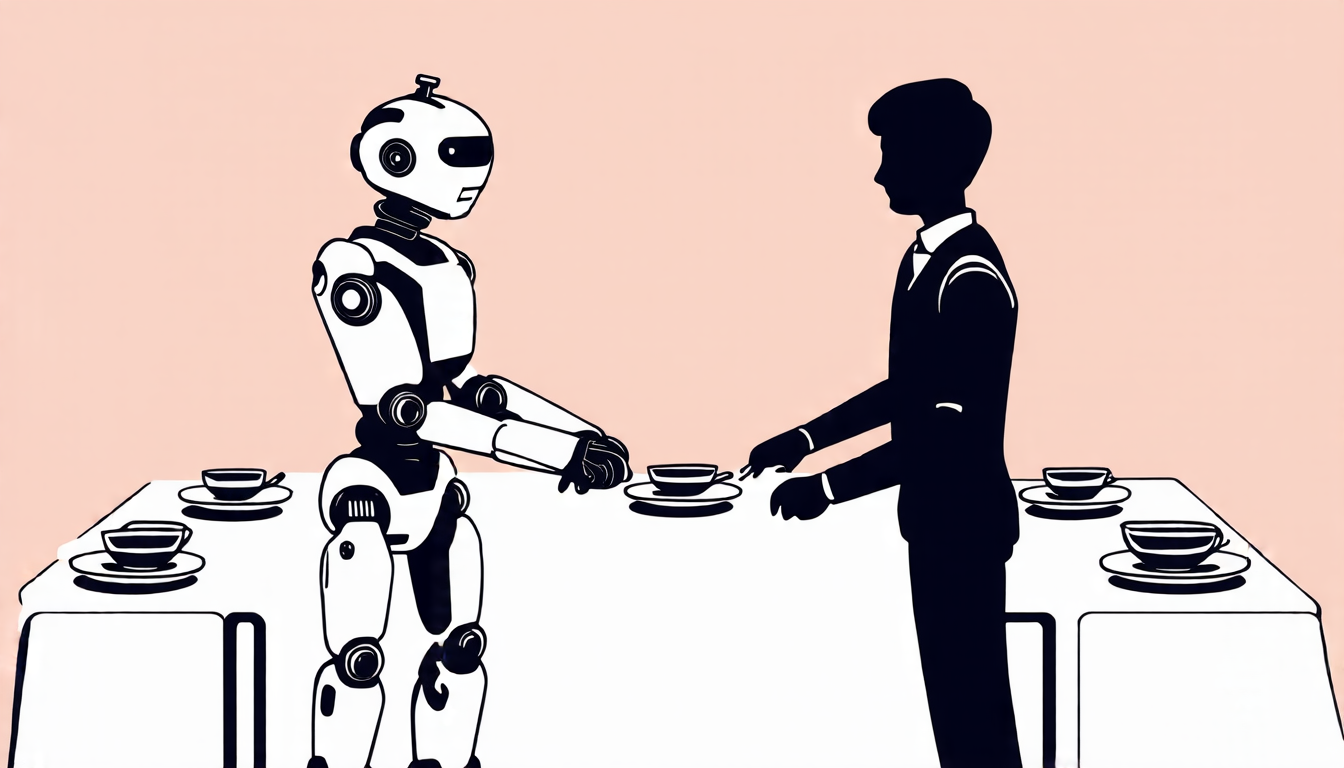
To test this framework, researchers designed an experiment where humans and robots worked together to organize and host a dinner party. The results showed that as the number of iterations increased, both the accuracy of the robot’s and human’s mental models improved, converging towards the true state of the task. Moreover, the alignment between the two mental models improved significantly.
The system’s effectiveness was also evaluated through user surveys, which revealed positive attitudes towards the robot and improved trust in its ability to collaborate effectively. The participants’ perceived workload decreased as they became more comfortable with the robot’s capabilities and limitations.
This research has significant implications for human-robot collaboration in various domains, such as healthcare, education, and manufacturing. By enabling robots and humans to reconcile their mental models in real-time, this system can improve task efficiency, reduce errors, and enhance overall performance.
The researchers’ approach uses a combination of planning languages, fact-based models, and LLMs to facilitate the alignment process. The robot’s mental model is represented using Planning Domain Definition Language (PDDL), while shared mental model context is represented as structured facts. An LLM processes natural language dialogue between the human and robot agents, providing explanations for discrepancies in their mental models.
The experiment demonstrated that this system can be effective even when both mental models contain incomplete information. The results highlight the importance of mutual understanding and communication in human-robot collaboration, emphasizing the need for robots to be able to adapt and learn from humans.
As researchers continue to develop and refine this technology, it is likely that we will see significant advancements in human-robot collaboration, enabling us to work more effectively together in a wide range of applications.
Cite this article: “Unlocking Human-Robot Harmony: A Framework for Bi-Directional Mental Model Reconciliation”, The Science Archive, 2025.
Human-Robot Collaboration, Mental Models, Natural Language Dialogue, Large Language Models, Bi-Directional Reconciliation, Task Efficiency, Error Reduction, Performance Improvement, Planning Domain Definition Language, Fact-Based Models





