

Wednesday 09 April 2025
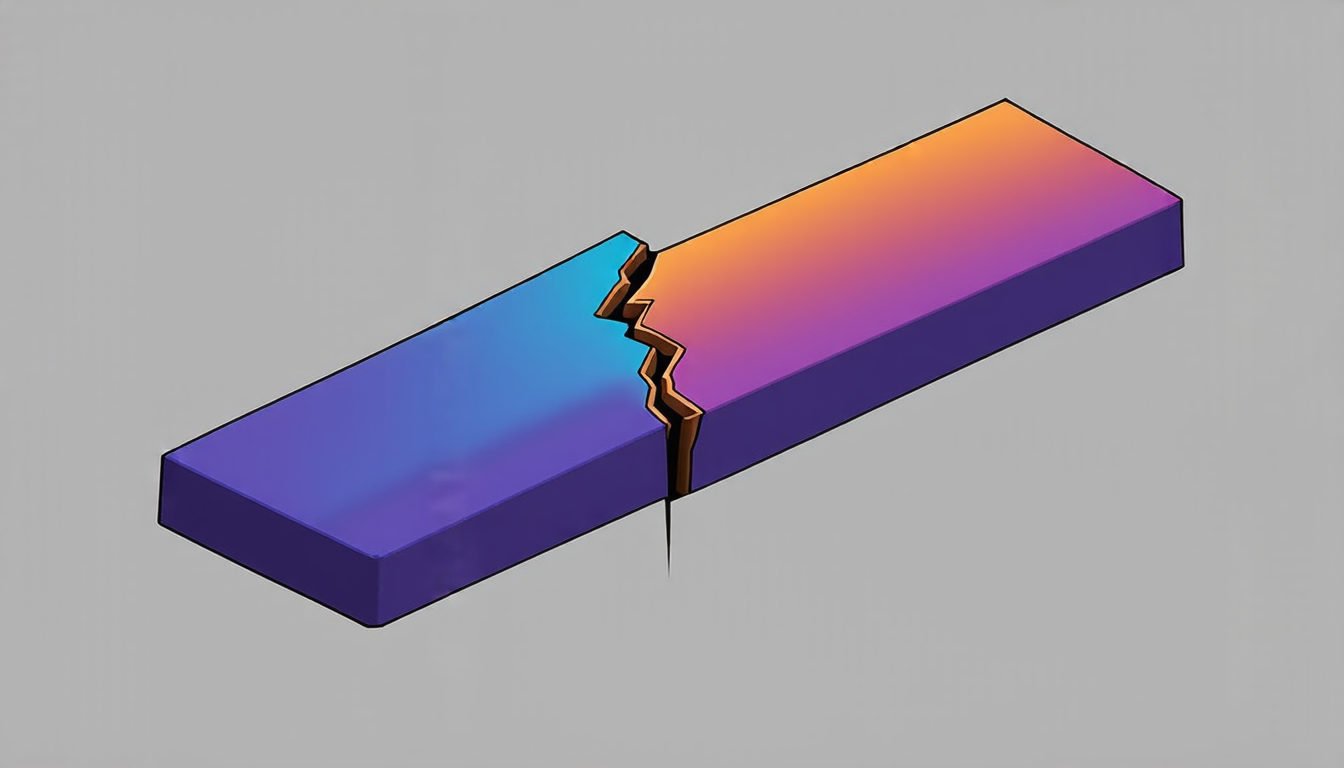
Cracks in materials are a natural part of their life cycle, but they can be problematic when it comes to maintaining structural integrity and preventing failures. Researchers have long sought ways to better understand and predict how cracks form and propagate, especially in complex materials like composites or anisotropic solids.
Recently, a team of scientists made significant strides in this area by developing a new model for simulating the behavior of cracks in these types of materials. Their approach uses a combination of mathematical techniques and computational methods to accurately capture the complex interactions between the crack tip, the surrounding material, and the external loads applied to the system.
One of the key innovations of this work is its ability to account for the non-linear responses of the material at the crack tip. In traditional models, the material is often assumed to behave linearly, which can lead to inaccurate predictions when the actual behavior is more complex. By incorporating non-linear effects into their model, the researchers were able to better capture the subtle changes in stress and strain that occur near the crack tip.
The team also developed a novel finite-element method for discretizing the problem, which allowed them to accurately resolve the complex spatial variations in stress and strain around the crack tip. This was particularly important for capturing the intricate details of the crack propagation process, where small changes in the material’s behavior can have significant effects on the overall outcome.
To test their model, the researchers applied it to a range of scenarios involving different types of cracks and materials. They found that their approach was able to accurately predict the behavior of the cracks in each case, even when the external loads were highly non-uniform or the material properties varied significantly over the length scale of interest.
The implications of this work are significant for a wide range of fields, from aerospace engineering to materials science and beyond. By providing more accurate predictions of crack behavior, researchers can better design structures that are more resilient to damage and failure, which could have major benefits in terms of safety and cost savings.
In addition, the methods developed by the team have broader applications in the field of computational mechanics, where they can be used to study a wide range of problems involving non-linear materials and complex geometries. As researchers continue to push the boundaries of what is possible with these techniques, we can expect to see even more innovative solutions emerge in the years to come.
Cite this article: “Unveiling the Secrets of Crack Propagation in Anisotropic Materials: A Novel Finite Element Approach”, The Science Archive, 2025.
Cracks, Materials, Simulation, Modeling, Nonlinear, Finite-Element, Computational Mechanics, Composite Materials, Anisotropic Solids, Structural Integrity.





