

Wednesday 09 April 2025
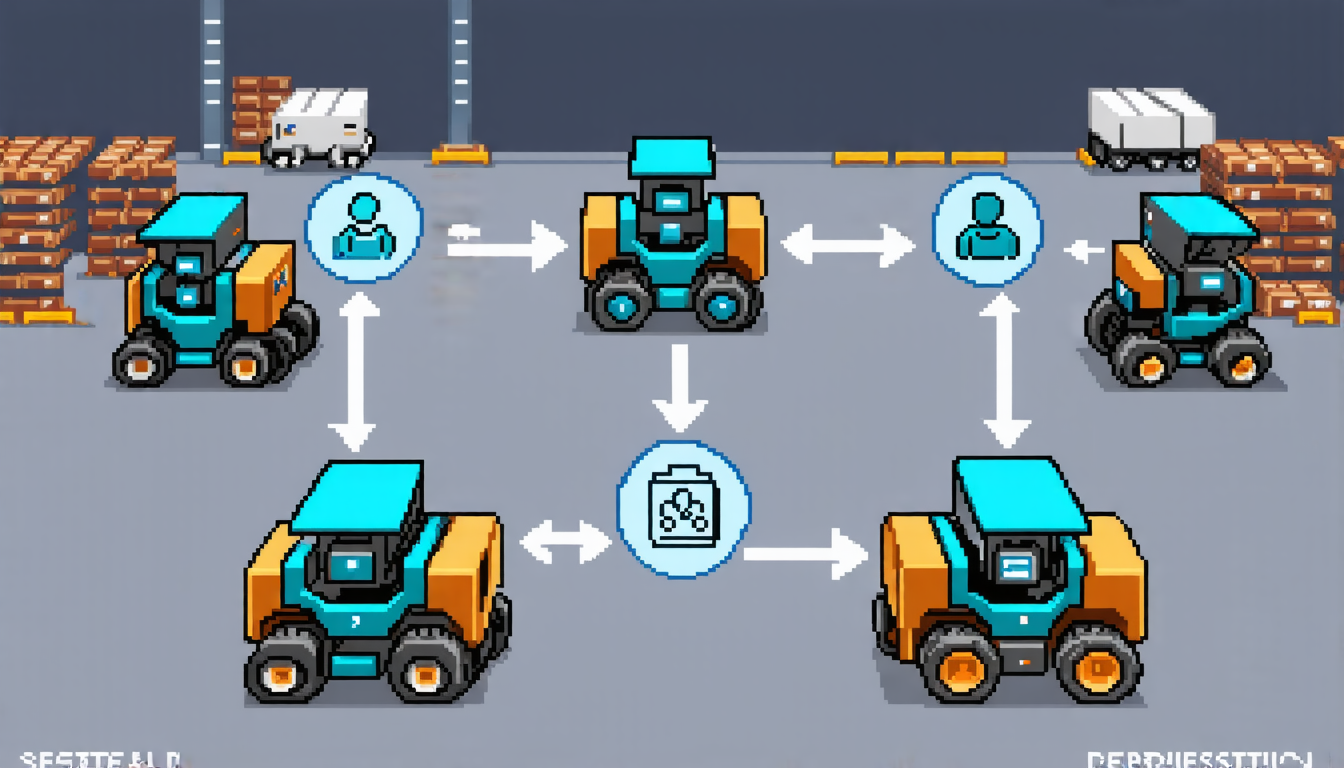
Researchers have developed a novel decentralized task allocation framework that enables multiple robots and vehicles to work together efficiently in dynamic environments. The system, called HIPPO-MAT, uses graph neural networks (GNNs) to aggregate information from all agents and make rapid, conflict-aware decisions.
The problem of task allocation is a classic challenge in robotics and autonomous systems. In traditional approaches, a central authority assigns tasks to each agent based on its capabilities and the environment’s constraints. However, this can lead to inefficiencies and bottlenecks, especially when dealing with large numbers of agents or dynamic environments.
HIPPO-MAT addresses these limitations by introducing a decentralized approach that relies on GNNs to process information from all agents. Each agent receives local observations about the environment and tasks, which it uses to compute an embedding that represents its current state and capabilities. The GNN then aggregates these embeddings across all agents, creating a global representation of the system’s state.
This aggregated representation is fed into an independent policy network, which makes decisions about task allocation based on the global state. The policy network is trained using a deep reinforcement learning algorithm, allowing it to adapt to changing environments and task distributions.
The researchers evaluated HIPPO-MAT in various scenarios, including fixed-task allocation and continuous task allocation with dynamic tasks. In both cases, the system demonstrated excellent performance, achieving near-optimal results while reducing allocation time by up to 90% compared to traditional centralized approaches.
HIPPO-MAT’s decentralized nature also allows it to handle conflicts between agents effectively. When two or more agents attempt to allocate the same task, the system uses a modified A* path planner to resolve the conflict and ensure that each agent has a clear route to its assigned task.
The researchers validated HIPPO-MAT in real-world experiments using JetBot ROS AI robots, which demonstrated the system’s ability to robustly handle sensor noise and communication delays. The results show that HIPPO-MAT is not only efficient but also scalable and adaptable to changing environments.
While HIPPO-MAT is still a research prototype, its potential applications are vast. It could be used in various domains, such as warehouse management, search and rescue operations, or even urban planning, where multiple agents need to work together to achieve a common goal.
The development of HIPPO-MAT highlights the ongoing progress in decentralized AI and robotics research. As we move towards more autonomous systems, it’s essential to develop frameworks that can efficiently allocate tasks and resources in dynamic environments.
Cite this article: “Decentralized Task Allocation in Dynamic Environments: A Graph Neural Network Approach”, The Science Archive, 2025.
Decentralized Ai, Graph Neural Networks, Task Allocation, Robotics, Autonomous Systems, Dynamic Environments, Reinforcement Learning, Conflict Resolution, Scalability, Efficiency





