

Wednesday 09 April 2025
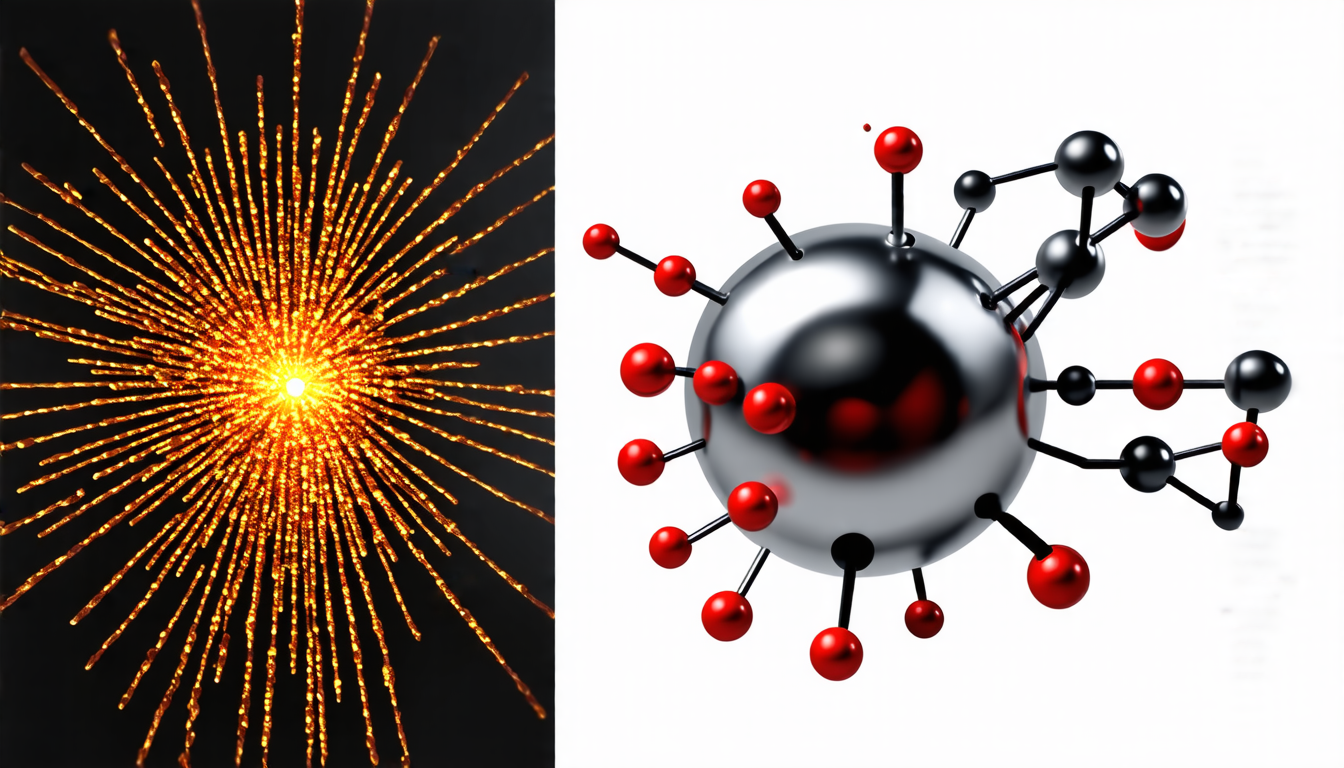
A team of physicists has made a significant breakthrough in understanding the behavior of heavy-flavored mesons, which are subatomic particles composed of quarks and antiquarks. These particles play a crucial role in our understanding of the strong nuclear force that holds protons and neutrons together inside atomic nuclei.
To study these particles, the researchers used a technique called Schrödinger’s equation, which is a mathematical formula that describes how particles move and interact with each other. They applied this equation to a type of heavy-flavored meson called B mesons, which are made up of a bottom quark and an up or down antiquark.
The researchers found that when they exposed these B mesons to an external magnetic field, the energy levels of the particles changed in a predictable way. This is similar to what happens when you place a magnet near a piece of iron: the iron atoms align themselves with the magnetic field, causing the iron to become magnetized.
In this case, the researchers found that the B mesons behaved as if they were spinning around an axis, just like electrons do in atoms. When they exposed these particles to a magnetic field, the spin axis aligned itself with the direction of the field, causing the energy levels of the particles to shift.
This study has important implications for our understanding of the strong nuclear force and how it behaves at very small distances. It also provides new insights into the behavior of heavy-flavored mesons and how they can be used as probes to study the properties of subatomic particles.
The researchers used a technique called harmonic oscillator basis vector expansion to solve Schrödinger’s equation for these B mesons. This involved breaking down the complex mathematical problem into simpler pieces that could be solved using well-known algorithms.
One of the key findings of this study was that the energy levels of the B mesons changed in a predictable way when they were exposed to different strengths of magnetic field. The researchers found that as the strength of the magnetic field increased, the energy levels of the particles shifted downward.
This is similar to what happens when you place a magnet near a piece of iron: as the strength of the magnetic field increases, the iron becomes more strongly magnetized. In this case, the B mesons are behaving like tiny magnets that are aligning themselves with the direction of the external magnetic field.
Cite this article: “Unlocking the Secrets of Heavy-Flavored Mesons in Magnetic Fields”, The Science Archive, 2025.
Heavy-Flavored Mesons, Schrödinger’S Equation, B Mesons, Bottom Quark, Up Antiquark, Down Antiquark, Magnetic Field, Spin Axis, Harmonic Oscillator Basis Vector Expansion, Strong Nuclear Force





