

Wednesday 09 April 2025
The future of artificial intelligence (AI) is rapidly evolving, and one area that’s gaining significant attention is adaptive routing protocols for AI multi-agent systems. These protocols aim to optimize communication between agents in complex networks, ensuring timely responses to high-priority tasks while efficiently managing global resources.
Traditionally, routing algorithms have focused on minimizing latency and maximizing bandwidth, but these approaches often fall short in dynamic environments where agents’ capabilities, availability, and reliability change frequently. To address this challenge, researchers have developed a new algorithm that integrates multiple factors into a single cost function, allowing it to adapt to changing network conditions.
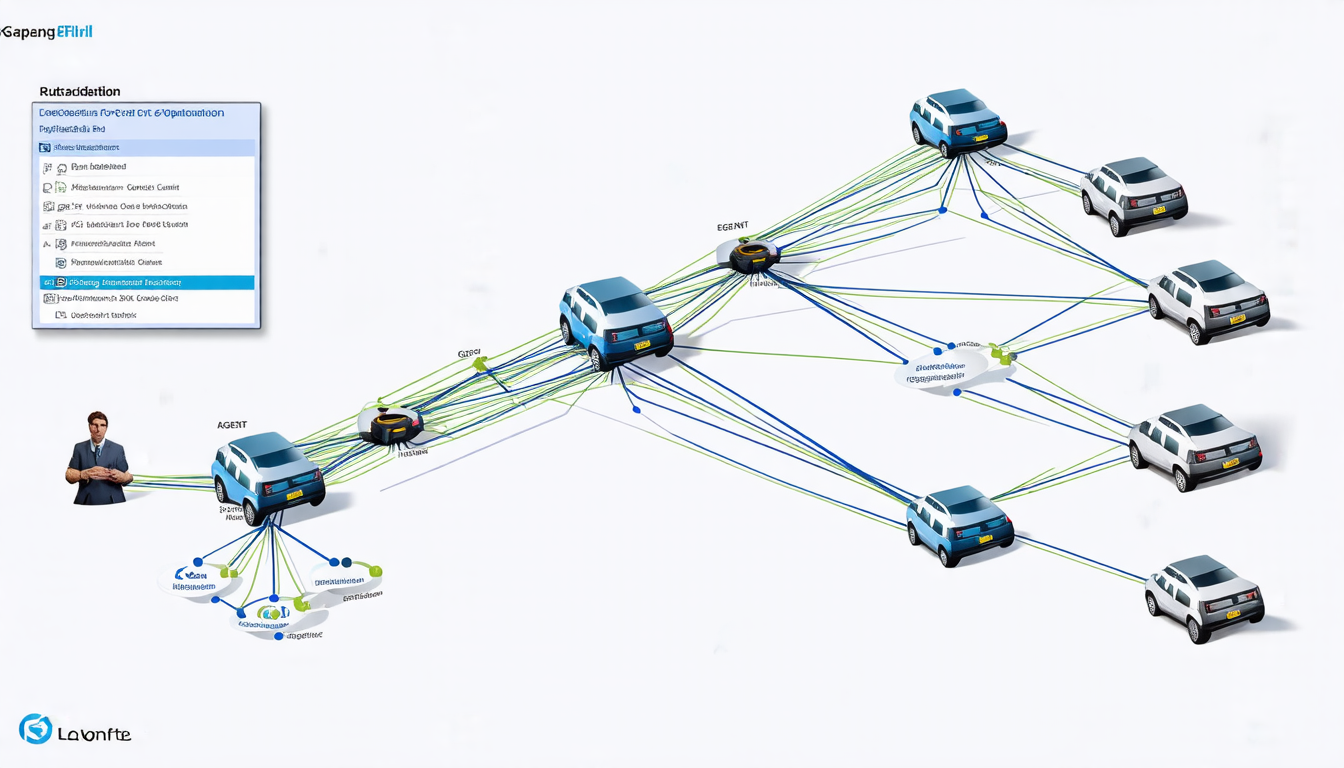
The adaptive priority-based Dijkstra’s Algorithm (APBDA) is designed for AI multi-agent systems, which are networks of autonomous agents that work together to achieve common goals. These agents can be found in various applications, such as distributed robotics, federated learning platforms, and large-scale IoT networks. APBDA’s primary goal is to determine the optimal path for each agent’s communication needs while taking into account factors like task complexity, user request priority, agent processing capability, availability, bandwidth, latency, load, model sophistication, and reliability.
The algorithm works by computing a cost function for each possible route between agents. This cost function incorporates weights that reflect the relative importance of each factor in the decision-making process. For example, if an agent is experiencing high latency, the algorithm may assign a higher weight to this factor, causing it to prioritize routes with lower latency.
To further improve routing decisions, APBDA employs reinforcement learning (RL) techniques. RL allows the algorithm to learn from its mistakes and adapt to changing network conditions over time. This process involves periodically updating the weights based on system-wide metrics like average completion time for high-priority tasks, load distribution fairness, and agent reliability.
The benefits of APBDA are numerous. It enables contextual intelligence by selecting routes tailored to the specific needs of each task. For instance, if a high-priority task requires fast processing, the algorithm will prioritize agents with high processing capabilities. Additionally, APBDA’s dynamic adaptation ensures that routing decisions remain optimal even as network conditions change.
To reduce computational complexity in large-scale networks, researchers have also developed heuristic filtering and hierarchical clustering techniques. Heuristic filtering involves pruning suboptimal paths early in the search process, while hierarchical clustering groups agents into clusters and applies the full APBDA algorithm within each cluster.
Cite this article: “Adaptive Routing in AI Multi-Agent Systems: A Priority-Based Approach to Optimize Task Allocation and Resource Utilization”, The Science Archive, 2025.
Artificial Intelligence, Multi-Agent Systems, Adaptive Routing Protocols, Dijkstra’S Algorithm, Priority-Based Routing, Reinforcement Learning, Iot Networks, Distributed Robotics, Federated Learning, Contextual Intelligence





