

Wednesday 09 April 2025
Scientists have long sought to harness the power of Majorana fermions, exotic particles that could revolutionize computing and data storage. These particles are known for their ability to exist in two states at once, a property known as non-Abelian statistics. This unique behavior allows them to process information in ways that traditional computers can only dream of.
Majorana fermions are typically found in superconducting materials, which have zero electrical resistance. However, creating and manipulating these particles is an incredibly challenging task. In order to study Majorana fermions, scientists need to create a system where they can be isolated and observed.
Recently, researchers have made significant progress in this area by using a combination of semiconductor and superconducting materials. These hybrid systems allow scientists to control the behavior of Majorana fermions with unprecedented precision.
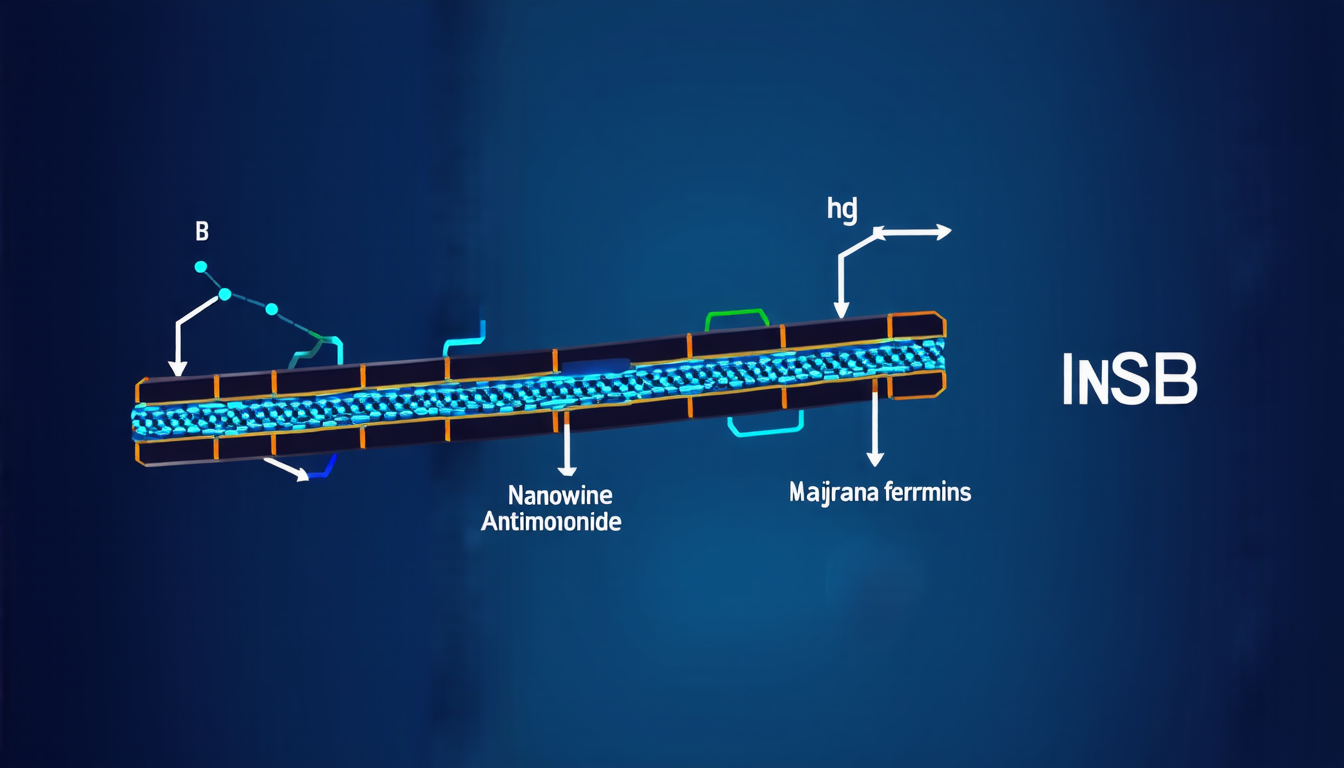
One such system is a nanowire made from a semiconductor material called indium antimonide (InSb). When cooled to extremely low temperatures, InSb becomes superconducting, allowing it to host Majorana fermions. The researchers were able to create a nanowire with a specific shape and structure that allowed them to isolate the Majorana fermions.
The team then used advanced imaging techniques to visualize the behavior of these particles. They found that the Majorana fermions exhibited the expected non-Abelian statistics, processing information in a way that was both fascinating and potentially revolutionary.
However, the researchers also discovered that the presence of disorder in the nanowire had a significant impact on the behavior of the Majorana fermions. Disorder refers to the random arrangement of atoms or impurities within the material. In this case, the disorder caused the Majorana fermions to behave in unexpected ways, making it more challenging to study and manipulate them.
Despite these challenges, the researchers were able to develop new techniques for identifying and characterizing the Majorana fermions. They used a combination of theoretical modeling and experimental data to understand how the particles behaved in response to different conditions.
The findings from this research have significant implications for the development of topological quantum computers. These computers would use Majorana fermions to process information, allowing them to solve complex problems that are currently unsolvable with traditional computers.
In the future, scientists hope to continue studying Majorana fermions and developing new techniques for manipulating and controlling them. This research has the potential to revolutionize computing and data storage, opening up new possibilities for fields such as medicine, finance, and climate modeling.
Cite this article: “Majorana Mayhem: Unraveling the Mystery of Zero-Bias Peaks in Semiconductor-Superconductor Heterostructures”, The Science Archive, 2025.
Majorana Fermions, Non-Abelian Statistics, Superconducting Materials, Semiconductor, Nanowire, Indium Antimonide, Disorder, Topological Quantum Computers, Computing, Data Storage





