

Wednesday 09 April 2025
Scientists have made a significant breakthrough in developing a new approach to training artificial intelligence (AI) systems that can learn from demonstrations, without requiring explicit programming or rewards. This innovation has the potential to revolutionize the way we design and deploy AI systems, particularly in safety-critical applications such as autonomous vehicles.
Traditionally, AI systems are trained using reinforcement learning techniques, which involve trial-and-error exploration of a system’s behavior, often with rewards and penalties to guide the learning process. However, this approach can be time-consuming, computationally expensive, and may not always produce optimal results. In contrast, imitation learning allows AI systems to learn from demonstrations provided by an expert, such as a human or another AI system.
The new approach, developed by researchers at the University of California, Berkeley, combines elements of reinforcement learning with imitation learning. The system uses a safety penalty term to ensure that the learned policy respects constraints and safety boundaries, even in the absence of explicit rewards. This is achieved through the use of control barrier functions, which are mathematical constructs that define the safe operating region of a system.
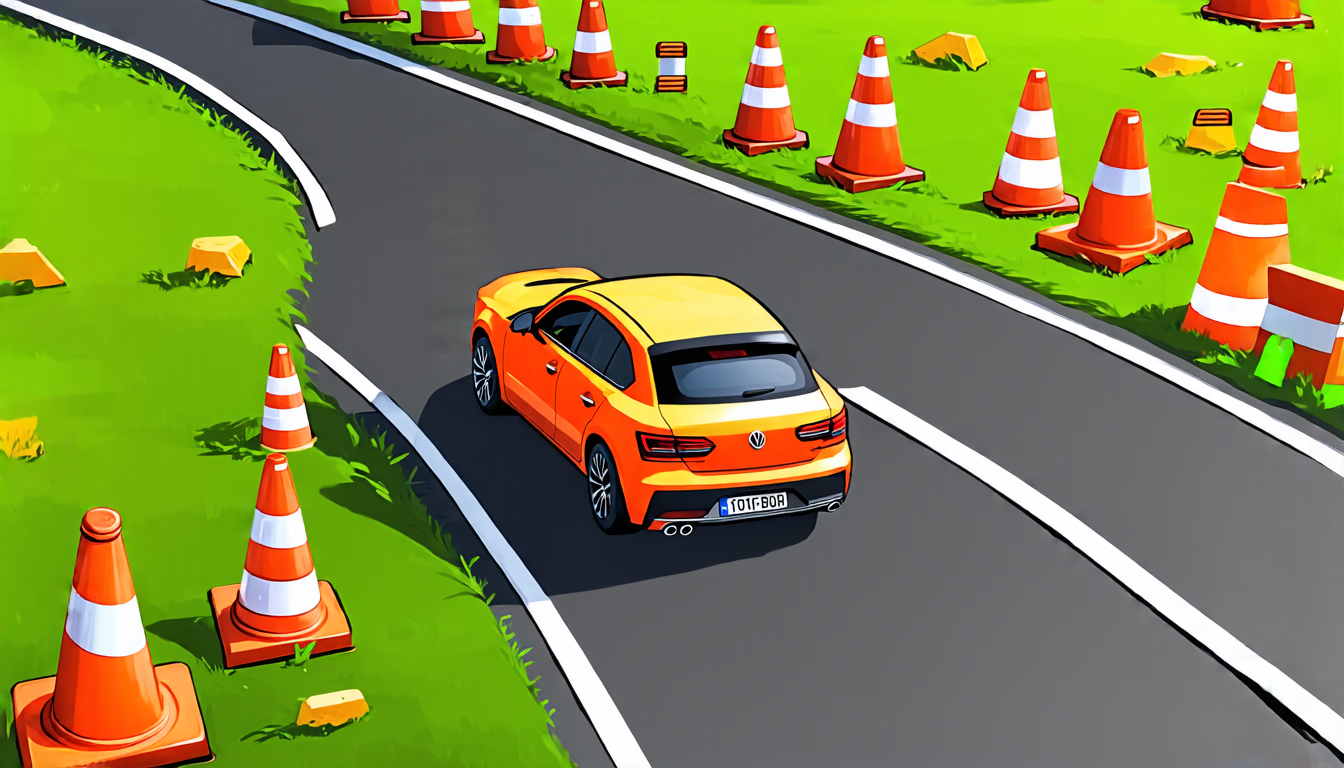
The proposed approach has been tested on various autonomous driving scenarios, including racing and path-following tasks. The results show that the AI system can learn to navigate complex environments and avoid obstacles while respecting safety constraints. Moreover, the system is able to adapt to new situations and uncertain environments, making it more robust and reliable than traditional reinforcement learning approaches.
One of the key advantages of this approach is its ability to learn from a small number of demonstrations, making it more efficient and scalable than traditional reinforcement learning methods. Additionally, the use of safety penalties ensures that the learned policy respects constraints and safety boundaries, even in situations where the expert demonstration may not have explicitly provided guidance on how to behave.
The implications of this breakthrough are significant, particularly in the development of autonomous vehicles. Autonomous driving is a complex task that requires AI systems to navigate multiple scenarios, avoid obstacles, and respect traffic laws and regulations. The proposed approach has the potential to improve the safety and reliability of autonomous vehicles by enabling them to learn from expert demonstrations and adapt to new situations.
In addition to autonomous vehicles, this approach may have applications in other areas, such as robotics, healthcare, and finance. For example, AI systems could be trained to perform complex surgical procedures or manage financial portfolios using expert demonstrations and safety penalties.
Overall, the proposed approach represents a significant advancement in the development of AI systems that can learn from demonstrations.
Cite this article: “Safe and Efficient Autonomous Racing through Imitation Learning with Safety Filters”, The Science Archive, 2025.
Artificial Intelligence, Autonomous Vehicles, Machine Learning, Imitation Learning, Reinforcement Learning, Control Barrier Functions, Safety Penalties, Robotic Systems, Healthcare Applications, Financial Management.





