

Wednesday 09 April 2025
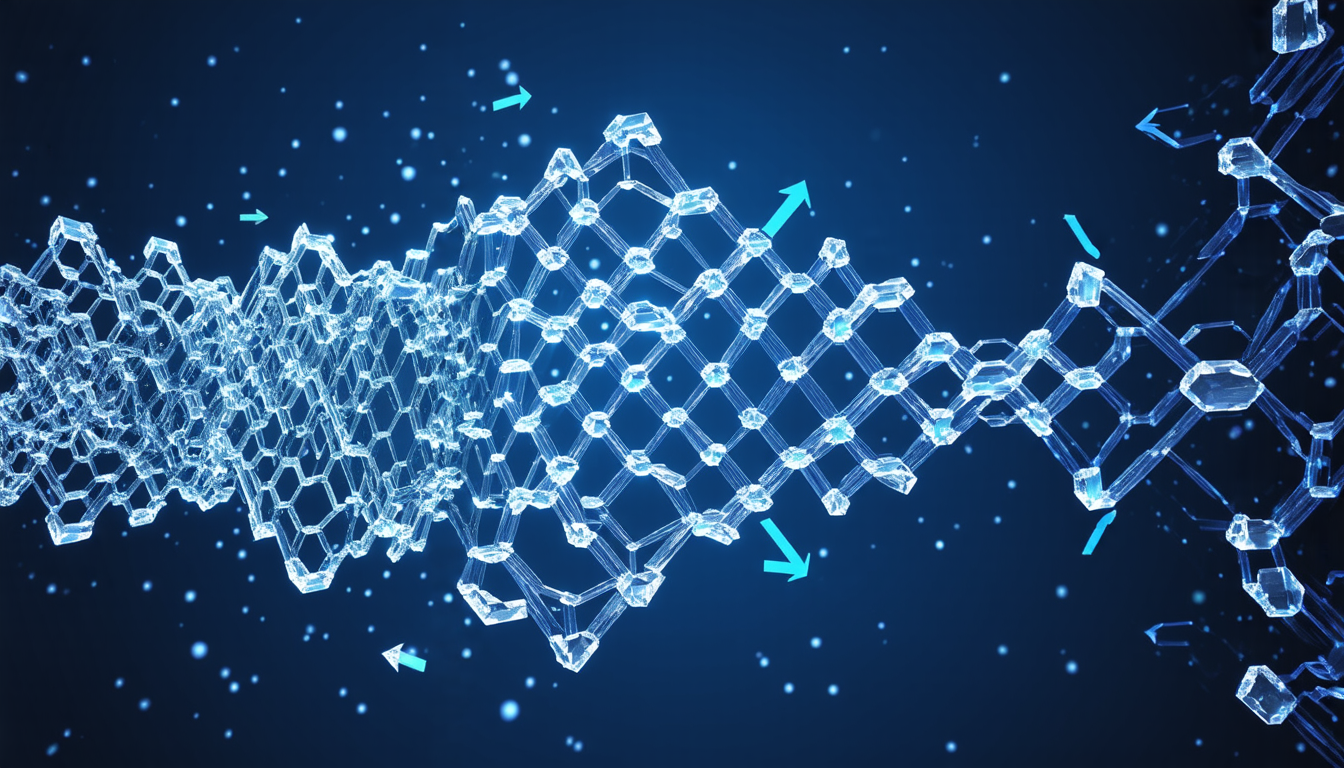
Time crystals have been a topic of fascination in the scientific community for some time now. These unusual systems exhibit periodic motion, but unlike traditional crystals that vibrate at a fixed frequency, time crystals can change their vibrational pattern over time. This phenomenon was first predicted theoretically and later observed experimentally in 2017.
In a recent study, researchers have explored the properties of time crystals further by using a different approach to create these systems. Instead of relying on periodic driving forces, they used an external packing field that varies with time to induce the formation of time crystals. This technique allows for more flexibility and control over the system, enabling scientists to tailor the behavior of the time crystal to specific applications.
The study focused on a type of particle known as the weakly asymmetric simple exclusion process (WASEP). In this system, particles move along a one-dimensional lattice according to certain rules, with the packing field influencing their motion. By analyzing the behavior of these particles, researchers were able to identify the conditions under which time crystals form and the characteristics of these systems.
One key finding was that the time crystal exhibits a phase transition, where it suddenly changes its properties in response to changes in the external driving force. This transition is accompanied by a sudden change in the order parameter, which measures the degree of symmetry breaking in the system. The researchers also observed that the time crystal displays universal behavior, meaning that its properties are independent of the specific details of the system and can be described by simple mathematical equations.
The study has important implications for our understanding of phase transitions and the behavior of complex systems. Time crystals offer a unique platform for studying these phenomena, as they are easier to experimentally manipulate than traditional systems. The researchers believe that their findings could lead to new insights into the fundamental laws governing physical systems and potentially even inspire novel technological applications.
In addition to advancing our understanding of phase transitions, this research has practical implications for fields such as materials science and chemistry. Time crystals have the potential to be used in the development of new materials with unique properties, such as superconductors or nanomaterials. The study also highlights the importance of interdisciplinary collaboration between physicists, chemists, and mathematicians.
Overall, this research demonstrates the power of innovative approaches in advancing our understanding of complex systems. By exploring new techniques and methods, scientists can uncover previously unknown phenomena and push the boundaries of human knowledge.
Cite this article: “Unlocking the Secrets of Time Crystals: A New Era in Quantum Physics”, The Science Archive, 2025.
Time Crystals, Phase Transitions, Complex Systems, Weakly Asymmetric Simple Exclusion Process, Wasep, Packing Field, External Driving Force, Order Parameter, Symmetry Breaking, Universal Behavior.





