

Wednesday 09 April 2025
Scientists have been working tirelessly to develop a robot that can perform complex tasks, like us humans do, but without the need for extensive programming or manual control. This dream has finally become a reality with the introduction of RoboCopilot, a revolutionary new system that enables robots to learn from human demonstrations and adapt to new situations.
The system is designed to mimic the way we learn skills, by observing and imitating others. In this case, humans can teach robots new tasks by simply showing them how it’s done. The robot then uses machine learning algorithms to refine its actions, allowing it to perform the task more efficiently and accurately over time.
One of the key features of RoboCopilot is its ability to learn from feedback. This means that if a human operator makes a mistake while teaching the robot, the system can correct itself and adapt to the new information. This level of flexibility is unprecedented in robotic technology and opens up a wide range of possibilities for applications.
The potential uses of RoboCopilot are vast and varied. In industries such as manufacturing and healthcare, robots could be trained to perform complex tasks that require human-like dexterity and precision. In search and rescue operations, robots could be used to navigate treacherous terrain and locate people in need of assistance.
But what really sets RoboCopilot apart is its ability to learn from humans. This means that the robot can adapt to new situations and environments, allowing it to perform tasks that would be impossible for a traditional robot to accomplish.
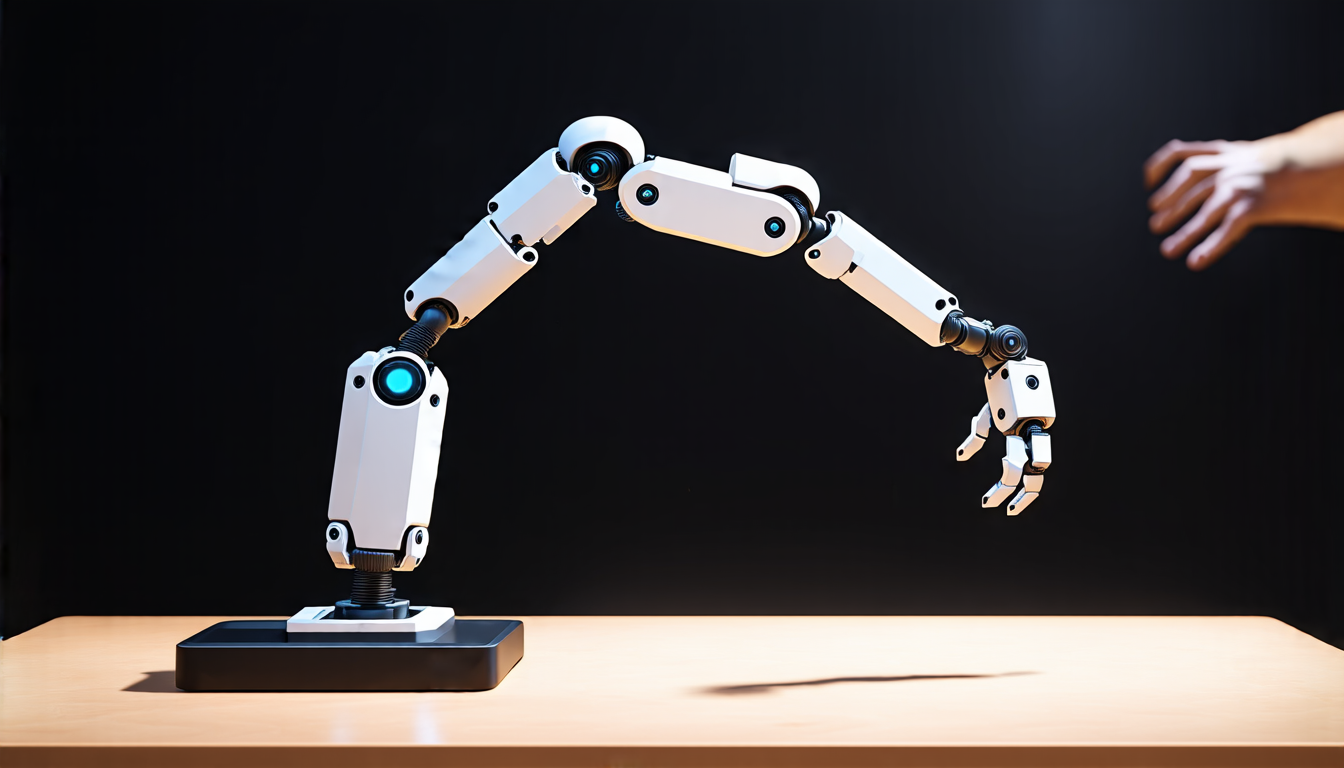
The system consists of two main components: the robot arm and the teleoperation device. The robot arm is designed to mimic human movement, with seven degrees of freedom that allow it to reach and manipulate objects in a variety of ways. The teleoperation device, on the other hand, is a scaled-down replica of the robot arm that allows humans to control the robot remotely.
The team behind RoboCopilot has also developed a range of tools and software to support the system. These include algorithms for learning and adaptation, as well as interfaces for human-robot interaction.
In addition to its technical capabilities, RoboCopilot also has the potential to revolutionize the way we interact with robots. The system’s ability to learn from humans means that it can be used in a wide range of applications, from industrial manufacturing to search and rescue operations.
RoboCopilot is an exciting new development in the field of robotics, one that has the potential to change the way we live and work.
Cite this article: “Revolutionizing Human-Robot Interaction: A Novel Approach to Efficient Interactive Learning and Teleoperation”, The Science Archive, 2025.
Robotics, Artificial Intelligence, Machine Learning, Automation, Manufacturing, Healthcare, Search And Rescue, Teleoperation, Human-Robot Interaction, Adaptation





