

Wednesday 09 April 2025
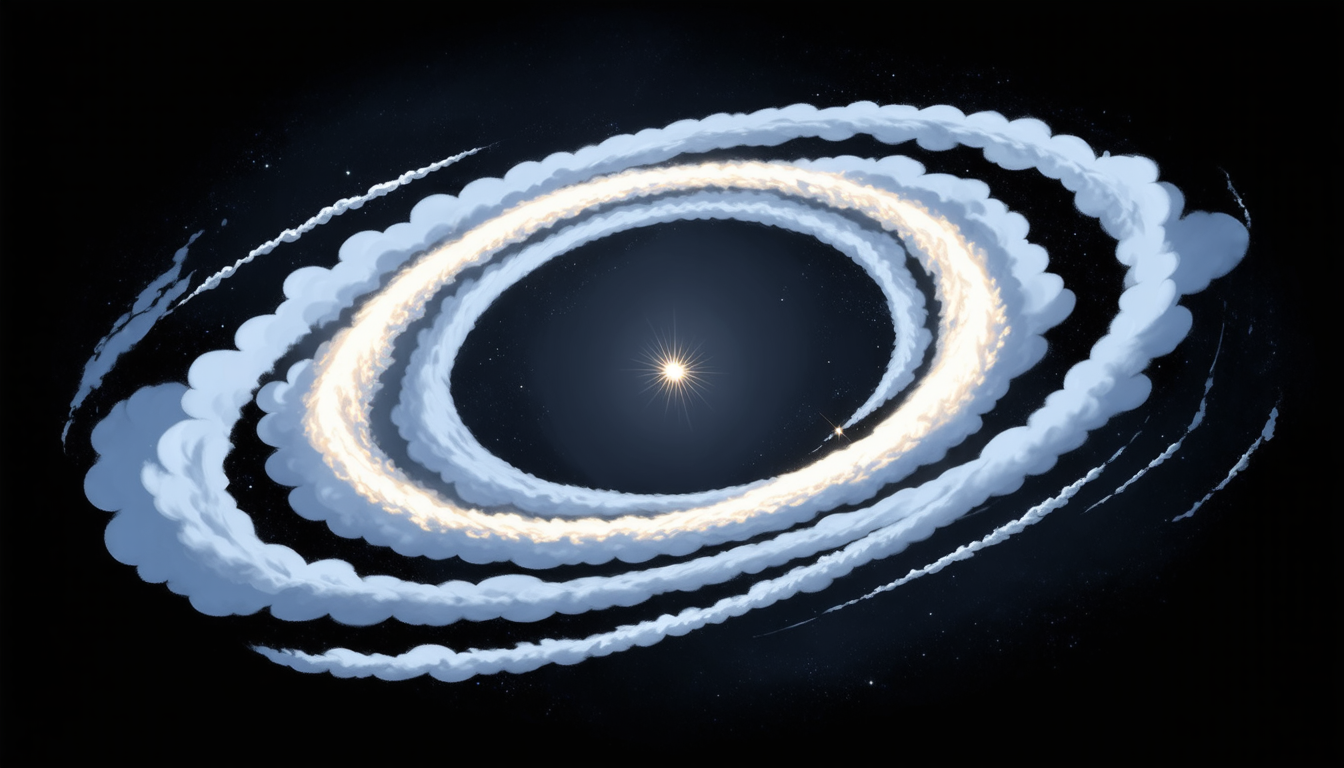
A swirling vortex of dust and gas, a young star is born in the L1448 region of space. Scientists have long been fascinated by this celestial nursery, where stars are still in their early stages of development. Now, a new study has shed light on the mysteries surrounding the formation of these young stars.
The research team used the Atacama Large Millimeter/submillimeter Array (ALMA) to observe the L1448 region in unprecedented detail. ALMA’s incredible resolution allowed scientists to peer deep into the heart of this star-forming complex, revealing intricate structures and patterns that had previously gone unnoticed.
One of the most striking findings is the alignment of dust polarization with spiral arms. Dust particles in these areas are aligned in a specific way, indicating the presence of strong magnetic fields. These fields play a crucial role in shaping the formation of young stars and their surrounding disks.
The study also revealed the presence of multiple sources within the L1448 region, each with its own unique characteristics. Some sources exhibit signs of vigorous star-forming activity, while others appear to be more dormant. By analyzing these variations, scientists can gain valuable insights into the complex processes that govern star formation.
Another notable discovery is the detection of a previously unknown source, dubbed L1448 IRS3-ALMA. This new find is particularly exciting, as it may provide clues about the earliest stages of star formation.
The research team’s findings have significant implications for our understanding of how stars are born. By studying the L1448 region in such detail, scientists can refine their models of star formation and better understand the complex interplay between magnetic fields, gas, and dust.
As we continue to explore the mysteries of the universe, discoveries like this remind us of the awe-inspiring beauty of creation. The swirling vortex of L1448 is a testament to the incredible complexity and diversity of celestial bodies that exist beyond our planet.
Cite this article: “Unlocking the Secrets of Star Formation: Polarized Light Reveals Hidden Patterns in the L1448 Region”, The Science Archive, 2025.
Star Formation, Alma, L1448 Region, Dust Polarization, Magnetic Fields, Spiral Arms, Young Stars, Star-Forming Complex, Celestial Nursery, Astronomical Research





