

Wednesday 09 April 2025
Scientists have been studying a fascinating object in space for years, and their latest findings have shed new light on its mysterious behavior.
V4641 Sgr is a binary system consisting of a black hole and a star that orbits around it. It’s one of the most well-studied systems of its kind, but despite all the attention, researchers still don’t fully understand what makes it tick.
Recently, astronomers used the NuSTAR space telescope to study V4641 Sgr in unprecedented detail. They were looking for clues about how matter behaves when it gets close to a black hole – an event that can reveal secrets about the universe’s most enigmatic objects.
One of the key discoveries was the presence of highly ionized gas surrounding the black hole. This gas is like a cosmic mist, filled with electrically charged atoms and molecules. It’s thought to be formed when matter from the star is pulled towards the black hole, getting hotter and more energetic as it goes.
The NuSTAR observations showed that this gas is not just present around the black hole, but also seems to be re-processing the energy emitted by the system. This means that the gas is acting like a kind of cosmic mirror, reflecting back some of the radiation that’s absorbed from the star and the black hole.
But what’s really interesting about V4641 Sgr is its soft spectral state – a term that might sound technical, but basically refers to how bright or dim the system appears in different wavelengths of light. In this case, the system was observed to be much brighter than expected, which suggests that there’s something unusual going on.
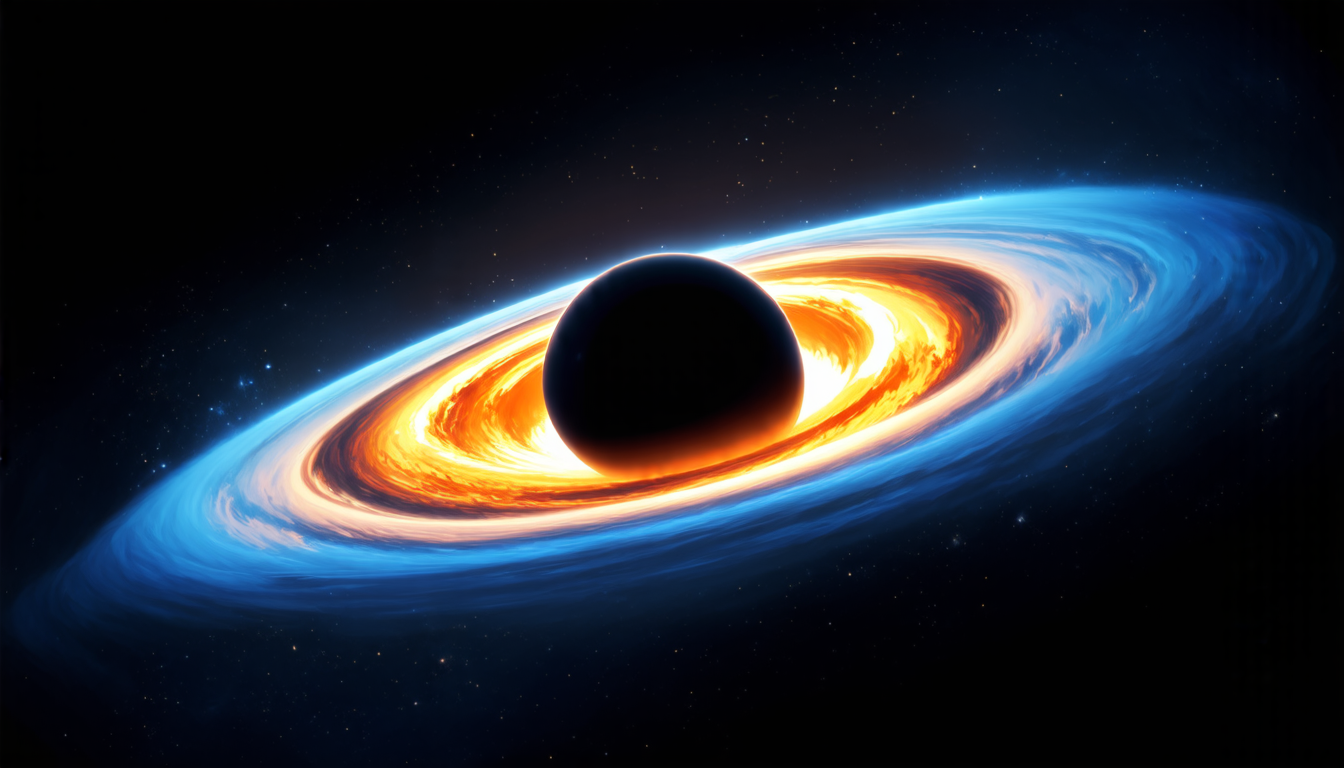
The researchers think that the bright emission could be due to a combination of factors, including the re-processing of energy by the ionized gas and the presence of a disk-like structure around the black hole. This disk is thought to be made up of hot, swirling matter that’s been pulled towards the black hole from the star.
The study provides new insights into how black holes interact with their surroundings, and could help us better understand some of the most extreme events in the universe – like supernovae explosions or gamma-ray bursts. It also highlights the importance of continued observations and research into these mysterious objects.
In the end, V4641 Sgr remains a fascinating enigma, full of secrets waiting to be uncovered by scientists. But with each new discovery, we get closer to unraveling its mysteries and gaining a deeper understanding of the universe around us.
Cite this article: “Unveiling the Secrets of V4641 Sgr: A NuSTAR Study of the Accretion Disk and Ionized Reflection Components”, The Science Archive, 2025.
Black Hole, Binary System, Star, Nustar, Space Telescope, Ionized Gas, Cosmic Mist, Re-Processing Energy, Spectral State, Galaxy Bursts





