

Wednesday 09 April 2025
A new framework for fine-tuning foundation models has been developed, offering significant improvements in classification tasks under low-labelled data conditions. This approach leverages mutual information decomposition to address the challenges of semi-supervised learning.
Foundation models are pre-trained on large datasets and can be adapted to specific downstream tasks. However, this process is often hindered by limited labelled data, making it difficult to achieve accurate results. Traditional approaches to semi-supervised learning rely heavily on assumptions about data distributions or task-specific tuning, which can limit their generalizability.
The new framework, called TwinTURBO, derives two distinct lower bounds: one for optimizing downstream task performance and another for aligning latent space representations. This approach allows the model to effectively utilize unlabelled data, leading to improved results in classification tasks.
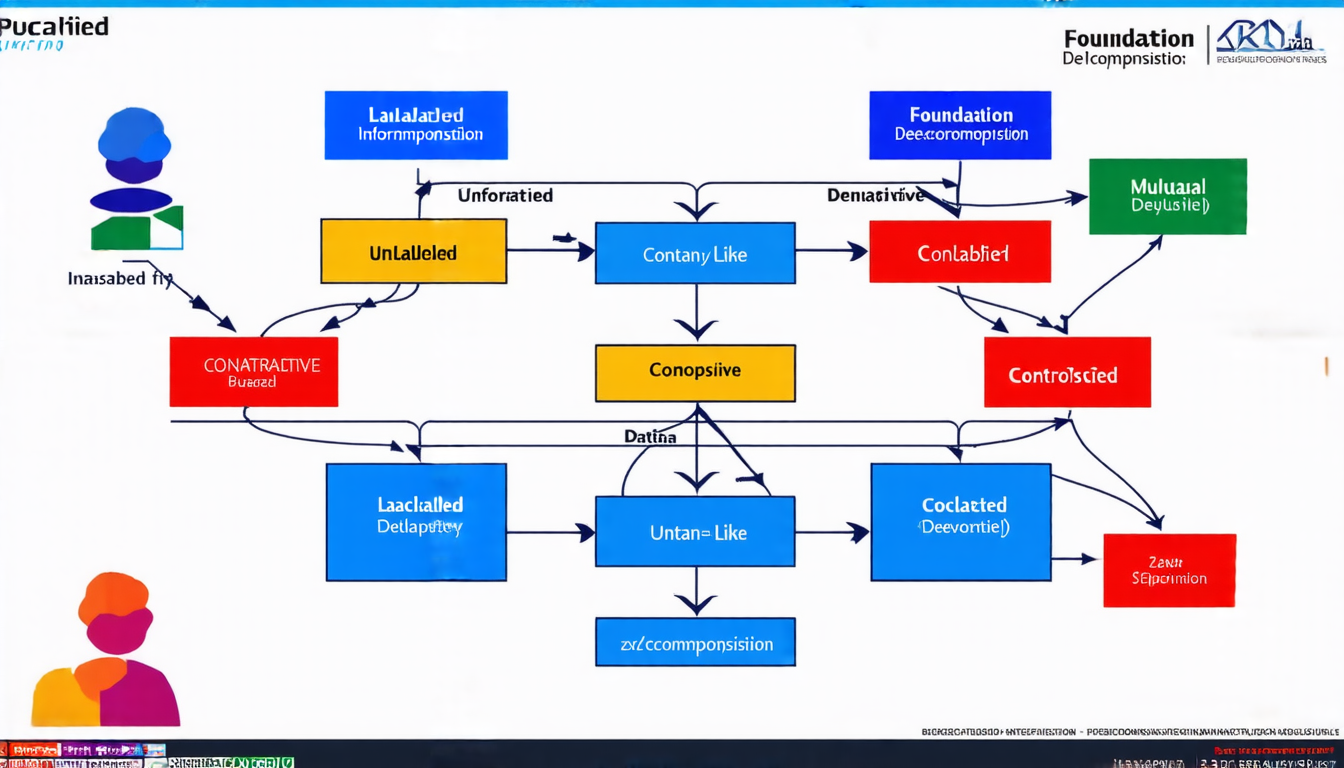
One key innovation of TwinTURBO is its ability to decompose the mutual information between the input data and the predictor outputs into two components: one that optimizes the downstream task performance and another that aligns the latent space representations. This decomposition enables the model to focus on different aspects of the data, leading to better performance under low-labelled conditions.
The framework also incorporates a contrastive- like decomposition, which allows the model to learn from both labelled and unlabelled data. This approach is particularly effective in situations where only a small fraction of the data samples are labelled.
TwinTURBO has been tested on several datasets, including MNIST, CIFAR10, and SVHN, with significant improvements in classification accuracy under low-labelled conditions. The results demonstrate the effectiveness of this framework in leveraging unlabelled data to improve performance.
The authors suggest that TwinTURBO holds promise for extension to multimodal models, such as vision-language models, paving the way for broader applications in semi-supervised learning. They also emphasize the importance of fine-tuning foundation models with proper methods to fully exploit their potential.
In summary, TwinTURBO offers a novel approach to semi-supervised learning that leverages mutual information decomposition and contrastive-like decomposition to improve classification accuracy under low-labelled conditions. Its results demonstrate significant improvements in performance and highlight its potential for broader applications in machine learning.
Cite this article: “Unveiling the Power of Mutual Information: A Novel Framework for Semi-Supervised Learning in Computer Vision”, The Science Archive, 2025.
Foundation Models, Semi-Supervised Learning, Twinturbo, Mutual Information Decomposition, Low-Labelled Data, Classification Tasks, Contrastive-Like Decomposition, Labelled Data, Unlabelled Data, Multimodal Models





