

Wednesday 09 April 2025
The search for efficient ways to cluster high-dimensional data has been a longstanding challenge in the field of machine learning. This complex problem arises when trying to group together similar points in a large dataset, often encountered in applications such as image or text analysis.
Researchers have long relied on various clustering algorithms, each with its own strengths and weaknesses. However, these methods can be computationally expensive and may not always yield the most accurate results. A new approach has now been proposed that addresses these limitations by leveraging a combinatorial-topological strategy to identify clusters in high-dimensional spaces.
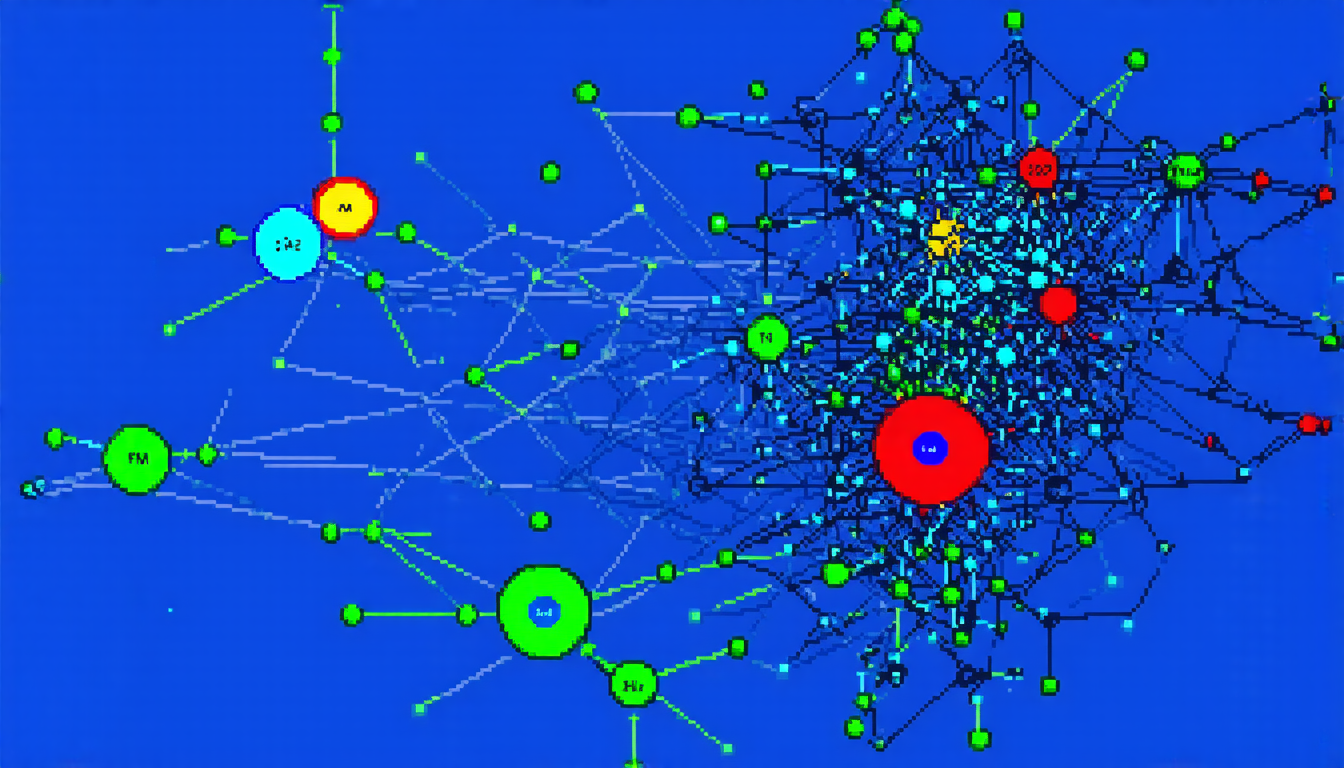
The innovative method, known as HyperOctant Search Clustering (HOSC), is based on the idea of partitioning a graph representing hyperoctants – regions of space defined by signs of coordinates. By examining the relationships between these regions, HOSC can efficiently identify clusters of similar data points.
One of the key advantages of HOSC is its ability to reduce the size of the dataset while preserving crucial topological features. This makes it particularly suitable for handling large amounts of high-dimensional data, which are common in many fields such as computer vision and natural language processing.
The researchers behind HOSC have demonstrated the effectiveness of their approach through a range of experiments on text mining tasks. These results suggest that HOSC is not only more efficient than traditional clustering methods but also yields more accurate results.
Furthermore, HOSC offers an additional benefit: it provides valuable insights into the underlying structure of the data. By examining the hyperoctants and their relationships, researchers can gain a deeper understanding of the patterns and correlations present in the dataset.
The potential applications of HOSC are vast and varied. For instance, it could be used to improve image segmentation, enable more accurate text classification, or facilitate more efficient clustering of genomic sequences.
While much work remains to be done to fully realize the potential of HOSC, this new approach has already shown significant promise in addressing the challenges of high-dimensional data clustering. As researchers continue to refine and expand upon this innovative method, we can expect to see even greater advancements in machine learning and its many applications.
Cite this article: “Unveiling the Power of Hyperoctant Search Clustering: A Novel Approach to Uncover Hidden Patterns in High-Dimensional Data”, The Science Archive, 2025.
Machine Learning, Data Clustering, High-Dimensional Data, Combinatorial-Topological Strategy, Hyperoctant Search Clustering, Graph Partitioning, Text Mining, Computer Vision, Natural Language Processing, Genomic Sequences





