

Wednesday 09 April 2025
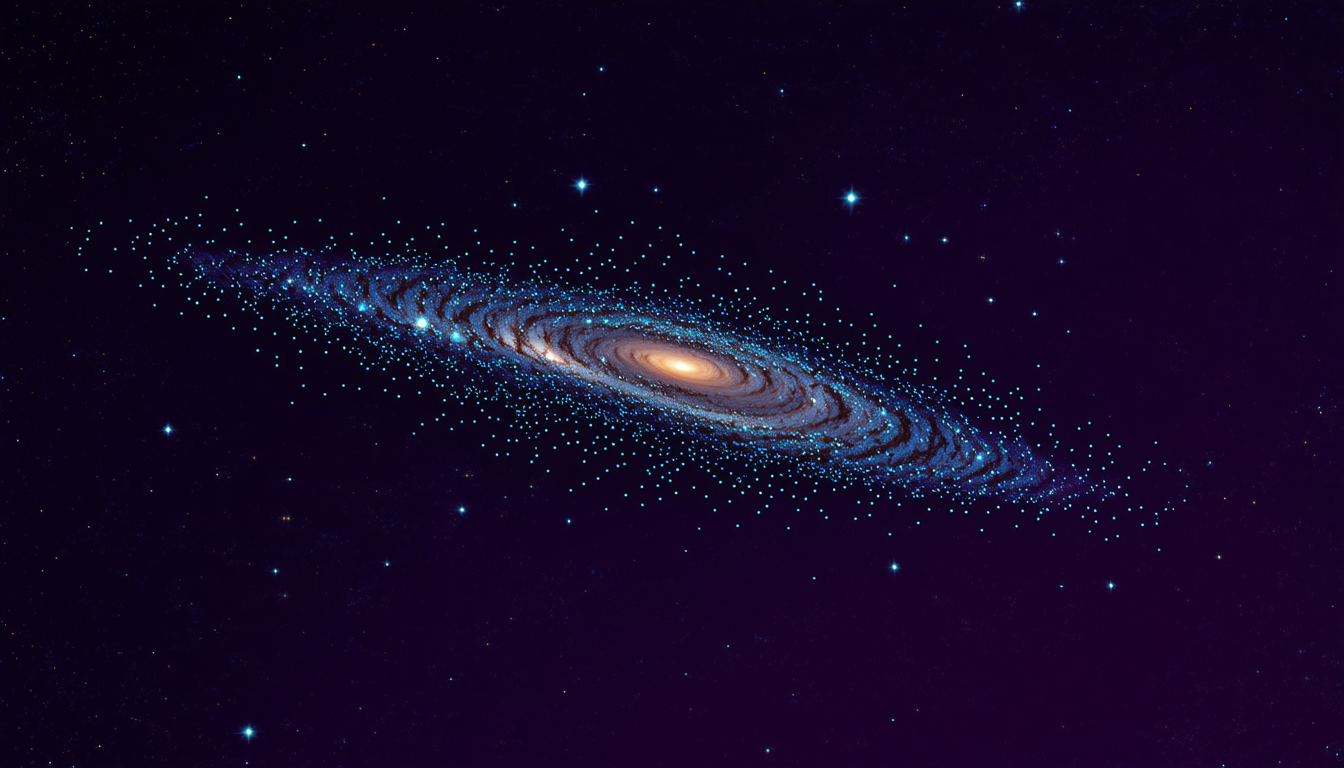
Scientists have made a significant breakthrough in identifying young star clusters within the Andromeda Galaxy, also known as M31. By employing deep learning models and analyzing vast amounts of photometric data, researchers have been able to pinpoint new cluster candidates with high accuracy.
The Andromeda Galaxy is our closest galactic neighbor, located approximately 2.5 million light-years away. It’s a treasure trove for astronomers, offering insights into the formation and evolution of galaxies like our own Milky Way. However, identifying young star clusters within this vast galaxy has proven to be a challenging task.
Traditionally, researchers have relied on manual inspections of images taken by telescopes, which can be time-consuming and prone to human error. The sheer volume of data generated by these observations makes it difficult to detect faint or small clusters without sophisticated algorithms.
To overcome these limitations, scientists turned to deep learning models, specifically convolutional neural networks (CNNs). These AI-powered tools are designed to recognize patterns within large datasets and make predictions based on those patterns.
By training a CNN using photometric data from the Pan-Andromeda Archaeological Survey (PAndAS) and the Panchromatic Hubble Andromeda Treasury (PHAT) surveys, researchers were able to identify young disk star clusters with unprecedented accuracy. The model was tested on a dataset of 92,159 sources, achieving an impressive recall rate of 73.55% and precision rate of 80.66%.
The findings suggest that the CNN is capable of accurately distinguishing between genuine clusters and non-clusters, even in regions where the data is noisy or contaminated by other celestial objects. This breakthrough has significant implications for our understanding of galaxy evolution and the formation of star clusters.
One of the most exciting aspects of this research is its potential to shed light on the early history of galaxies like M31. By analyzing the properties of these young star clusters, scientists may be able to reconstruct the conditions that led to their formation and gain insights into the complex processes that shape galaxy evolution.
In the coming years, researchers plan to expand their analysis to include data from other surveys and telescopes, allowing them to further refine their model and uncover even more hidden secrets within M31. As we continue to push the boundaries of our understanding, it’s clear that AI-powered astronomy will play a vital role in unlocking the mysteries of the universe.
Cite this article: “Unlocking the Secrets of Andromedas Star Clusters: A Deep Learning Approach”, The Science Archive, 2025.
Andromeda Galaxy, Star Clusters, Deep Learning, Convolutional Neural Networks, Photometric Data, Pan-Andromeda Archaeological Survey, Panchromatic Hubble Andromeda Treasury, Galaxy Evolution, Star Formation, Astronom





