

Wednesday 09 April 2025
As NASA’s DART spacecraft hurtled towards the asteroid Dimorphos in October 2022, scientists were eager to see the impact it would have on the small moonlet of the binary system Didymos. The mission aimed to test a new technique for deflecting potentially hazardous asteroids that could one day threaten Earth.
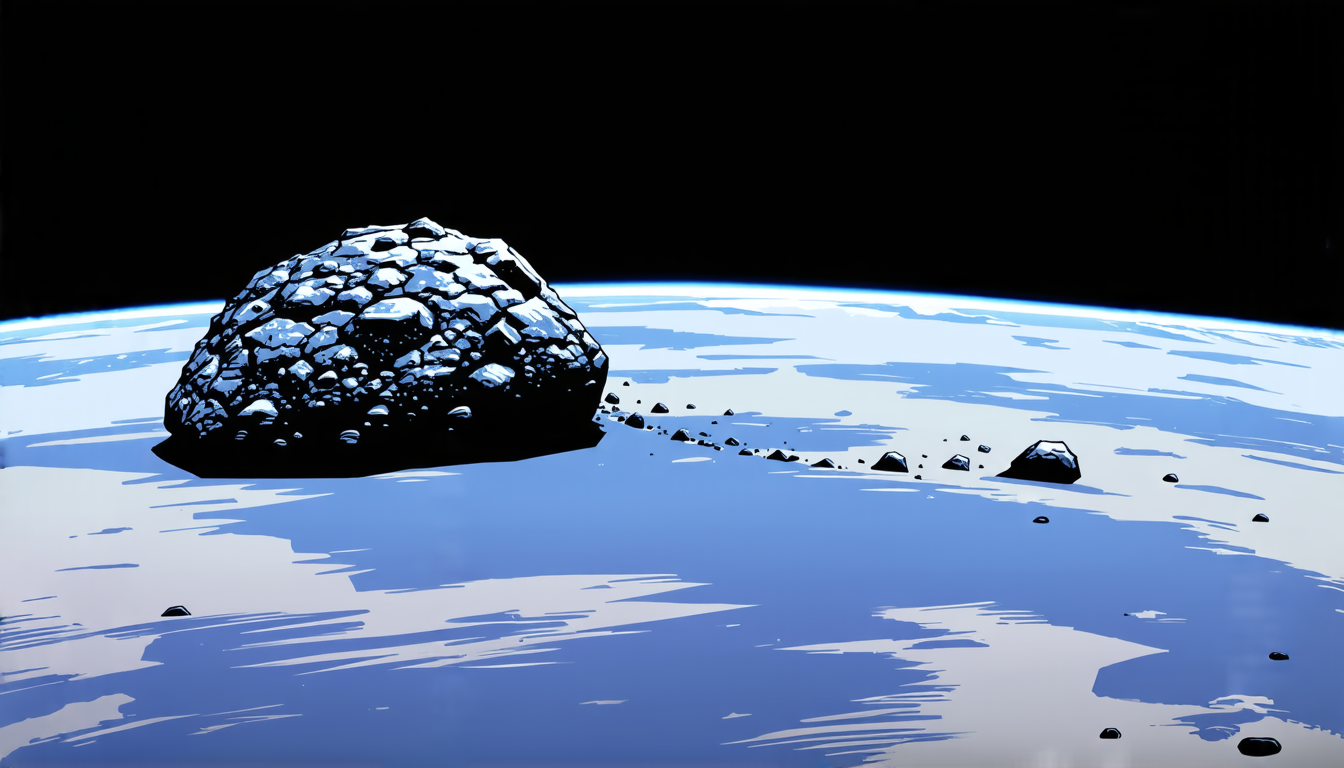
Since then, researchers have been analyzing the aftermath of the collision and have made some fascinating discoveries. It turns out that the DART impact sent a vast array of debris into space, including rocks, boulders, and even dust particles. Some of these ejecta have since re-impacted both Dimorphos and Didymos, leaving behind small craters on their surfaces.
According to simulations, many of these secondary impacts had surprisingly low velocities, ranging from just 10% to 80% of the initial impact speed. This means that even relatively small particles could travel a significant distance before landing back on the asteroids. In fact, some dust particles were found to have re-impacted Didymos after traveling hundreds of kilometers.
The researchers used computer models to simulate the dynamics of these ejecta and their subsequent interactions with the asteroids. They discovered that most of the particles eventually re-impact on the surface, but a small fraction manages to escape the system altogether. This could potentially lead to a dusty tail forming around Didymos, which would be visible from Earth.
The fresh dust released by these impacts is likely to settle on the surface of Didymos, mostly near the equator. This could result in differences in the observed spectral properties between lower and higher latitudes. The Asteroid Framing Cameras instrument on NASA’s Hera mission, set to arrive at Didymos in 2026, should be able to detect these small craters when it gets close to the asteroid.
The findings provide valuable insights into the complex dynamics of asteroid collisions and their aftermath. They also highlight the importance of considering secondary impacts in our understanding of these events. As we continue to explore and study asteroids, these discoveries will help us better prepare for potential threats from space rocks in the future.
In addition to providing new knowledge about asteroid interactions, the DART mission has also opened up new avenues for scientific research. The re-impact debris offers a unique opportunity to study the composition and properties of the asteroids’ surfaces, which could shed light on their formation and evolution over billions of years.
Cite this article: “Asteroid Impact Aftermath: Uncovering the Secrets of Didymos Dusty Debris”, The Science Archive, 2025.
Asteroids, Dart Mission, Dimorphos, Didymos, Asteroid Collisions, Debris, Ejecta, Secondary Impacts, Nasa, Space Rocks





