

Wednesday 09 April 2025
The researchers behind this study have made significant strides in developing a Socratic chain-of-thought reasoning method, dubbed SocraCoT, that combines the strengths of two established techniques: Chain-of-Thought (CoT) and the Socratic method. This approach aims to improve the logic and accuracy of generated sub-task lists and coding sequences for robotic task planning and execution.
The study’s authors have created a simulated environment in Webots, a popular robotics simulation platform, where they tested their SocraCoT framework with GPT-4, a large language model designed to generate human-like text. The goal was to evaluate the effectiveness of SocraCoT in completing a spatial task involving object search and navigation.
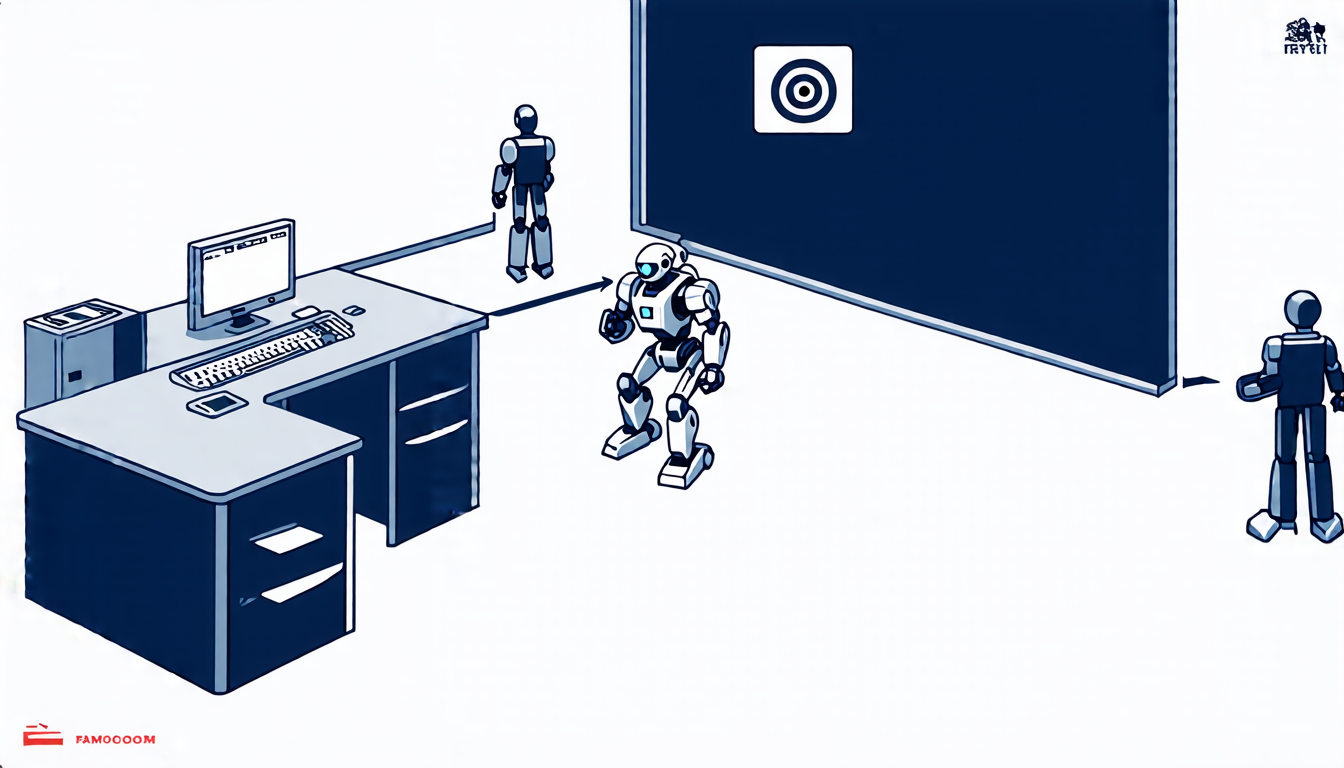
In this experiment, the researchers used Webots to simulate an office environment, where a Tiago robot was tasked with moving to a specific distance from a target object while avoiding obstacles. To accomplish this, the robot needed to identify the target object, plan its path, and execute the necessary movements. The authors designed a high-level task description in natural language, which was then broken down into subtasks using CoT.
The Socratic method was incorporated by introducing an adversarial debate between two LLMs (Large Language Models): LLMA and LLMB. These models were tasked with generating revised lists of subtasks, evaluating each other’s arguments, and refining their predictions based on the debate outcomes. The authors used a blend of confidence-based weights to update the predictions, ensuring that both models contributed to the final solution.
The results show that SocraCoT outperformed CoT alone in terms of task completion rates and execution time. Although the non-CoT/non-SocraCoT approach achieved some success, it was hampered by code failures and incorrect object identification. In contrast, SocraCoT’s debate mechanism helped to identify and resolve potential issues earlier on.
The authors also proposed a new framework called EVINCE-LoC, which uses Wasserstein distance and mutual information to aid in robotics localization and perception. This approach aims to mitigate the language model’s struggles with spatial awareness by incorporating more domain-specific knowledge.
While this study has limitations, it demonstrates the potential of SocraCoT for improving robotic task planning and execution. The authors’ use of a simulated environment and realistic task scenarios adds credibility to their findings.
Cite this article: “Unlocking Robotics with Socratic Chain-of-Thought Reasoning: A Study on Zero-Shot Task Planning”, The Science Archive, 2025.
Robotics, Task Planning, Execution, Socratic Method, Chain-Of-Thought, Gpt-4, Webots, Object Search, Navigation, Spatial Awareness





