

Wednesday 09 April 2025
A team of researchers has made a significant breakthrough in the field of robotics and control theory, developing a new approach that enables robots to learn complex behaviors without needing precise knowledge of their dynamics.
Traditionally, designing controllers for robotic systems requires a deep understanding of the underlying physics and math. However, real-world systems can be notoriously tricky to model, and small errors in these models can have significant consequences. In response, researchers have developed various methods to abstract away some of this complexity, but these approaches often come with limitations.
The new approach, described in a recent paper, takes a different tack. Instead of trying to simplify the system dynamics or rely on approximate models, it uses advanced mathematical techniques to decompose complex control problems into a sequence of simpler tasks. This allows the robot to learn and adapt to its environment in real-time, without needing precise knowledge of its own mechanics.
The approach relies on a combination of spatiotemporal tubes – mathematical structures that describe the evolution of a system over time and space – and nondeterministic Büchi automata, which are used to specify complex temporal properties. By combining these two components, the researchers were able to develop a control policy that ensures the robot’s behavior meets the desired specifications, even in the presence of uncertainty or disturbances.
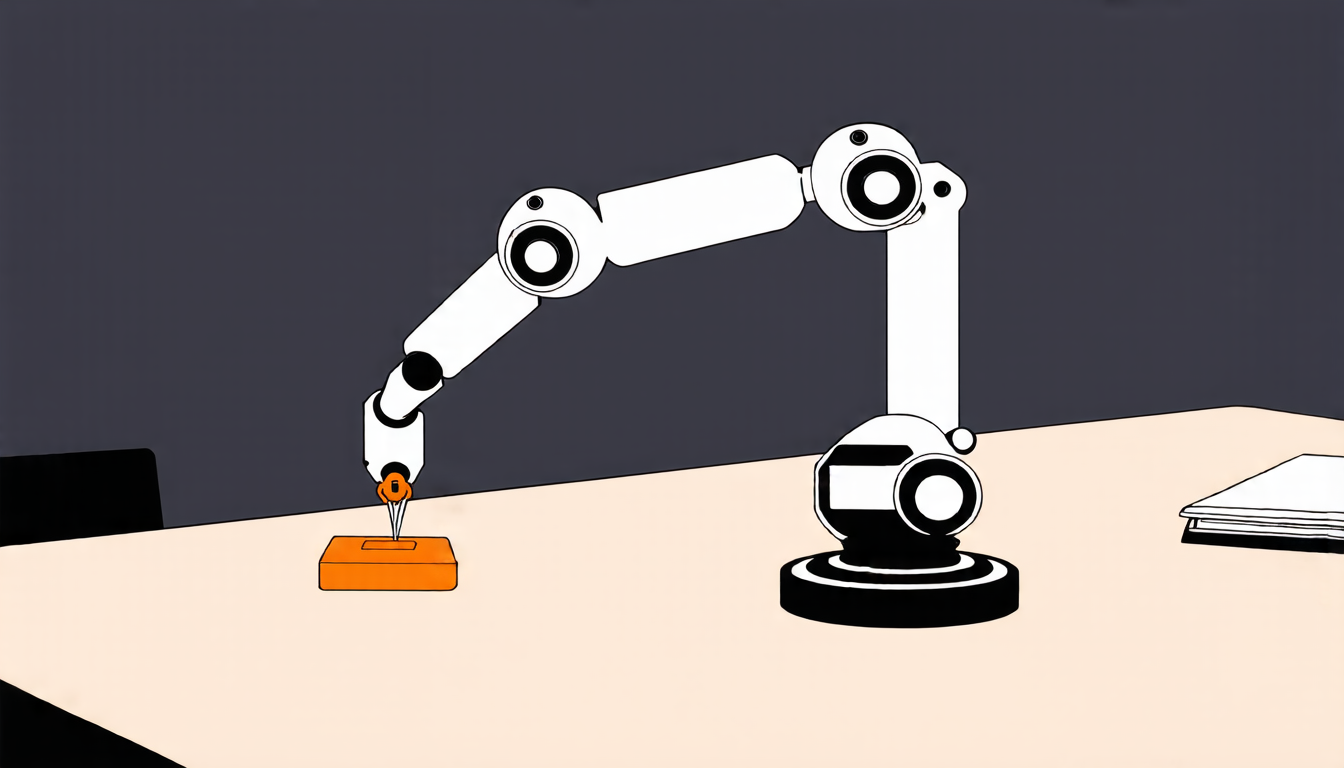
The team tested their approach on two real-world robotic systems: a manipulator executing a pick-and-place operation and an omnidirectional mobile robot performing a delivery task. In both cases, the controller was able to successfully guide the robot through its tasks, despite significant uncertainties and disturbances.
This breakthrough has significant implications for the development of autonomous robots and intelligent control systems. By allowing robots to learn complex behaviors without precise knowledge of their dynamics, this approach opens up new possibilities for real-world applications, from search-and-rescue missions to industrial automation.
The researchers’ innovative use of spatiotemporal tubes and nondeterministic Büchi automata also highlights the potential for interdisciplinary collaboration between robotics, control theory, and computer science. As we continue to push the boundaries of what is possible with autonomous systems, this kind of cross-pollination will be essential for driving progress.
In the future, it will be interesting to see how this approach is applied in different domains and contexts.
Cite this article: “Unlocking Complexity: A Novel Framework for Synthesizing Controllers for Unknown Systems”, The Science Archive, 2025.
Robotics, Control Theory, Machine Learning, Autonomous Systems, Spatiotemporal Tubes, Nondeterministic Büchi Automata, Uncertainty, Disturbances, Real-Time Adaptation, Complex Behaviors





