

Wednesday 09 April 2025
The Trinity AI system, a novel approach to integrating Large Language Models (LLMs), Visual Language Models (VLMs), and Reinforcement Learning (RL) for humanoid robots, has made significant strides in enhancing task understanding, environmental interaction, and motion control. This modular and hierarchical design enables flexible optimization and collaboration between components.
The Trinity AI system is designed to tackle complex tasks that require both linguistic and visual understanding. It achieves this by combining LLMs, which excel at processing natural language, with VLMs, which are adept at analyzing visual data. The result is a humanoid robot capable of comprehending and executing complex instructions in various scenarios.
One of the key features of Trinity is its ability to integrate safety constraints into the planning process. This ensures that the robot takes into account potential hazards and obstacles when completing tasks, preventing accidents or harm to humans. Additionally, the system’s hierarchical design allows it to adapt to new situations and tasks by adjusting its control policy.
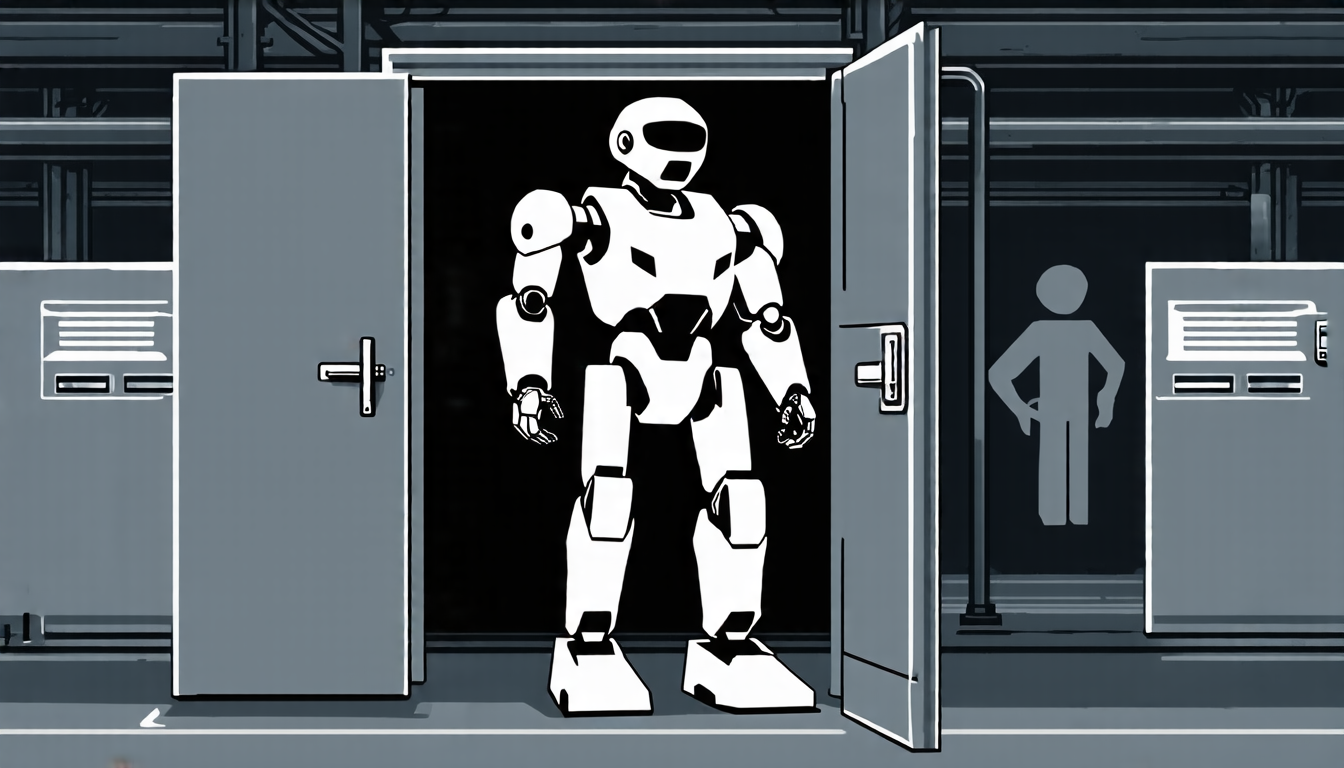
The Trinity AI system has been successfully implemented on a full-scale humanoid robot, demonstrating its practical feasibility. The robot is able to perform complex tasks such as opening doors, grasping objects, and manipulating articulated workpieces. It also shows impressive balance and stability while executing these tasks, even in the presence of external forces or obstacles.
The researchers behind Trinity have made significant advancements in several areas, including whole-body humanoid control, language-based task planning, and visual-linguistic perception. They have also developed novel techniques for integrating LLMs and VLMs with RL algorithms to enable more efficient and effective control of humanoid robots.
One of the most impressive aspects of Trinity is its ability to generalize and adapt to new situations. This is achieved through a combination of reinforcement learning, imitation learning, and language-based task planning. The system’s modular design allows it to learn from multiple sources, including demonstrations, natural language instructions, and visual feedback.
The potential applications of Trinity are vast and varied. In the short term, it could be used to improve the efficiency and effectiveness of humanoid robots in industries such as manufacturing, healthcare, and logistics. In the long term, Trinity could play a key role in developing more advanced forms of human-robot collaboration, enabling humans and robots to work together seamlessly and safely.
Overall, the Trinity AI system represents a significant step forward in the development of intelligent humanoid robots.
Cite this article: “Unlocking Humanoid Robotics: Trinitys Modular AI System Revolutionizes Whole-Body Control and Manipulation”, The Science Archive, 2025.
Humanoid Robots, Artificial Intelligence, Reinforcement Learning, Visual Language Models, Large Language Models, Task Planning, Safety Constraints, Whole-Body Control, Imitation Learning, Language-Based Task Planning





