

Wednesday 09 April 2025
The random dance of particles has long fascinated scientists, and a new study sheds light on the intricate patterns that emerge when these tiny entities interact.
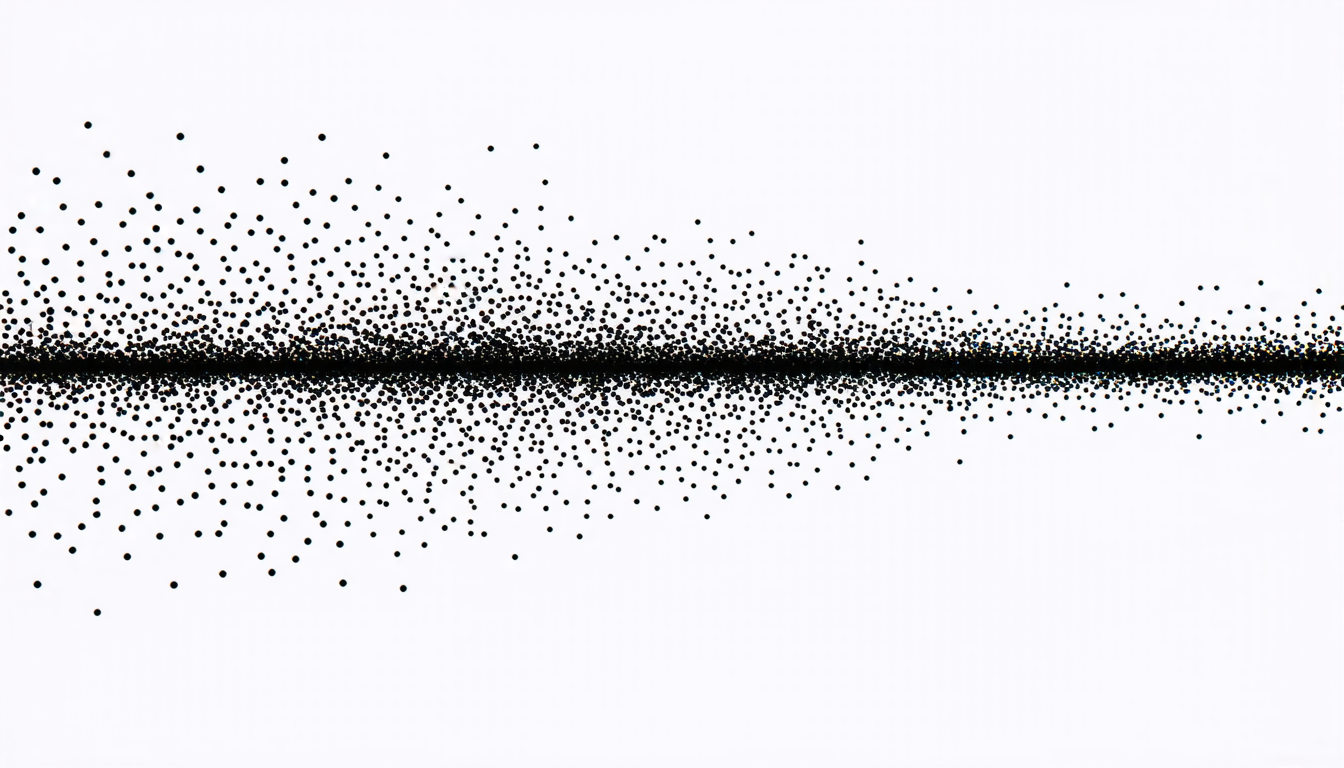
Researchers have been studying the oriented swap process, a type of statistical model that describes how particles move and interact in a system. In this particular case, the particles are arranged along a line, and they can swap positions with their neighbors at random intervals. The team behind the study set out to understand the behavior of these particles over time.
One of the key findings is that the particle at the leftmost position of the line will eventually remain static for long periods. This is because the probability of the particle jumping to its right decreases as time passes, making it increasingly unlikely for the particle to change position.
The researchers also discovered that the process can be described using a mathematical framework known as Hecke algebras. These algebras are used to study symmetry and patterns in mathematical structures. By applying this framework to the oriented swap process, the team was able to gain insight into the underlying dynamics of the system.
Another interesting aspect of the study is its connection to random walks on graphs. Random walks are a type of statistical model that describes how particles move randomly through a network. In this case, the researchers found that the oriented swap process can be seen as a type of random walk on a graph with a specific structure.
The team’s findings have implications for our understanding of complex systems and the behavior of particles in them. By studying the oriented swap process, scientists may gain insight into how similar systems behave in other areas of physics and beyond. For example, the study could shed light on the behavior of molecules in chemical reactions or the movement of people in a city.
The research is part of an ongoing effort to understand the intricate patterns that emerge in complex systems. By studying these patterns, scientists hope to gain a deeper understanding of how the world works and how we can harness this knowledge for practical applications.
In recent years, there has been a surge of interest in statistical models like the oriented swap process. These models are used to describe everything from the behavior of particles in a gas to the spread of diseases through a population. By studying these models, scientists hope to gain insight into how complex systems work and how we can control them.
The study is an important step forward in our understanding of the oriented swap process and its connections to other areas of physics.
Cite this article: “Unlocking the Secrets of Particle Swapping: New Insights into the Oriented Swap Process”, The Science Archive, 2025.
Particles, Statistical Models, Random Walks, Graphs, Hecke Algebras, Symmetry, Patterns, Complex Systems, Physics, Dynamics
Reference: Yuan Tian, “The oriented swap process on half line” (2025).





