

Wednesday 09 April 2025
Scientists have been studying the behavior of electrons and neutrons in atomic nuclei for decades, but a recent breakthrough has shed new light on how these particles interact with each other.
According to recent research, the interference between meson exchange currents and one-body currents in quasielastic electron scattering is more complex than previously thought. Quasielastic electron scattering occurs when an electron scatters off a nucleon in the nucleus, causing it to be ejected from the nucleus. This process provides valuable information about the underlying nuclear response functions.
The researchers found that the interference between meson exchange currents and one-body currents has a negative sign, which means that they partially cancel each other out. This cancellation leads to a reduction in the strength of the magnetic response function, which is an important property of nuclei.
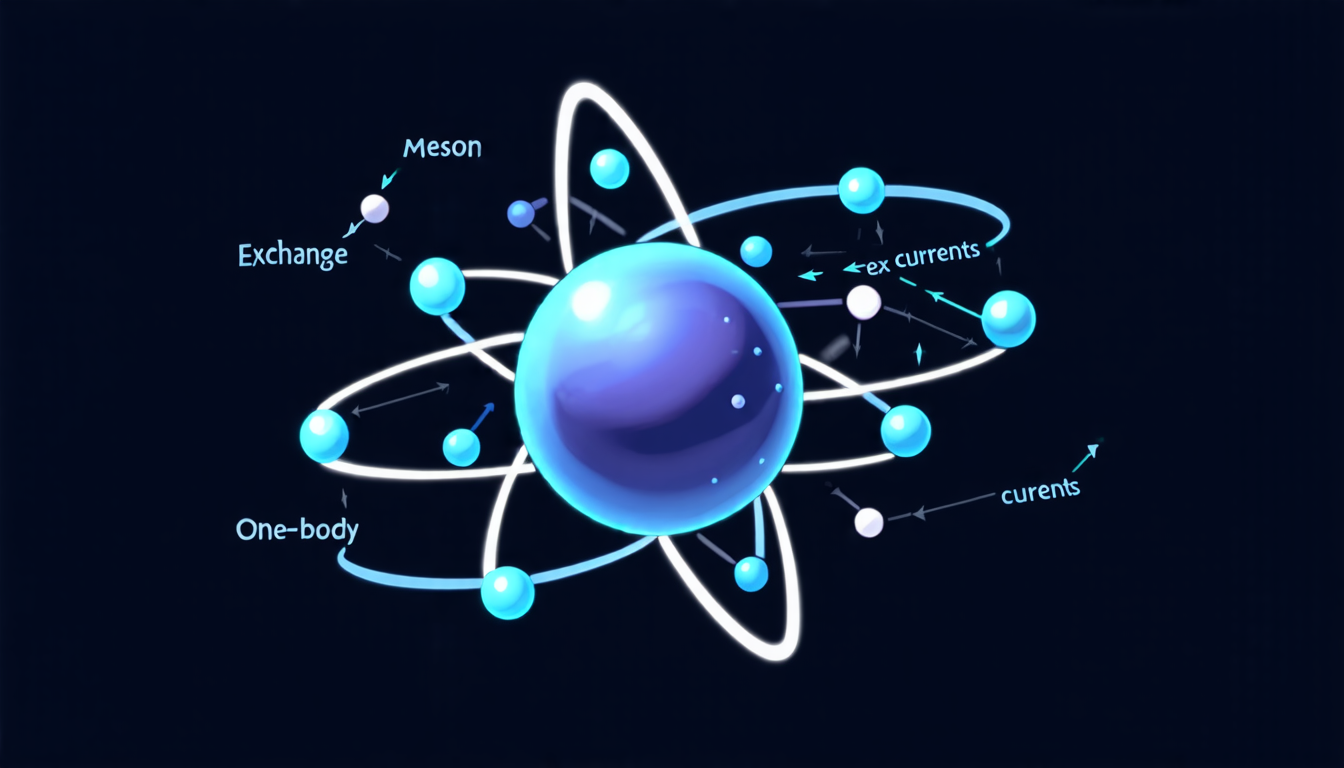
To understand how this works, let’s start with the concept of meson exchange currents. These are currents that arise from the exchange of particles like pions and delta-mesons between nucleons in the nucleus. In the context of quasielastic electron scattering, these currents can contribute to the response function by interacting with the scattered nucleon.
One-body currents, on the other hand, refer to the direct interaction between the incident electron and the scattered nucleon. This interaction is mediated by the electromagnetic force and leads to a simple, intuitive picture of the scattering process.
The interference between meson exchange currents and one-body currents arises because both types of currents contribute to the response function in different ways. Meson exchange currents are more effective at higher energies, while one-body currents dominate at lower energies.
By studying this interference, scientists can gain valuable insights into the behavior of nucleons in atomic nuclei. For example, the researchers found that the negative sign of the interference implies a reduction in the strength of the magnetic response function, which is an important property of nuclei.
This discovery has significant implications for our understanding of nuclear structure and dynamics. By better understanding how electrons interact with nucleons in the nucleus, scientists can gain insights into the properties of atomic nuclei and the behavior of subatomic particles.
In addition to its theoretical significance, this research also has practical applications. Quasielastic electron scattering is an important tool for studying nuclear reactions and nuclear structure. By improving our understanding of this process, scientists can develop more accurate models of nuclear reactions and better understand the behavior of atomic nuclei.
Overall, this recent breakthrough in our understanding of meson exchange currents and one-body currents has significant implications for our understanding of nuclear physics.
Cite this article: “Unlocking the Secrets of the Nucleus: A New Perspective on Meson Exchange Currents”, The Science Archive, 2025.
Nuclear Physics, Meson Exchange Currents, One-Body Currents, Quasielastic Electron Scattering, Nuclear Response Functions, Magnetic Response Function, Subatomic Particles, Atomic Nuclei, Nuclear Structure, Nuclear Dynamics.





