

Wednesday 09 April 2025
The quest for a more accurate understanding of complex flows has led researchers to develop innovative methods for analyzing and predicting their behavior. In a recent paper, scientists have proposed a novel approach that combines resolvent analysis with harmonic resolvent modes to extract optimal forcings and responses from periodic flows.
Resolvent analysis is a technique used to predict the mean linear response of a flow to forcing at different frequencies. It’s an essential tool for understanding how a flow responds to external stimuli, such as turbulence or control inputs. However, traditional methods have limitations when dealing with complex flows that exhibit non-linear behavior.
To address this issue, researchers have turned to harmonic resolvent modes, which are a set of functions that describe the response of a flow at different frequencies. By using these modes in conjunction with resolvent analysis, scientists can extract more accurate information about the optimal forcings and responses of a flow.
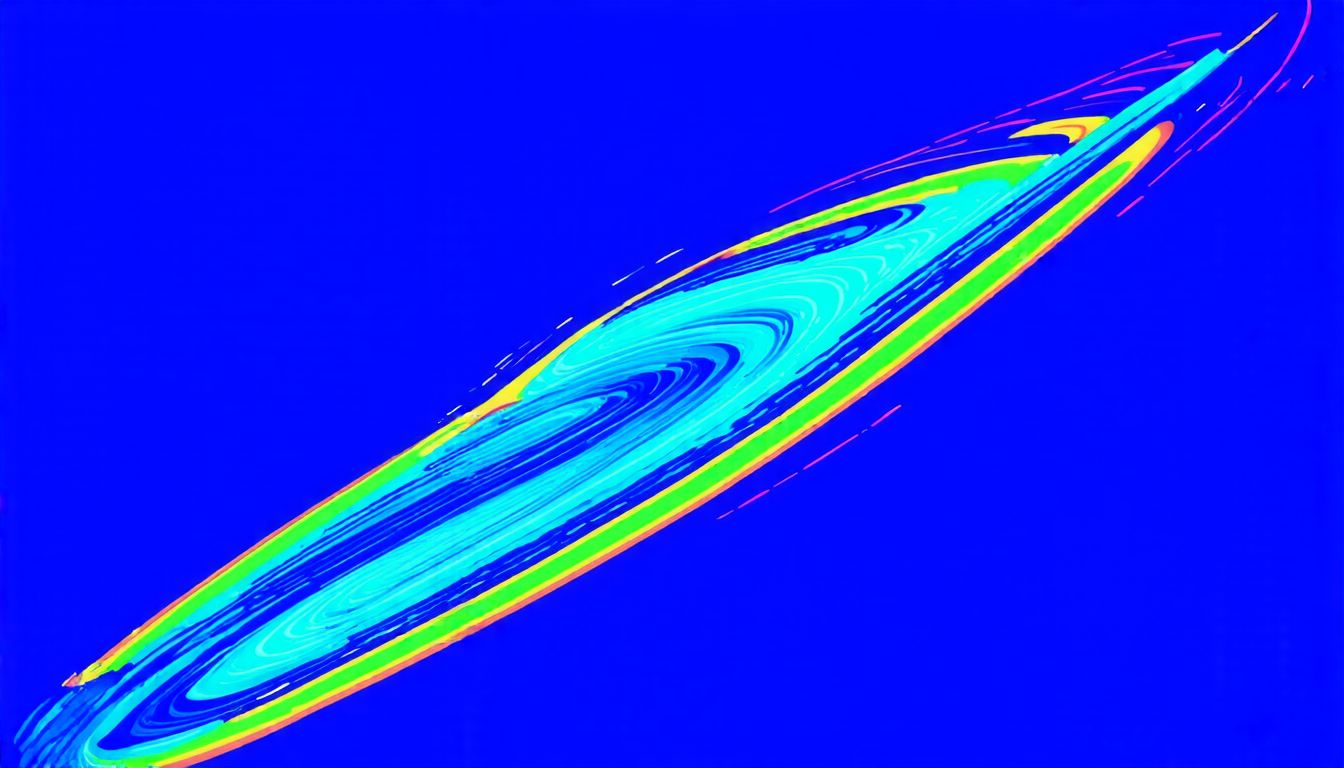
The new approach is demonstrated through an example of an axisymmetric laminar jet periodically forced at its inlet. The researchers found that their method correctly captured the main receptivity peak of the mean resolvent, as well as a secondary peak that was missed by traditional methods. This improved accuracy can lead to more effective control strategies for complex flows.
The method is not limited to periodic flows and has potential applications in various fields, such as aerodynamics, hydraulics, and biomedical engineering. It could be used to design more efficient airfoils or to improve the performance of medical devices that rely on fluid flow.
One of the key advantages of this approach is its ability to capture non-linear behavior in complex flows. This is achieved by using a projection algorithm that approximates the mean- flow resolvent modes within a subspace of mean-flow resolvent modes. This allows researchers to bypass the need for direct-adjoint looping, which can be computationally intensive.
The study demonstrates the power of combining innovative methods and techniques to tackle complex problems. By using harmonic resolvent modes in conjunction with resolvent analysis, scientists have made significant strides in understanding the behavior of periodic flows. This research has the potential to impact a wide range of fields and could lead to breakthroughs in flow control and optimization.
The authors’ approach is a testament to the power of interdisciplinary collaboration and the importance of pushing the boundaries of what is possible in scientific research. By combining expertise from different fields, scientists can tackle complex problems that may have seemed insurmountable otherwise.
Cite this article: “Unlocking the Secrets of Turbulent Jets: A New Approach to Understanding Flow Instabilities”, The Science Archive, 2025.
Complex Flows, Resolvent Analysis, Harmonic Resolvent Modes, Optimal Forcings, Periodic Flows, Flow Control, Turbulence, Aerodynamics, Hydraulics, Biomedical Engineering





