

Wednesday 09 April 2025
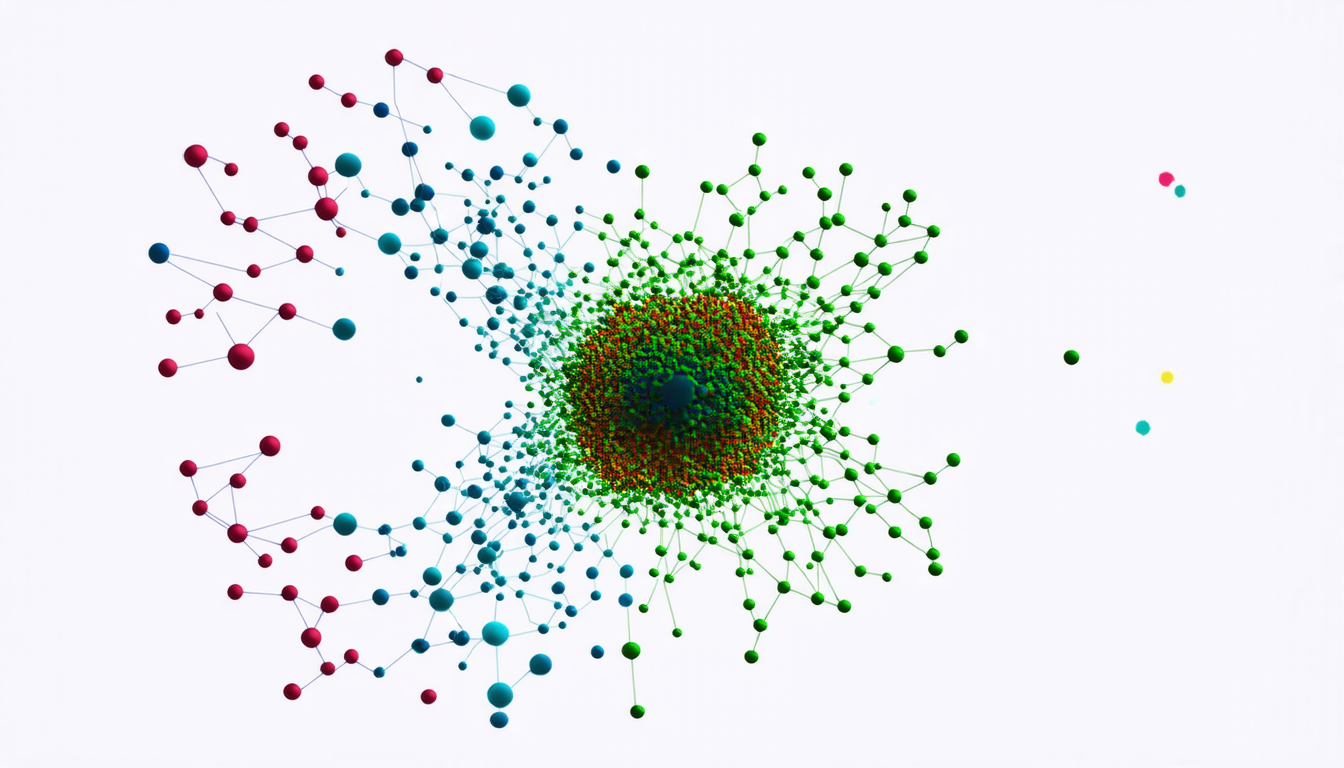
Scientists have long been fascinated by the behavior of many-particle systems, where tiny particles interact with each other in complex ways. These systems are found everywhere in nature, from the swirling patterns on a soap film to the chaotic motion of atoms in a gas.
Recently, researchers made significant progress in understanding these systems using a new mathematical approach. By applying this method, they were able to develop a powerful tool for predicting the behavior of many-particle systems, which could have major implications for fields such as physics, chemistry, and biology.
The key to this breakthrough was the development of a hierarchy of evolution equations, which describe how particles interact with each other over time. This hierarchy is built by combining simple equations that govern the behavior of individual particles into more complex equations that take into account the interactions between multiple particles.
One of the most promising applications of this new tool is in understanding the behavior of quantum systems, where particles can exist in multiple states at once and interact with each other in strange and unpredictable ways. By using the hierarchy of evolution equations to model these systems, researchers hope to gain a deeper understanding of quantum phenomena such as superposition and entanglement.
Another area where this tool could make a major impact is in the study of complex chemical reactions. Chemical reactions involve the interactions between multiple molecules, which can lead to complex patterns of behavior that are difficult to predict using traditional methods. By applying the hierarchy of evolution equations to these systems, researchers hope to develop new models that can accurately predict the outcomes of complex chemical reactions.
The development of this tool also has implications for our understanding of biological systems. In biology, many-particle systems arise in the interactions between cells, molecules, and other biological components. By using the hierarchy of evolution equations to model these systems, researchers hope to gain a deeper understanding of how biological processes work at the molecular level.
The new tool is not without its challenges, however. The hierarchy of evolution equations is a complex system that requires powerful mathematical techniques to solve. In addition, the equations are often non-linear, which means that small changes in the initial conditions can lead to large and unpredictable effects.
Despite these challenges, researchers are optimistic about the potential of this new tool. With further development and refinement, it could become a powerful tool for understanding many-particle systems and making accurate predictions about their behavior. As scientists continue to explore its capabilities, we may discover new insights into the behavior of complex systems and uncover new ways to apply these insights to real-world problems.
Cite this article: “Unraveling the Mystery of Correlation Dynamics in Quantum Systems: A New Perspective on Clustering and Cumulants”, The Science Archive, 2025.
Many-Particle Systems, Quantum Systems, Chemical Reactions, Biological Processes, Complex Systems, Evolution Equations, Non-Linear Dynamics, Mathematical Modeling, Physics, Chemistry, Biology





