

Wednesday 09 April 2025
The quest for seamless motion in-betweening has long been a challenge in the world of computer graphics and animation. The process, which involves generating smooth transitions between keyframes, is crucial for creating lifelike character movements. While traditional methods have relied on manual adjustments or labor-intensive data collection, researchers have recently turned to deep learning-based approaches to tackle this problem.
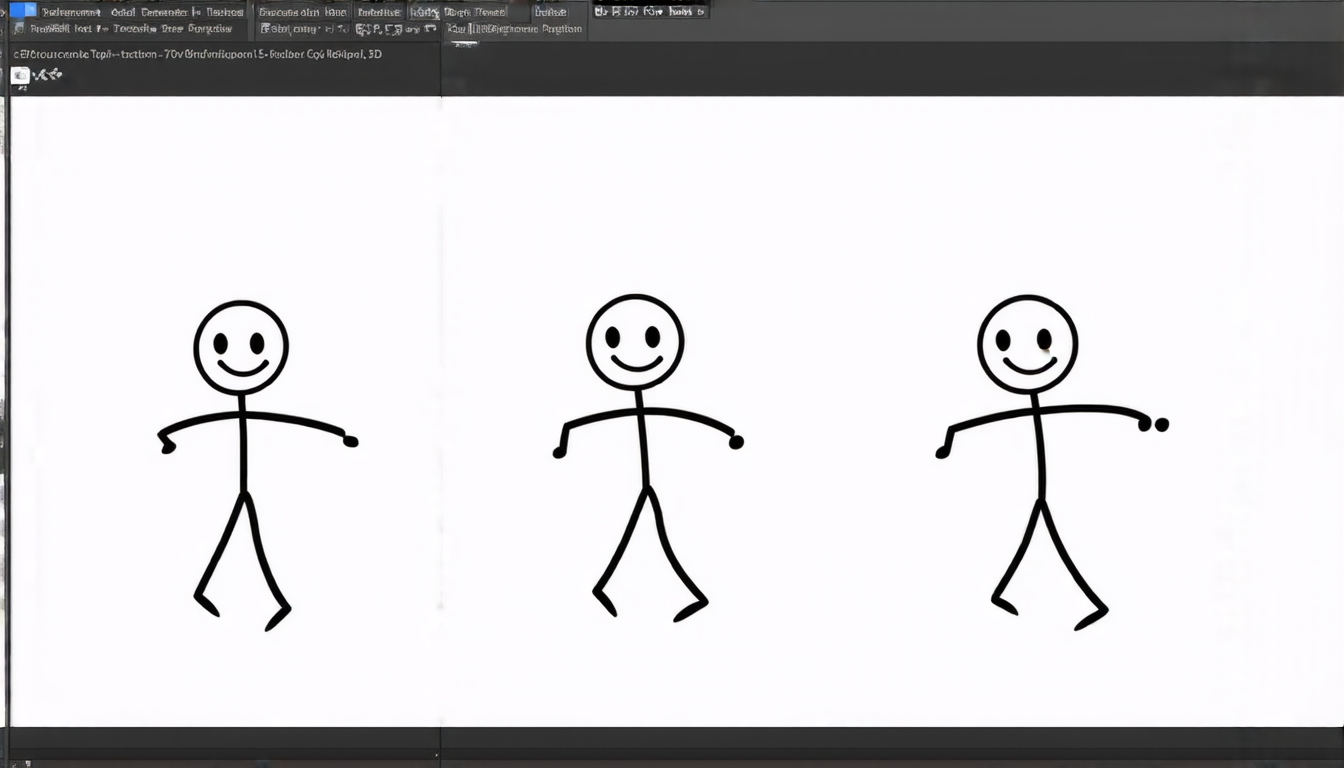
One such method, dubbed AnyMoLe, leverages video diffusion models to generate motion in-between frames for arbitrary characters without requiring external training data. This is a significant departure from existing solutions, which typically demand vast amounts of character-specific data or manual keyframing. By using pre-trained video diffusion models, AnyMoLe can produce realistic transitions between keyframes, effectively bypassing the need for extensive data collection.
To achieve this feat, the researchers developed a two-stage frame generation process. The first stage involves generating context frames from given keyframes, which provides the model with valuable contextual information about the character’s movement. This is followed by a second stage, where the diffusion model is fine-tuned to generate in-between frames that seamlessly bridge the gap between keyframes.
Another key innovation of AnyMoLe is its ability to adapt to different characters and motions without requiring extensive retraining or data collection. This is achieved through ICAdapt, a fine-tuning technique specifically designed for video diffusion models. By leveraging this technique, AnyMoLe can effectively learn the characteristics of a new character’s motion in just a few iterations.
The implications of AnyMoLe are far-reaching, particularly in industries where high-quality animation is essential, such as film and gaming. With the ability to generate realistic transitions between keyframes without the need for extensive data collection or manual adjustments, animators can focus on more creative tasks, such as developing storylines and character development.
Furthermore, AnyMoLe’s adaptability to different characters and motions opens up new possibilities for motion capture and animation pipelines. By leveraging pre-trained video diffusion models, studios can quickly generate high-quality animations for a wide range of characters and scenarios, reducing the time and cost associated with traditional data collection and keyframing methods.
While there are still challenges to be addressed in refining AnyMoLe’s performance, particularly in situations where rapid movements or complex dynamics occur, the potential benefits of this technology are undeniable. As researchers continue to push the boundaries of what is possible with video diffusion models, we can expect to see even more innovative applications of deep learning in computer graphics and animation.
Cite this article: “Revolutionizing Motion Synthesis: A Novel Approach to Character Animation using Video Diffusion Models”, The Science Archive, 2025.
Computer Graphics, Animation, Motion In-Betweening, Deep Learning, Video Diffusion Models, Anymole, Keyframes, Character Movements, Film, Gaming





